Study Guide
ASE B3 Study Guide: Non-Structural Analysis and Damage Repair
55 scored questions, 90 minutes, 6 content areas. Here is what to study and in what order.
ASE B3 at a Glance
The ASE B3 Non-Structural Analysis and Damage Repair test is one of five ASE collision repair and refinish certification tests. It has 55 scored questions plus 10 unscored research questions (65 in all), a 90-minute time limit, and is taken on a computer at a Prometric test center. Every question is multiple choice with four answers and one correct answer.
The scored questions are split across 6 content areas:
- Preparation: 7 questions
- Outer Body Panel Repairs, Replacements, and Adjustments: 17 questions
- Metal Finishing and Body Filling: 8 questions
- Glass and Hardware: 5 questions
- Welding, Cutting, and Removal: 12 questions
- Plastic Repair: 6 questions
Passing ASE B2, B3, B4 and B5 earns ASE Master Collision Repair and Refinish Technician status.
Certification is renewed every five years with a shorter recertification test. Check ase.com for current registration and fees. ASECollisionTestPrep.com is an independent study resource and is not affiliated with ASE.
Start Here
The ASE B3 Non-Structural Analysis and Damage Repair test is 55 scored questions in 90 minutes, and Outer Body Panel Repairs, Replacements, and Adjustments alone is 17 of them. Add Welding, Cutting, and Removal and you have more than half the test in two areas.
This guide walks the six content areas in weight order, names the task behind each question type, lists the terms the questions use, and ends with a 30-day plan.
Where the 55 scored questions come from
- A. Preparation713%
- B. Outer Body Panel Repairs, Replacements, and Adjustments1731%
- C. Metal Finishing and Body Filling815%
- D. Glass and Hardware59%
- E. Welding, Cutting, and Removal1222%
- F. Plastic Repair611%
Why technicians fail this test
- Treating panel replacement as one method: welded, weld-bonded, adhesively bonded and riveted panels each have their own OEM rules, and the question asks which applies.
- Welding questions that are really settings and tests: work clamp location, gun angle, weld-through primer, and the destructive test before the car.
- Skipping Preparation: scanning for codes, high-voltage disconnect, storing parts and protecting adjacent panels are seven questions most body techs do without thinking and miss without studying.

Written by Mr. Hernandez Collision Repair Instructor at Sheridan Technical College, five years teaching the ASE B-Series. About the instructor
A. Preparation
What to focus on
- Review the damage report, inspect for prior damage and repairs, research the OEM procedure and plan before any part comes off.
- Scan for diagnostic trouble codes and check the malfunction indicator lamp before repairs; perform the high-voltage disconnect procedure on hybrids and electric vehicles.
- Remove and store trim, panels and mechanical parts; protect adjacent panels; strip coatings only as far as the repair needs.
Trap: The answer that starts cutting or pulling before the scan and the research is always wrong.
All 14 official tasks in this area
- Review damage report and replacement parts for accuracy. Inspect for prior damage and repairs. Inspect for proper systems operation and/or deactivation. Verify coating thickness.
- Identify potential health, safety, and environmental concerns associated with vehicle components and systems, i.e. ABS, air bags (SRS), ADAS, refrigerants, high voltage, coolants.
- Research and determine repair plan, locate procedures; build data, materials, and methods of overall repairs in accordance with the vehicle manufacturer’s specifications and accepted industry procedures (including calibration/initialization of advanced vehicle systems).
- Position vehicle to perform repairs; lift, raise, or support if necessary.
- Remove damaged or undamaged interior and exterior trim and moldings/claddings as necessary; document missing, broken, or one-time use parts/fasteners/components; store removed parts/ fasteners/components.
- Remove and store undamaged, non-structural body panels and components; remove and store mechanical/electrical components that may interfere with or be damaged during the repair process.
- Check for malfunction indicator lamp (MIL) illumination; scan all control modules and retrieve diagnostic trouble codes (DTC), data, and settings; identify battery disconnect procedures.
- Protect panels and parts adjacent to repair area to prevent damage during repair.
- Remove dirt, grease, wax, and other contaminants from areas to be repaired.
- Remove pinstripes, emblems and decals (transfers/overlays and other paint protection accessories); remove adhesives if necessary.
- Remove corrosion protection, undercoatings, sealers, and other protective coatings as necessary to perform repairs.
- Remove repairable plastics and other parts for off-vehicle repair.
- Identify safety precautions: i.e., personal protection equipment (PPE), shock hazards, fumes, safety data sheet (SDS), etc. before beginning any repair operation.
- Perform high-voltage disconnect procedure; reconnect/enable high-voltage system after repairs are completed.
B. Outer Body Panel Repairs, Replacements, and Adjustments
What to focus on
- Direct, indirect and inertia damage, and how each one changes the repair plan.
- Hood, deck lid, door, bumper and fender removal, replacement and alignment: gaps, flush, latch and hinge adjustment in the order the OEM gives.
- Panel replacement by weld, weld-bond, adhesive and rivet, corrosion protection after, then seam sealers, foams, leaks and noise, and the final scan and calibration.
Trap: Alignment questions want the adjustment order (hinge, latch, striker) that the OEM procedure gives, not the one that looks fastest.
All 19 official tasks in this area
- Determine the extent of the direct (primary), indirect (secondary), and inertia damage; determine the direction of impact; plan the methods and order of repair.
- Remove and replace bolted, riveted, adhesively bonded, and welded panels or panel assemblies.
- Identify the body panel substrate (high-strength steel, aluminum, magnesium, composite, etc.); determine the extent of damage for reparability or replacement.
- Remove, reinstall or replace, and adjust/align hood, hood supports, hood hinges, and hood latch/lock.
- Remove, reinstall or replace, and adjust/align deck lid, lid hinges, tailgates, hatches, supports, liftgates supports, and lid latch/lock; perform initialization.
- Remove, reinstall or replace and adjust/align doors, latch/lock assemblies, handles, and hinges; perform initialization.
- Remove, reinstall or replace, and adjust/align bumpers, brackets, reinforcements, guards, absorbers, isolators, and mounting hardware.
- Remove, reinstall or replace and adjust/align front fenders; check and adjust gaps and clearances.
- Remove, reinstall or replace and adjust/align exterior lighting and mounting panels.
- Check outer body panel function, adjust as necessary for proper operation.
- Restore contours of a damaged panel to a surface condition suitable for metal finishing or body filling.
- Weld cracked or torn metal body panels.
- Apply protective coatings to restore corrosion protection.
- Remove damaged body panels; replace panels using a weld, weld-bond, adhesively bonded, rivet, rivet bond, or other fastening procedures.
- Repair door frame, repair or replace door skins; inspect intrusion beams.
- Restore seam sealers, mastic, sound deadeners, and foam fillers.
- Diagnose and repair water leaks, dust leaks, wind noise, squeaks, rattles, and vibrations.
- Install interior and exterior trim, pinstripes, emblems, decals (transfers/overlays, vapor barriers), and protective film.
- Perform initialization and calibration; test drive to achieve set conditions and scan computer systems as needed to verify proper system operation following outer body panel repair, replacement, or adjustment.
C. Metal Finishing and Body Filling
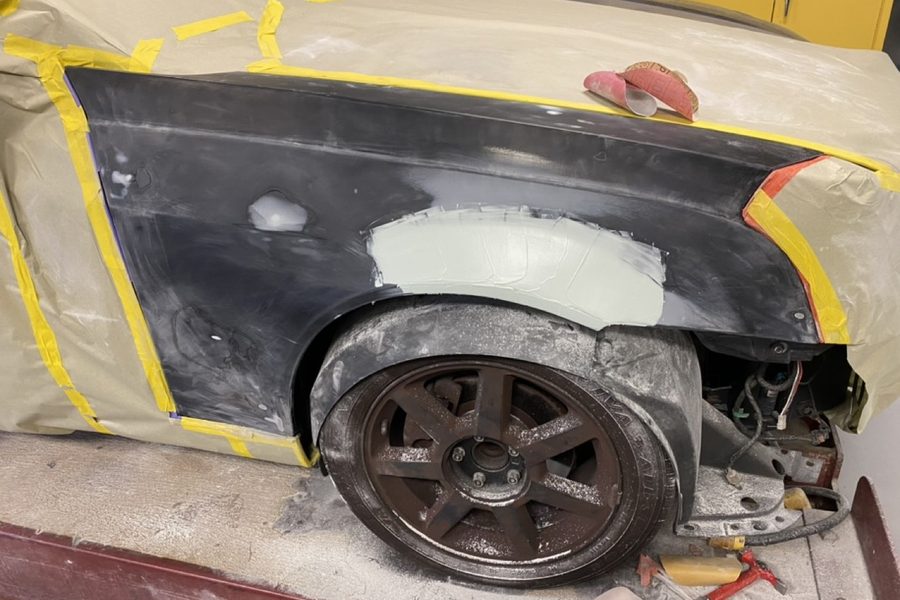
What to focus on
- Strip the damaged area, then heat-shrink or cold-shrink stretched metal to contour before any filler.
- Metal finishing to a surface that needs minimum filler; filler goes over clean, sanded bare metal or the primer the filler maker allows.
- Mix ratios, working time and sanding grits for filler, and why too much hardener fails later.
Trap: Filler over paint, over e-coat the filler maker does not list, or over a stretched panel that was never shrunk: the question describes it and asks why it failed.
All 7 official tasks in this area
- Remove paint and other coatings from the damaged area of a body panel.
- Heat-shrink stretched panel areas to proper contour.
- Cold-shrink stretched panel areas to proper contour
- Metal-finish the damaged area of a body panel to eliminate surface irregularities.
- Identify the considerations and procedures for preparing the surface for application of body filler material.
- Mix, apply, and shape body filler material.
- Sand cured body filler material to contour.
D. Glass and Hardware
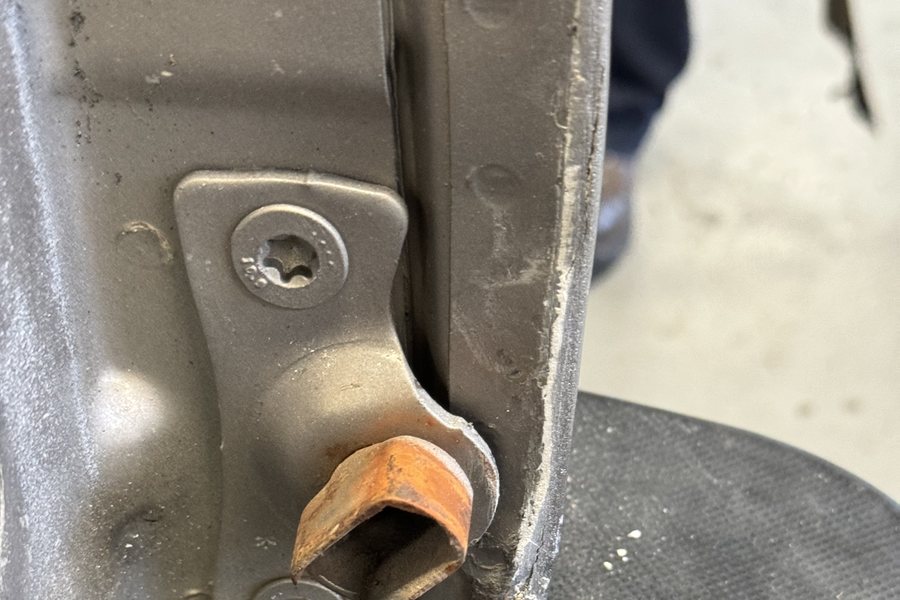
What to focus on
- Movable glass, regulators, run channels and power mechanisms: inspect, adjust, replace, and reset auto-up and pinch protection after.
- Power roof panels, convertible tops and their initialization procedures.
- Water, dust and wind-noise diagnosis, and the scan after stationary glass work.
Trap: After glass or roof work the question asks what is done last; the answer is the initialization or scan the OEM requires.
All 6 official tasks in this area
- Inspect, adjust, remove and/or replace moveable, electrically heated, stationary, mechanically fastened, bonded, and hinged glass.
- Inspect, adjust, repair, or replace window regulators, run channels, power mechanisms, and related controls. Reset automatic features and clear stored codes if necessary.
- Inspect, adjust, repair, and remove or replace power glass roof panels and related controls. Reset automatic features and clear stored codes if necessary.
- Diagnose and repair water leaks, dust leaks, wind noises; rattles, and vibrations; inspect, repair, or replace weatherstripping.
- Inspect, adjust, and install convertible or retractable roof and related mechanisms. Reset automatic features and clear stored codes if necessary.
- Scan computer systems and verify proper system operation following stationary glass removal or replacement.
E. Welding, Cutting, and Removal
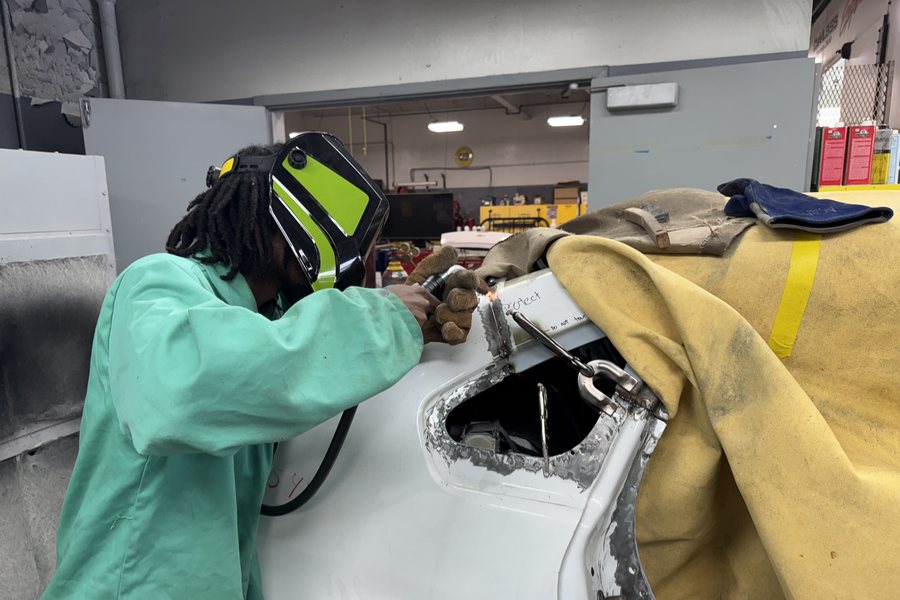
What to focus on
- Weldable and non-weldable materials, and which process (GMA, squeeze-type resistance spot welding, MIG brazing, rivet bonding) the OEM calls for.
- Setup and test welds: work clamp location, gun angle, distance, speed, weld-through primer, destructive test before welding on the car.
- Joint types (butt, butt with backing, lap, plug, slot) and when each is used; weld defects and their causes.
Trap: The test weld and the destructive test come before the first weld on the vehicle; any sequence that skips them is wrong.
All 13 official tasks in this area
- Identify weldable and non-weldable materials used in vehicle construction.
- Identify the considerations and procedures for cutting, removing, and welding various types of steels, aluminum, and other metals.
- Determine the correct welding process to be used in specific welding situations: compression/inverter/ squeeze type resistance spot (STRSW), GTAW (TIG), GMAW (MIG), MIG-brazing; determine settings, electrode, wire type, diameter, gas, and bonding material to be used in specific welding processes.
- Adjust the welding equipment for proper operation.
- Perform test welds. Visually inspect, perform destructive test, and make adjustments as necessary.
- Determine proper work clamp (ground) location.
- Use the proper gun-to-joint angle, distance, speed, and direction of gun travel for welds being made in all positions.
- Select proper STRSW arm set, electrode type and diameter, and settings based on the location and material to be welded.
- Protect vehicle components (adjacent components, hybrid/high voltage components, computers and other electronic modules) from possible damage caused by welding, cutting, and drilling; remove as necessary.
- Prepare the metal to be welded; ensure proper weld joint fit-up; apply weld through primer if required.
- Select and prepare the correct joint type (butt, lap, etc.) for the repair.
- Identify and perform the correct type of weld (continuous, stitch, tack, plug, spot, slot, etc.) for each specific welding operation.
- Identify the causes of weld defects; perform required equipment maintenance and/or make necessary adjustments.
F. Plastic Repair
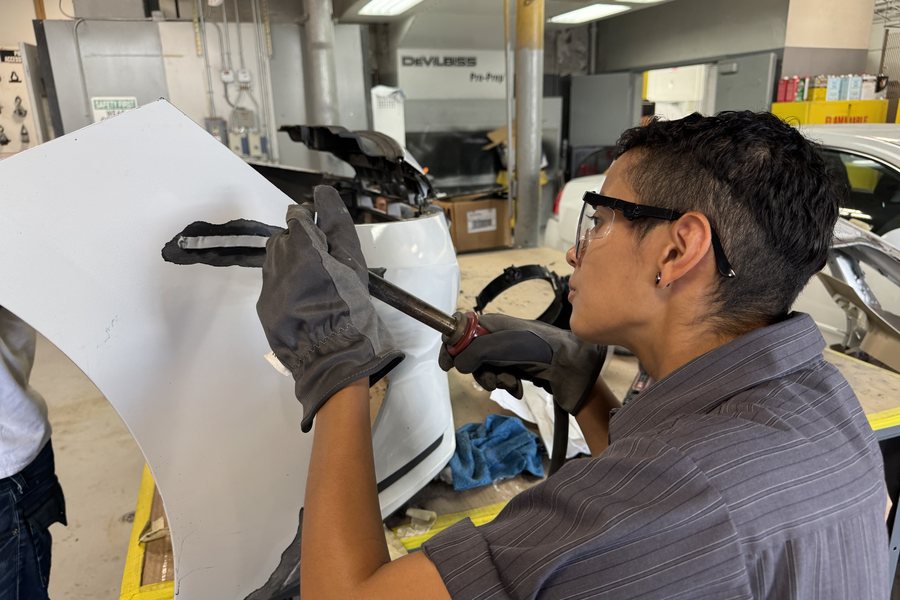
What to focus on
- Identify the plastic (ID symbol, flexibility, burn or float tests where allowed) and determine repairability.
- Clean, prepare and reshape; repair by welding or two-part adhesive; single-sided and two-sided repairs.
- Replace bonded and mechanically fastened plastic panels; straighten and align mounting points.
Trap: Adhesive and welding are not interchangeable; the plastic type and the OEM decide, and the question gives you the type.
All 7 official tasks in this area
- Identify the types of plastic(s) or composite(s); determine repairability.
- Identify the proper plastic or composite repair/cleaning procedures; clean and prepare the surfaces of plastic or composite parts for repair.
- Reshape plastic parts.
- Repair plastic parts by welding or using adhesive repair materials; repair composite parts using adhesive repair materials; use reinforcing materials as required.
- Perform single or two-sided repairs in plastic or composite panels.
- Replace bonded plastic or composite body panels; straighten or align mounting locations.
- Replace mechanically fastened plastic or composite body panels; straighten or align mounting locations if necessary; torque fasteners to specifications.
A 30-Day ASE B3 Study Plan
Diagnostic and Outer Body Panels
Take a full timed practice test. Then Outer Body Panel Repairs, Replacements, and Adjustments (31 percent): damage types, alignment procedures, replacement methods, corrosion protection, seam sealers, final scan.
Welding, Cutting, and Removal
22 percent of the test: processes by material, setup, test welds, joint types, weld defects. Add Metal Finishing and Body Filling.
Preparation, Plastic Repair, Glass and Hardware
The three smaller areas (33 percent together): scan and research first, high-voltage disconnect, plastic ID and repair, glass and roof initialization.
Review and timed tests
Two full timed practice tests on different days; review every miss against the task list. Stop new material 48 hours before the test.
Key Terms to Know
577 more in the ASE B3 glossary, each with a plain-words definition.
ASE B3 Study Guide FAQ
- How long should I study for the ASE B3?
- Four weeks at an hour a day for a working body technician. Outer Body Panels and Welding carry 29 of the 55 scored questions, so the plan spends the first two weeks there.
- What should I study first for the ASE B3?
- Outer Body Panel Repairs, Replacements, and Adjustments: 17 of 55 scored questions, and the replacement methods (weld, weld-bond, adhesive, rivet) come up again in the welding area.
- Is there a separate ASE B3 study guide article?
- Yes, the long-form ASE B3 Complete Study Guide on the blog carries a nine-week plan and the 100 terms list; this page is the condensed, task-list-first version.
- Where can I practice ASE B3 questions free?
- The free ASE B3 practice test on this site has 20 questions written in the ASE style with the answer and the reason, no sign-up.
More on the ASE B3 Test
- How to Pass the ASE B3 Non-Structural Analysis & Damage Repair Test
- What Is ASE Collision Repair Certification? The Five Tests, Which One to Take First, and What Master Status Means
- What Tesla Requires for Rivets and Structural Adhesive, and Why Ford, GM and Stellantis Answer It Differently
- How to Repair a Plastic Bumper Cover: Welding vs Adhesive (ASE B3 Prep)
- Bare Steel Restoration: Body Filler vs Epoxy Primer (ASE B2 and B3 Prep)
- ASE B3 Certification: Complete Study Guide (2026)
Next Steps
ASE®, the ASE logo, and "ASE Certified" are registered trademarks of the National Institute for Automotive Service Excellence. This site is an independent study resource and is not affiliated with, endorsed by, or sponsored by ASE. Content areas, question counts and pass requirements follow ASE's published test specifications.