For high school collision students
Earn Your First ASE Patch Before You Graduate
Practice the ASE Entry-Level collision tests on your phone, with the same question count, the same clock and the same pass mark as the real one.
- No work experience needed
- No sign-up to try
- $49 for 90 days

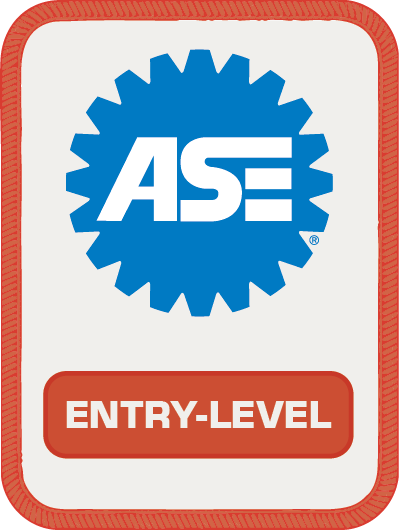
What You Earn When You Pass
The real ASE Entry-Level test is taken at your school, with a proctor. Pass it and this is yours.
Your certificate lists each test you pass
- Painting and Refinishing
- Non-Structural Analysis and Damage Repair (Body Components)
- Structural Analysis and Damage Repair
- Mechanical and Electrical Components
- Collision Repair and Refinish Fundamentals
An ASE Certificate
An ASE Entry-Level certificate with your name on it, listing each test you passed. It goes straight on your resume.
See ASE's sample certificateGood for Two Years
The credential is valid for two years from the day you pass. It does not renew: your next step is the ASE professional tests once you have the work experience.
The Uniform Patch
Schools can hand out the ASE Entry-Level patch to students who pass. Ask your instructor if yours does.
Source: ASE Education Foundation
Watch Yourself Get Ready
Every practice test updates your pass chance and shows the content areas you still need to work on. It runs in your phone's browser, nothing to download.

Try 5 Free ASE Entry-Level Questions · 5 questions
Five questions from our ASE Entry-Level Painting and Refinishing practice test. Pick an answer, then Check Answer to see why. No sign-up.
Practice Test Complete!
The full ASE Entry-Level practice tests have the real question count, a 60-minute clock and the real pass mark, with every answer explained.
Get the Full Practice TestStudents Doing the Real Work
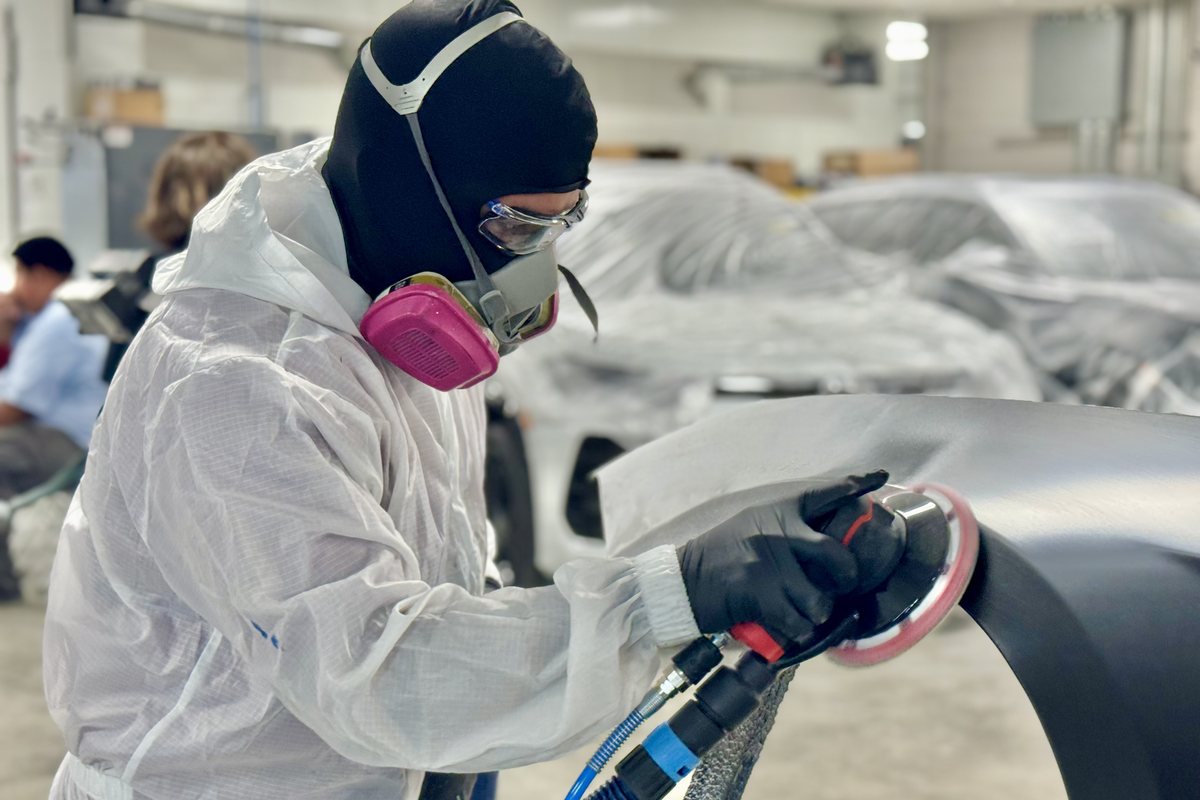
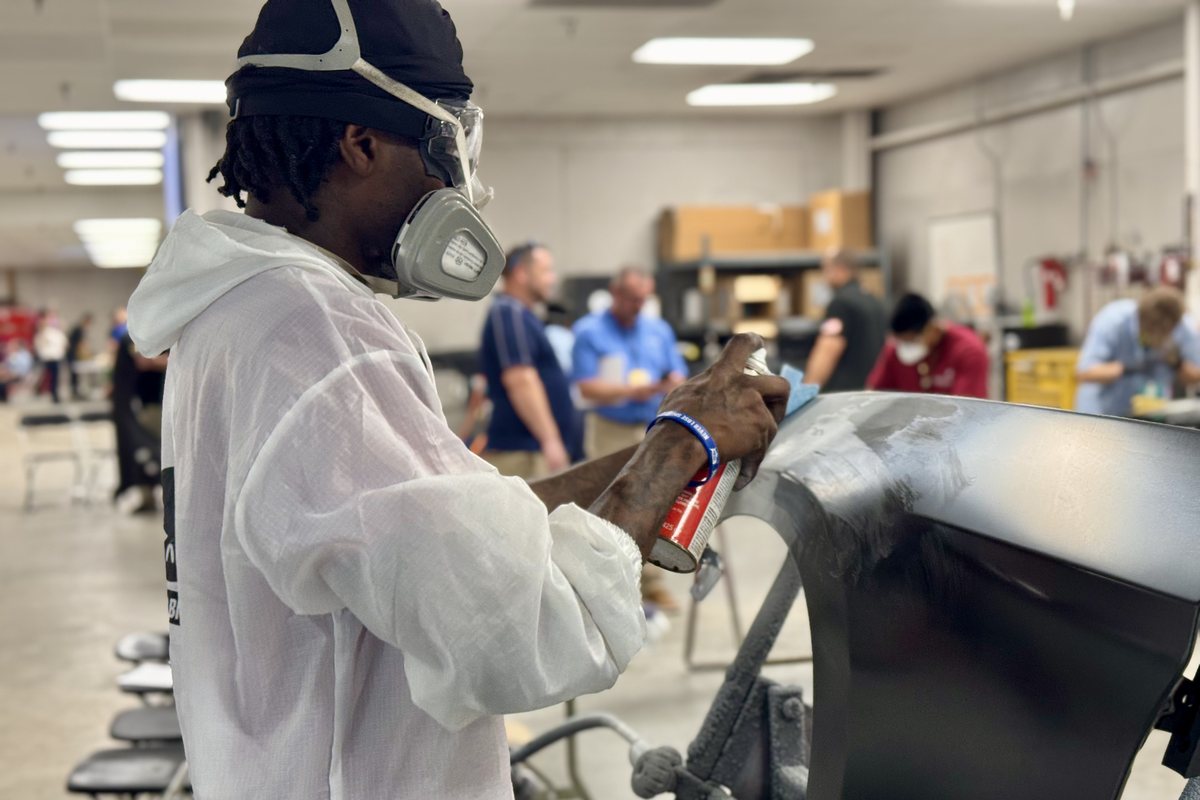
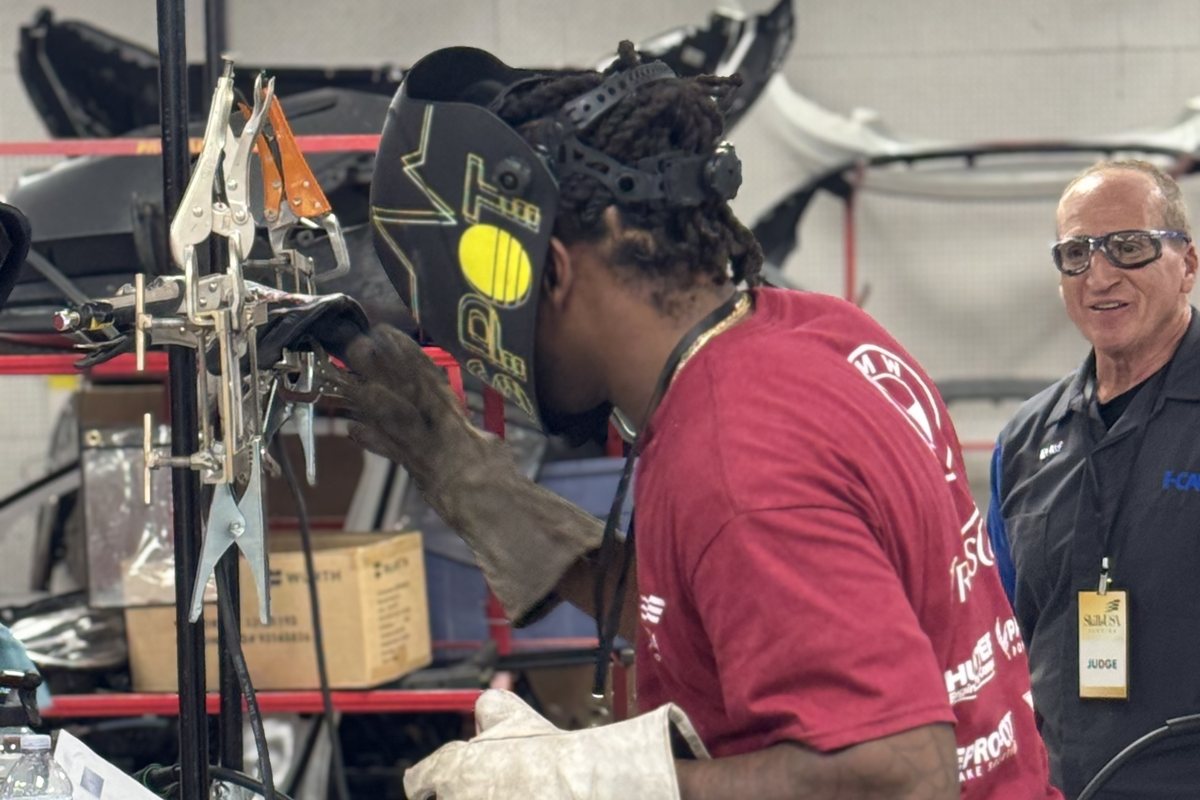
Students at the SkillsUSA Florida state collision contest. Every one of them started where you are now.
Get Started in 3 Steps
Billed once. Nothing renews on its own.
1 Pick the test you are taking
2 What you get
- Full practice tests with the real question count, time limit and pass mark
- Every answer explained, right and wrong
- 20-question drills on any one content area
- Your scores and best score saved on your dashboard
3 Check out
You will sign in or make a free account first, then pay securely with Stripe. Your 90 days start the day you buy.
The Five Entry-Level Collision Tests
Buy one test at a time. Each one is $49 for 90 days, starting the day you buy it.
Painting and Refinishing
40 questions · 60 minutes · pass with 23 of 40
The 6 content areas
- A. Safety Precautions (7 questions)
- B. Surface Preparation (8 questions)
- C. Spray Gun and Related Equipment Operation (5 questions)
- D. Paint Mixing, Matching, and Applying (9 questions)
- E. Paint Defects - Causes and Cures (7 questions)
- F. Final Detail (4 questions)
$49 90 days
Non-Structural Analysis and Damage Repair
40 questions · 60 minutes · pass with 22 of 40
The 6 content areas
- A. Preparation (8 questions)
- B. Outer Body Panel Repairs, Replacements, and Adjustments (9 questions)
- C. Metal Finishing and Body Filling (8 questions)
- D. Moveable Glass and Hardware (3 questions)
- E. Metal Welding, Cutting, and Joining (8 questions)
- F. Plastics, Adhesives, and Welding (4 questions)
$49 90 days
Structural Analysis and Damage Repair
40 questions · 60 minutes · pass with 22 of 40
The 4 content areas
- A. Frame Inspection and Repair (10 questions)
- B. Unibody and Unitized Structure Inspection, Measurement, and Repair (14 questions)
- C. Stationary Glass (2 questions)
- D. Metal Welding, Cutting, and Joining (14 questions)
$49 90 days
Mechanical and Electrical Components
40 questions · 60 minutes · pass with 22 of 40
The 8 content areas
- A. Suspension and Steering (9 questions)
- B. Electrical (8 questions)
- C. Brakes (3 questions)
- D. Heating and Air Conditioning (5 questions)
- E. Cooling Systems (4 questions)
- F. Drive Train (3 questions)
- G. Fuel, Intake and Exhaust Systems (2 questions)
- H. Restraint Systems (6 questions)
$49 90 days
Collision Repair and Refinish Fundamentals
60 questions · 60 minutes · pass with 36 of 60
The 13 content areas
- A. Damage Analysis and Estimating: Damage Analysis (4 questions)
- B. Damage Analysis and Estimating: Estimating (3 questions)
- C. Damage Analysis and Estimating: Vehicle Construction and Parts Identification (4 questions)
- D. Refinishing: Safety Precautions and Regulations (4 questions)
- E. Refinishing: Surface Preparation (11 questions)
- F. Refinishing: Spray Gun and Related Equipment Operation (2 questions)
- G. Non-Structural Repair: Preparation (5 questions)
- H. Non-Structural Repair: Outer Body Panels (7 questions)
- I. Non-Structural Repair: Metal Finishing and Body Filling (7 questions)
- J. Non-Structural Repair: Moveable Glass and Hardware (2 questions)
- K. Non-Structural Repair: Plastics, Adhesives, and Welding (5 questions)
- L. Mechanical and Electrical Components (3 questions)
- M. Workplace, Personal, and High Voltage Safety (3 questions)
$49 90 days
A school license covers both the entry-level tests and the ASE B2 to B6 professional tests for its term.
What Is on Each Test
Every task ASE lists for the entry-level collision tests. Tap a test to see its list.
Painting and Refinishing · 6 content areas
ASafety Precautions7 questions · 5 tasks
- Select and use the proper personal safety equipment for surface preparation, spray gun and related equipment operation, paint mixing, matching and application, paint defects, and detailing (gloves, suits, hoods, eye, and ear protection, etc.); take necessary precautions with hazardous operations and materials according to federal, state, and local regulations.
- Identify safety and personal health hazards according to OSHA guidelines and the Right to Know law.
- Inspect spray environment and equipment to ensure compliance with federal, state, and local regulations, and for safety and cleanliness hazards.
- Select and use a NIOSH approved supplied air (Fresh Air Make-up) respirator system. Perform proper maintenance in accordance with OSHA Regulation 1910.134 and applicable state and local regulation.
- Perform vehicle clean-up; complete quality control using a checklist on operations performed.
BSurface Preparation8 questions · 28 tasks
- Inspect, remove, store, protect, and replace exterior trim and components necessary for proper surface preparation.
- Soap and water wash entire vehicle; use appropriate cleaner to remove contaminants.
- Inspect and identify type of finish, surface condition, and film thickness; develop and document a plan for refinishing using a total product system.
- Remove paint finish as needed.
- Properly sand areas to be refinished.
- Identify and select appropriate sandpaper to featheredge areas to be refinished.
- Apply suitable metal treatment or primer in accordance with total product systems.
- Mask and protect other areas that will not be refinished.
- Demonstrate different masking techniques (recess/back masking, foam door type, etc.).
- Mix primer, primer-surfacer and primer-sealer following paint manufacturers technical data sheet instructions
- Identify a complimentary color or shade of undercoat to improve coverage.
- Apply primer onto surface of repaired area; demonstrating control of primer application by keeping the areas small as possible.
- Apply two-component finishing filler to minor surface imperfections.
- Guide coat and block sand area with correct grade/grit sandpaper to which primer-surfacer has been applied.
- Dry sand area to which two-component finishing filler has been applied.
- Remove dust from area to be refinished, including cracks or moldings of adjacent areas.
- Clean area to be refinished using a recommended final cleaning solution.
- Remove, with a tack rag, any dust or lint particles from the area to be refinished.
- Apply suitable primer sealer to the area being refinished.
- Scuff sand to remove nibs or imperfections from a sealer.
- Apply stone chip resistant coating.
- Restore caulking and seam sealers to repaired areas and replacement panels as required.
- Prepare adjacent panels for blending using paint manufacturers procedures.
- Identify the types of rigid, semi-rigid or flexible plastic parts to be refinished; determine the materials needed, preparation, and refinishing procedures.
- Identify metal parts to be refinished; determine the materials needed, preparation, and refinishing procedures.
- Identify chip resistant coatings and texture match.
- Identify caulking and seal sealers that may need replacement.
- Identify refinishing guidelines for stationary glass flange areas to be refinished.
CSpray Gun and Related Equipment Operation5 questions · 4 tasks
- Inspect, clean, and determine condition of spray guns and related equipment (air hoses, regulators, air lines, air source, spray environment, and fillers).
- Select spray gun setup (fluid needle, nozzle, and cap) for product being applied.
- Test and adjust spray gun using fluid, air, and pattern control valves.
- Demonstrate an understanding of the operation of pressure spray equipment.
DPaint Mixing, Matching, and Applying9 questions · 16 tasks
- Identify color code by manufacturer’s vehicle information label.
- Shake, stir, reduce, catalyze/activate, and strain refinish materials.
- Apply finish using appropriate spray techniques (gun arc, angle, distance, travel speed, and spray pattern overlap) for the finish being applied.
- Apply selected product on test or let-down panel; check for color match, properly store and maintain a color catalog.
- Understand the application of single stage topcoats.
- Apply basecoat/clearcoat for panel blending, panel refinishing. and cut-in’s.
- Apply basecoat/clearcoat for overall refinishing.
- Remove nibs or imperfections from basecoat.
- Identify product expiration dates as applicable.
- Refinish plastic parts.
- Apply multi-stage coats for panel blending and overall refinishing.
- Identify and mix paint using a formula.
- Identify poor hiding colors; determine necessary action.
- Tint color using formula to achieve a blendable match.
- Identify alternative color formula to achieve a blendable match.
- Identify the materials, equipment, and preparation differences between solvent and waterborne technologies.
EPaint Defects - Causes and Cures7 questions · 27 tasks
- Identify blistering (raising of the paint surface, air entrapment); correct the cause(s) and the condition.
- Identify a dry spray appearance in the paint surface; correct the cause(s) and the condition.
- Identify the presence of fish-eyes (crater-like openings) in the finish; correct the cause(s) and the condition.
- Identify lifting; correct the cause(s) and the condition.
- Identify clouding (mottling and streaking in metallic finishes); correct the cause(s) and the condition.
- Identify orange peel; correct the cause(s) and the condition.
- Identify overspray; correct the cause(s) and the condition.
- Identify solvent popping in freshly painted surface; correct the cause(s) and the condition.
- Identify sags and runs in paint surface; correct the cause(s) and the condition.
- Identify sanding marks or sandscratch swelling; correct the cause(s) and the condition.
- Identify contour mapping/edge mapping; correct the cause(s) and the condition.
- Identify color difference (off-shade); correct the cause(s) and the condition.
- Identify tape tracking; correct the cause(s) and the condition.
- Identify low gloss condition; correct the cause(s) and the condition.
- Identify poor adhesion; correct the cause(s) and the condition.
- Identify paint cracking (shrinking, splitting, crowsfeet or line-checking, micro-checking, etc.); correct the cause(s) and the condition.
- Identify corrosion; correct the cause(s) and the condition.
- Identify dirt or dust in the paint surface; correct the cause(s) and the condition.
- Identify water spotting; correct the cause(s) and the condition.
- Identify finish damage caused by bird droppings, tree sap, and other natural causes; correct the condition.
- Identify finish damage caused by airborne contaminants (acids, soot, rail dust, and other industrial-related causes); correct the condition.
- Identify die-back conditions (dulling of the paint film showing haziness); correct the cause(s) and the condition.
- Identify chalking (oxidation); correct the cause(s) and the condition.
- Identify bleed-through (staining); correct the cause(s) and the condition.
- Identify pin-holing; correct the cause(s) and the condition.
- Identify buffing-related imperfections (swirl marks, wheel burns); correct the condition.
- Identify pigment flotation (color change through film build); correct the cause(s) and the condition.
FFinal Detail4 questions · 9 tasks
- Apply decals, transfers, tapes, stone guards, moldings, and emblems, etc.
- Sand, buff and polish fresh finish to remove defects and texture as required.
- Sand, buff and polish existing finish to recondition defects as required, match existing finish.
- Clean interior, exterior, and glass.
- Clean body openings (door jambs, gaps, and edges, etc.).
- Remove overspray.
- Perform vehicle clean-up; complete quality control using a checklist.
- Measure and record film thickness before and after buffing.
- Perform nib sanding to remove small imperfections as required.
Non-Structural Analysis and Damage Repair · 6 content areas
APreparation8 questions · 10 tasks
- Review damage report and analyze damage to determine appropriate methods for overall repair; develop and document a repair plan.
- Inspect, remove, protect, label, store, inventory, and reinstall exterior trim and moldings.
- Inspect, remove, protect, label, store, inventory, and reinstall interior trim and components.
- Inspect, remove, protect, label, store, inventory, and reinstall body panels and components that may interfere with or be damaged during repair.
- Inspect, remove, protect label, store, inventory, and reinstall vehicle mechanical and electrical components that may interfere with or be damaged during repair.
- Protect panels, glass, interior parts, and other vehicles adjacent to the repair area.
- Soap and water wash entire vehicle; complete pre-repair inspection checklist.
- Prepare damaged area using water-based and solvent-based cleaners.
- Remove corrosion protection, undercoating, sealers, and other protective coatings as necessary to perform repairs.
- Inspect, remove, and reinstall repairable plastics and other components for off-vehicle repair.
BOuter Body Panel Repairs, Replacements, and Adjustments9 questions · 17 tasks
- Inspect/locate direct, indirect, or hidden damage and direction of impact.
- Inspect, remove and replace welded steel panel or panel assemblies.
- Determine the extent of damage to aluminum body panels; repair or replace.
- Inspect, remove, replace, and align hood, hood hinges, and hood latch.
- Inspect, remove, replace, and align deck lid, lid hinges, and lid latch.
- Inspect, remove, replace, and align doors, latches, hinges, and related hardware.
- Inspect, remove, replace, and align tailgates, hatches, liftgates and sliding doors.
- Inspect, remove, replace, overhaul, and align bumpers, covers, reinforcements, guards, impact absorbers, and mounting hardware.
- Inspect, remove, replace and align fenders, and related panels.
- Restore corrosion protection during and after the repair.
- Replace door skins.
- Restore sound deadeners and foam materials.
- Perform panel bonding and weld bonding.
- Diagnose and repair water leaks, dust leaks, and wind noise.
- Identify one-time use fasteners.
- Weld damaged or torn steel body panels; repair broken welds.
- Inspect, identify labels/decals and replace as necessary.
CMetal Finishing and Body Filling8 questions · 12 tasks
- Prepare a panel for body filler by abrading or removing the coatings; featheredge, refine scratches, and clean the surface before the application of body filler.
- Locate and repair surface irregularities and straighten contours on a damaged body panel using power tools, hand tools, and weld-on pulling attachments.
- Demonstrate hammer and dolly techniques.
- Heat shrink stretched panel areas to proper contour.
- Cold shrink stretched panel areas to proper contour.
- Identify body filler defects; correct the cause and condition. (Pinholing, ghosting, staining, over catalyzing, etc.)
- Identify different types of body fillers.
- Shape body filler to contour; finish sand.
- Perform proper metal finishing techniques for aluminum.
- Perform proper application of body filler to aluminum.
- Locate and repair surface irregularities and straighten contours on a damaged panel using Glue-Pulling Dent Repair (GPDR).
- Mix and apply body filler.
DMoveable Glass and Hardware3 questions · 5 tasks
- Inspect, adjust, overhaul, repair or replace window regulators, run channels, glass, power mechanisms, and related controls.
- Inspect, adjust, repair, remove, reinstall, or replace weather-stripping.
- Inspect, remove, repair or replace, and adjust removable power operated roof panel and hinges, latches, guides, handles, retainer, and controls of sunroofs.
- Inspect, remove, reinstall, and align convertible top and related mechanisms.
- Identify or recalibrate electrical components that may need to be initialized.
EMetal Welding, Cutting, and Joining8 questions · 17 tasks
- Identify the considerations for cutting, removing, and welding various types of steel, aluminum, and other metals.
- Determine the correct GMAW welder type, electrode/wire type, diameter, and gas to be used in a specific welding situation.
- Set up, attach work clamp (ground), and adjust the GMAW welder to "tune" for proper electrode stickout, voltage, polarity, flow rate, and wire-feed speed required for the substrate being welded.
- Store, handle, and install high-pressure gas cylinders; test for leaks.
- Determine the proper angle of the gun to the joint and direction of gun travel for the type of weld being made.
- Protect adjacent panels, glass, vehicle interior, etc., from welding and cutting operations.
- Identify hazards; foam coatings and flammable materials prior to welding/cutting procedures.
- Protect computers and other electronics/wires prior to welding procedures.
- Clean and prepare the metal to be welded, assure good metal fit-up, apply weld-through primer if necessary, clamp or tack as required.
- Determine the joint type (butt weld with backing, lap, etc.) for weld being made.
- Determine the type of weld (continuous, stitch weld, plug, etc.) for each specific welding operation.
- Perform the following welds: plug, butt weld with and without backing, and fillet, etc., in the flat, horizontal, vertical, and overhead positions.
- Perform visual evaluation and destructive test on each weld type.
- Identify the causes of various welding defects; make necessary adjustments.
- Identify cause of contact tip burn-back and failure of wire to feed; make necessary adjustments.
- Identify cutting process for different substrates and locations; perform cutting operation.
- Identify different methods of attaching structural components (squeeze type resistance spot welding (STRSW), riveting, structural adhesive, MIG bronze, rivet bonding, weld bonding, etc.).
FPlastics, Adhesives, and Welding4 questions · 10 tasks
- Identify the types of plastics; determine repairability.
- Clean and prepare the surface of plastic parts; identify the types of plastic repair procedures.
- Repair rigid, semi-rigid, and flexible plastic panels.
- Remove, replace, or repair damaged areas of rigid exterior composite panels.
- Replace bonded rigid exterior composite body panels; straighten or align panel supports.
- Repair plastic parts by welding (nitrogen, airless).
- Perform a single-sided adhesively bonded cosmetic repair.
- Perform a double-sided adhesively bonded repair.
- Perform an adhesively bonded or welded tab repair.
- Shape and reform damaged plastic.
Structural Analysis and Damage Repair · 4 content areas
AFrame Inspection and Repair10 questions · 16 tasks
- Measure and diagnose structural damage using a metric tape measure and a tram gauge.
- Properly install vehicle on to a frame bench/rack.
- Analyze, straighten and align mash (collapse) damage.
- Analyze, straighten and align sag damage.
- Analyze, straighten and align side sway damage.
- Analyze, straighten and align twist damage.
- Analyze, straighten and align diamond frame damage.
- Remove and replace damaged structural components.
- Remove and replace protective coatings; restore corrosion protection to repaired or replaced frame areas and anchoring locations.
- Analyze and identify misaligned or damaged steering, suspension, and powertrain mounting points and components.
- Align or replace misaligned or damaged steering, suspension, and powertrain mounting points and components.
- Identify heat limitations and monitoring procedures for structural components.
- Demonstrate an understanding of structural foam applications.
- Measure and diagnose structural damage using a three-dimensional measuring system (mechanical, electronic, laser), etc.
- Determine the extent of the direct and indirect damage and the direction of impact; document the methods and sequence of repair.
- Analyze and identify crush/collapse zones.
BUnibody and Unitized Structure Inspection, Measurement, and Repair14 questions · 18 tasks
- Analyze and identify misaligned or damaged steering, suspension, and powertrain mounting points that can cause vibration, steering, and chassis alignment problems.
- Align or replace misaligned or damaged steering, suspension, and powertrain mounting points that can cause vibration, steering and chassis alignment problems.
- Measure and diagnose unibody damage using a metric tape measure and tram gauge.
- Measure and diagnose unibody vehicles using a dedicated (fixture) measuring system.
- Diagnose and measure unibody vehicles using a three-dimensional measuring system (mechanical, electronic, and laser, etc.).
- Determine the extent of the direct and indirect damage and the direction of impact; plan and document the methods and sequence of repair.
- Attach anchoring devices to vehicle; remove or reposition components as necessary.
- Straighten and align roof rails/headers and roof panels.
- Straighten and align rocker panels and pillars.
- Straighten and align vehicle openings and floor pans.
- Straighten and align quarter panels, wheelhouse assemblies, and rear body sections (including rails and suspension/powertrain mounting points).
- Straighten and align front-end sections (aprons, strut towers, upper and lower rails, steering, and suspension/power train mounting points, etc.).
- Determine structural repair component or replacement recommendations.
- Identify proper cold stress relief methods.
- Determine sectioning procedures of a steel body structure.
- Remove and replace damaged structural components.
- Determine the extent of damage to aluminum structural components; repair, weld, or replace.
- Analyze and identify crush/collapse zones.
CStationary Glass2 questions · 4 tasks
- Identify considerations for removal, handling, one time use parts, and installation of advanced glass systems (comfort and safety features).
- Remove and reinstall or replace modular glass using recommended materials.
- Check for water leaks, dust leaks, and wind noise.
- Identify considerations for pre-scan, post-scan, and recalibration procedures.
DMetal Welding, Cutting, and Joining14 questions · 17 tasks
- Identify the considerations for cutting, removing, and welding various types of steel, aluminum, and other metals.
- Determine the correct GMAW welder type, electrode/wire type, diameter, and gas to be used in a specific welding situation.
- Set up, attach work clamp (ground), and adjust the GMAW welder to "tune" for proper electrode stickout, voltage, polarity, flow rate, and wire-feed speed required for the substrate being welded.
- Store, handle, and install high-pressure gas cylinders; test for leaks.
- Determine the proper angle of the gun to the joint and direction of gun travel for the type of weld being made.
- Protect adjacent panels, glass, vehicle interior, etc., from welding and cutting operations.
- Identify hazards; foam coatings and flammable materials prior to welding/cutting procedures.
- Protect computers and other electronics/wires prior to welding procedures.
- Clean and prepare the metal to be welded, assure good metal fit-up, apply weld-through primer if necessary, clamp or tack as required.
- Determine the joint type (butt weld with backing, lap, etc.) for weld being made.
- Determine the type of weld (continuous, stitch weld, plug, etc.) for each specific welding operation.
- Perform the following welds: plug, butt weld with and without backing, and fillet, etc., in the flat, horizontal, vertical, and overhead positions.
- Perform visual evaluation and destructive test on each weld type.
- Identify the causes of various welding defects; make necessary adjustments.
- Identify cause of contact tip burn-back and failure of wire to feed; make necessary adjustments.
- Identify cutting process for different substrates and locations; perform cutting operation.
- Identify different methods of attaching structural components (squeeze type resistance spot welding (STRSW), riveting, structural adhesive, MIG bronze, rivet bonding, weld bonding, etc.).
Mechanical and Electrical Components · 8 content areas
ASuspension and Steering9 questions · 32 tasks
- Perform visual inspection and measuring checks to identify steering and suspension collision damage.
- Identify one-time use fasteners.
- Clean, inspect, and prepare reusable fasteners.
- Remove, replace, inspect or adjust power steering pump, pulleys, belts, hoses, fittings and pump mounts.
- Remove and replace power steering gear (non-rack and pinion type).
- Inspect, remove, and replace power rack and pinion steering gear and related components.
- Inspect and replace parallelogram steering linkage components.
- Inspect, remove and replace upper and lower control arms and related components.
- Inspect, remove and replace steering knuckle/spindle/hub assemblies (including bearings, races, seals, etc.).
- Inspect, remove and replace front suspension system coil springs and spring insulators (silencers).
- Inspect, remove, replace, and adjust suspension system torsion bars, and mounts.
- Inspect, remove and replace stabilizer bar bushings, brackets, and links.
- Inspect, remove and replace MacPherson strut or assembly, upper bearing, and mount.
- Inspect, remove, and replace rear suspension system transverse links, control arms, stabilizer bars, bushings, and mounts.
- Inspect, remove, and replace suspension system leaf spring(s and related components.
- Inspect axle assembly for damage and misalignment.
- Inspect, remove and replace shock absorbers.
- Diagnose, inspect, adjust, repair or replace active suspension systems and associated lines and fittings.
- Measure vehicle ride height and wheel base according to manufacturers specifications..
- Inspect, remove, replace, and align front and rear frame (cradles/subframe).
- Diagnose and inspect steering wheel, steering column, and components.
- Verify proper operation of steering systems including electronically controlled, hydraulic and electronically assisted steering systems.
- Diagnose front and rear suspension system noises and body sway problems; determine necessary action.
- Diagnose vehicle wandering, pulling, hard steering, bump steer, memory steering, torque steering, and steering return problems; determine necessary action.
- Demonstrate an understanding of wheel suspension and steering alignments (caster, camber, toe, SAI etc.).
- Inspect tires; identify tire wear patterns, direction of rotation and location; check tire size, identify nitrogen or air, check tire pressure monitoring system (TPMS) and adjust air pressure.
- Diagnose wheel/tire vibration, shimmy, tire pull (lead), wheel hop problems; determine needed repairs.
- Measure wheel, tire, axle, and hub runout; determine needed repairs.
- Reinstall wheels and torque lug nuts.
- Perform initialization or calibration procedures following suspension and/or steering system repairs.
- Perform a tire pressure monitoring system (TPMS) recalibration.
- Lift the vehicle for inspection, service, and repair by properly raising and supporting the vehicle.
BElectrical8 questions · 25 tasks
- Demonstrate an understanding of Ohm’s Law.
- Check for available voltage, voltage drop and current, and resistance in electrical wiring circuits and components with a DMM (digital multimeter).
- Repair wiring and connectors.
- Inspect, test, and replace fusible links, circuit breakers, and fuses.
- Perform battery state-of-charge test and slow/fast battery charge.
- Inspect, clean, repair or replace battery, battery cables, connectors and clamps.
- Dispose/recycle batteries according to local, state, and federal requirements.
- Identify programmable electrical/electronic components and check for malfunction indicator lamp (MIL) and fault codes; record data for reprogramming before disconnecting battery.
- Inspect alignment, adjust, remove and replace alternator (generator), drive belts, pulleys, and fans.
- Check operation and aim headlamp assemblies and fog/driving lamps; determine needed repairs.
- Inspect, test, and repair or replace bulbs, sockets, connectors, and ground wires of interior and exterior light circuits.
- Remove and replace horn(s); check operation.
- Check operation of wiper/washer systems; determine needed repairs.
- Check operation of power side and tailgate window; determine needed repairs.
- Check operation of motorized sliding doors, lift gates tailgates, running boards, etc.; determine needed repairs.
- Inspect, remove and replace power seat, motors, linkages, cables, etc.
- Inspect, remove and replace components of electric door and hatch/trunk lock.
- Inspect, remove and replace components of keyless lock/unlock devices and alarm systems.
- Inspect, remove and replace components of electrical sunroof and convertible/retractable hard top.
- Check operation of electrically heated mirrors, windshields, back lights, panels, etc.; determine needed repairs.
- Demonstrate self-grounding procedures (anti-static) for handling electronic components.
- Check for module communication errors using a scan tool.
- Use wiring diagrams, component location, and diagnostic flow charts during diagnosis of electrical circuit problems.
- Identify safe disabling techniques of high voltage systems on hybrid/electric vehicles.
- Identify potential safety and material handling concerns associated with high voltage hybrid/electric vehicle battery systems.
CBrakes3 questions · 11 tasks
- Inspect brake lines, hoses, and fittings for damage or wear; tighten fittings and supports; replace brake lines (double flare and ISO types).
- Replace hoses, fittings, seals, and supports.
- Identify, handle, store, and fill with appropriate brake fluids.
- Bleed (manual, pressure, or vacuum) hydraulic brake system.
- Pressure test brake hydraulic system; determine necessary action.
- Adjust brake shoes or pads; remove and reinstall brake drums or drum/hub assemblies.
- Remove, clean and inspect caliper and rotor assembly and mountings for wear and damage; reinstall.
- Inspect parking brake system operation; repair or adjust as necessary; verify operation.
- Identify the proper procedures for handling brake dust.
- Check for bent or damaged brake system components.
- Demonstrate an understanding of various types of advanced braking systems (ABS, electronic parking brake, hydraulic, electronic, traction and stability control).
DHeating and Air Conditioning5 questions · 14 tasks
- Identify and comply with environmental regulations relating to refrigerants and coolants.
- Maintain and verify correct operation of certified refrigerant recovery and recharging equipment.
- Locate and identify A/C system service ports.
- Recover, label and recycle refrigerant from an A/C system.
- Select refrigerant, evacuate, and recharge an A/C system; check for leaks.
- Select oil type and install correct amount in A/C system.
- Inspect, adjust, and replace A/C compressor drive belts; check pulley alignment.
- Remove and replace A/C compressor; inspect, repair or replace A/C compressor mount.
- Inspect, repair or replace A/C system mufflers, hoses, lines, fittings, orifice tube, expansion valve, and seals.
- Inspect, test, and replace A/C system condenser and mounts.
- Inspect and replace receiver/drier or accumulator/drier.
- Inspect and repair A/C component wiring.
- Demonstrate an understanding of safe handling procedures associated with high voltage A/C compressors and wiring.
- Inspect and protect open A/C system components from contaminants during repairs.
ECooling Systems4 questions · 6 tasks
- Check engine cooling and heater system hoses and belts; determine necessary action.
- Inspect, test, remove, and replace radiator, pressure cap, coolant system components, and water pump.
- Recover, refill, and bleed system with proper coolant and check level of protection; leak test system and dispose of materials in accordance with EPA regulations.
- Remove, inspect and replace fan (both electrical and mechanical), fan sensors, fan pulley, fan clutch, and fan shroud; check operation.
- Inspect, remove, and replace auxiliary oil/fluid coolers; check oil levels.
- Demonstrate an understanding of hybrid/electric cooling systems.
FDrive Train3 questions · 7 tasks
- Remove, replace, and adjust shift or clutch linkage as required.
- Remove and replace electronic sensors, wires, and connectors.
- Remove and reinstall powertrain assembly; inspect, replace, and align powertrain mounts.
- Remove and replace drive axle assembly.
- Inspect, remove and replace half shafts and axle constant velocity (CV) joints.
- Inspect, remove and replace drive shafts and universal joints.
- Demonstrate an understanding of safe handling procedures associated with high voltage powertrain components.
GFuel, Intake and Exhaust Systems2 questions · 4 tasks
- Inspect, remove and replace exhaust pipes, mufflers, converters, resonators, tail pipes, and heat shields.
- Inspect, remove and replace fuel/DEF tank, tank filter, cap, filler hose, pump/sending unit and inertia switch; inspect and replace fuel lines and hoses.
- Inspect, remove and replace engine components of air intake components.
- Inspect, remove and replace canister, filter, vent, and purge lines of fuel vapor (EVAP) control systems.
HRestraint Systems6 questions · 10 tasks
- Inspect, remove, and replace seatbelt and shoulder harness assembly and components.
- Inspect restraint system mounting areas for damage; repair as needed.
- Inspect the operation of the seatbelt system.
- Disable and enable Supplemental Restraint System (SRS).
- Inspect, protect, remove and replace Supplemental Restraint Systems (SRS) sensors and wiring; ensure sensor orientation.
- Verify that Supplemental Restraint System (SRS) is operational.
- Inspect, remove, replace and dispose of deployed and non-deployed airbag(s) and pretensioners.
- Use Diagnostic Trouble Codes (DTC) to diagnose and repair the Supplemental Restraint System (SRS).
- Demonstrate an understanding of advanced restraint and occupant classification systems (OCS). systems.
- Identify components of Supplemental Restraint Systems (SRS).
Collision Repair and Refinish Fundamentals · 13 content areas
ADamage Analysis and Estimating: Damage Analysis4 questions · 7 tasks
- Identify components to be removed to gain access to damaged areas.
- Analyze damage to determine appropriate repair methods in accordance with manufacturer's recommendations and guidelines.
- Determine the direction, point(s) of impact, and extent of direct, indirect, and inertia damage.
- Perform visual inspection of non-structural components.
- Determine parts, components, material type(s) and procedures necessary for a proper repair.
- Identify suspension, electrical, and mechanical component physical damage.
- Identify single (one time) use components.
BDamage Analysis and Estimating: Estimating3 questions · 5 tasks
- Determine and record customer/vehicle owner information.
- Identify and record vehicle identification number (VIN) information, including nation of origin, make, model, restraint system, body type, production date, engine type, build data, and assembly plant.
- Identify and record vehicle mileage and options, including trim level, paint code, transmission, accessories, and modifications.
- Identify safety systems; determine precautions, inspections, and replacement items as required.
- Apply appropriate estimating and parts nomenclature (terminology).
CDamage Analysis and Estimating: Vehicle Construction and Parts Identification4 questions · 7 tasks
- Identify type of vehicle construction (unibody, body-over-frame).
- Recognize the different collision damage between unibody and body-over-frame vehicles.
- Identify impact energy absorbing components.
- Identify different types and strengths of substrates (steel types, aluminum, magnesium, plastic, composites, etc.)
- Identify vehicle glass components and repair/replacement procedures.
- Identify add-on accessories.
- Recognize different vehicle joining/attaching methods (e.g., welding, adhesives, rivets, etc.)
DRefinishing: Safety Precautions and Regulations4 questions · 7 tasks
- Select and use the proper personal safety equipment for surface preparation, spray gun and related equipment operation, paint mixing, matching and application, paint defects, and detailing (gloves, suits, hoods, eye and ear protection, etc.); take necessary precautions with hazardous operations and materials according to federal, state, and local regulations.
- Identify safety and personal health hazards according to OSHA guidelines, the “Right to Know Law”, and SDS information.
- Inspect spray environment and equipment to ensure compliance with federal, state, and local regulations, and for safety and cleanliness hazards.
- Select and use a NIOSH approved respiratory protection system (supplied air/fresh air make up recommended). Perform proper maintenance in accordance with OSHA Regulation 1910.134 and applicable state and local regulations.
- Perform equipment and work area clean-up as per applicable federal, state, and local regulations.
- Demonstrate knowledge of the process for tracking of expelled VOCs.
- Follow federal, state, and local regulations regarding the handling and disposal of refinishing waste products.
ERefinishing: Surface Preparation11 questions · 20 tasks
- Inspect, remove, store, protect, and replace exterior trim and components necessary for proper surface preparation.
- Soap and water wash entire vehicle; use appropriate cleaner to remove contaminants.
- Remove paint finish as needed.
- Properly sand areas to be refinished.
- Identify and select appropriate sandpaper to featheredge areas to be refinished.
- Apply suitable metal treatment or primer in accordance with total product systems.
- Mask and protect other areas that will not be refinished.
- Demonstrate different masking techniques (recess/back masking, foam door type, etc.).
- Mix primer, primer-surfacer following paint manufacturers technical data sheet instructions.
- Apply primer onto surface of repaired area, demonstrating control of primer application by keeping the areas as small as possible.
- Force curing and drying of primer coating following paint manufacturers technical data sheet.
- Apply two-component finishing filler to minor surface imperfections.
- Apply guide coat and block sand area with correct grade/grit sandpaper to which primer-surfacer has been applied.
- Dry sand area to which two-component finishing filler has been applied.
- Remove dust from area to be refinished, including cracks or moldings of adjacent areas.
- Clean area to be refinished using a recommended final cleaning solution.
- Prepare adjacent panels for blending using paint manufacturers procedures.
- Identify the types of rigid, semi-rigid or flexible plastic parts to be refinished; determine the materials needed, preparation, and refinishing procedures.
- Identify metal parts to be refinished; determine the materials needed, preparation, and refinishing procedures.
- Identify refinishing guidelines for stationary glass flange areas to be refinished.
FRefinishing: Spray Gun and Related Equipment Operation2 questions · 3 tasks
- Inspect, clean, and determine condition of spray guns and related equipment (air hoses, regulators, air lines, air source, spray environment, and filters).
- Select spray gun setup (fluid needle, nozzle, and cap) for product being applied.
- Test and adjust spray gun using fluid, air, and pattern control valves.
GNon-Structural Repair: Preparation5 questions · 9 tasks
- Inspect, remove, protect, label, store, inventory, and reinstall exterior trim and moldings.
- Inspect, remove, protect, label, store, inventory, and reinstall interior trim and components.
- Inspect, remove, protect, label, store, inventory, and reinstall body panels and components that may interfere with or be damaged during repair.
- Inspect, remove, protect, label, store, inventory, and reinstall vehicle mechanical and electrical components that may interfere with or be damaged during repair.
- Protect panels, glass, interior parts, and other vehicles adjacent to the repair area.
- Soap and water wash entire vehicle; complete pre-repair inspection checklist.
- Prepare damaged area using water-based and solvent-based cleaners.
- Remove corrosion protection, undercoating, sealers, and other protective coatings as necessary to perform repairs.
- Inspect, remove, and reinstall repairable plastics and other components for off-vehicle repair.
HNon-Structural Repair: Outer Body Panels7 questions · 13 tasks
- Inspect, remove, replace, and align hood, hood hinges, and hood latch.
- Inspect, remove, replace, and align deck lid, lid hinges, and lid latch.
- Inspect, remove, replace, and align doors, latches, hinges, and related hardware.
- Inspect, remove, replace, and align tailgates, hatches, and liftgates.
- Inspect, remove, replace, and align sliding doors.
- Inspect, remove, replace, overhaul, and align bumpers, covers, reinforcements, guards, impact absorbers, and mounting hardware.
- Inspect, remove, replace, and align fenders and related panels.
- Restore corrosion protection during and after the repair.
- Replace seam sealer to match OEM appearance.
- Restore sound deadeners and foam materials.
- Identify one-time use fasteners.
- Inspect and identify labels/decals and replace as necessary.
- Follow manufacturers guidelines when applying heat to non-structural components during repair.
INon-Structural Repair: Metal Finishing and Body Filling7 questions · 12 tasks
- Prepare a panel for body filler by abrading or removing the coatings; featheredge, refine scratches, and clean the surface before the application of body filler.
- Locate and repair surface irregularities and straighten contours on a damaged body panel using power tools, hand tools, and weld-on pulling attachments.
- Demonstrate hammer and dolly techniques.
- Heat shrink stretched panel areas to proper contour.
- Cold shrink stretched panel areas to proper contour.
- Identify body filler defects; correct the cause and condition (pinholing, ghosting, staining, over catalyzing, etc.)
- Identify different types of body fillers.
- Shape body filler to contour; finish sand.
- Perform proper metal straightening techniques for aluminum.
- Perform proper application of body filler to aluminum.
- Locate and repair surface irregularities and straighten contours on a damaged panel using Glue-Pulling Dent Repair (GPDR).
- Mix and apply body filler.
JNon-Structural Repair: Moveable Glass and Hardware2 questions · 3 tasks
- Inspect, adjust, overhaul repair, or replace window regulators, run channels, glass, power mechanisms, and related controls.
- Inspect, adjust, repair, remove, reinstall, or replace weather-stripping.
- Inspect, remove, repair, or replace, and adjust removable power operated roof panel and hinges, latches, guides, handles, retainer, and controls of sunroofs.
KNon-Structural Repair: Plastics, Adhesives, and Welding5 questions · 10 tasks
- Identify the types of plastics; determine repairability.
- Identify location of damage relative to safety systems (ADAS); determine repairability according to manufacturer repair procedures.
- Clean and prepare the surface of plastic parts; identify the types of plastic repair procedures.
- Repair rigid, semi-rigid, and flexible plastic panels.
- Remove, replace, or repair damaged areas of rigid exterior composite panels.
- Repair plastic parts by welding (nitrogen or airless).
- Perform a single-sided adhesively bonded cosmetic repair.
- Perform a double-sided adhesively bonded repair.
- Perform an adhesively bonded or welded tab repair.
- Shape and reform damaged plastic.
LMechanical and Electrical Components3 questions · 6 tasks
- Reinstall wheels and tighten lug nuts to manufacturers spec using a torque wrench.
- Remove and replace air intake components.
- Remove, replace, and recharge battery.
- Check operation and aim headlamp assemblies and fog/driving lamps.
- Remove and replace horn(s); check operation.
- Check operation of wiper/washer systems.
MWorkplace, Personal, and High Voltage Safety3 questions · 12 tasks
- Select and use proper personal safety equipment; take necessary precautions with hazardous operations and materials in accordance with federal, state, and local regulations.
- Locate OEM procedures to identify material and composition of the vehicle being repaired (mild steel, high strength steel, ultra-high strength steel, aluminum, stationary glass, etc.)
- Locate procedures and precautions that may apply to the vehicle being repaired, including materials used in the repair.
- Identify vehicle system precautions and/or inspections to include but not limited to supplemental restraint system (SRS), advanced driver assistance systems (ADAS), hybrid/electric/alternative fuel vehicles, locations, and recommended procedures before inspecting or replacing components.
- Perform vehicle clean-up; complete quality control using a checklist on operations performed.
- Determine telematic/connectivity of the vehicle and recognize the need to place vehicle in service mode.
- Demonstrate knowledge of hazards related to high voltage systems/electric vehicles, including electrocution, fire, explosion, arc flash, gasses and fumes, hazardous chemicals, and EMF, and how to properly respond to emergency situations.
- Demonstrate knowledge of high voltage system and component coloring, warning labels, lights, signage, and lock-out/tag-out procedures.
- Demonstrate ability to identify which components and circuits contain high voltage.
- Demonstrate knowledge of steps needed to assess possible hazards prior to servicing high voltage/electric vehicle, including awareness of automatic systems that may operate while the key switch/ignition is off.
- Understand limitations on which systems, components, and circuits of a high voltage/electric vehicle a technician is capable of safely servicing based on their level of training and qualification.
- Demonstrate knowledge of high voltage/electric vehicle intake process, inspection, handling, and in-process monitoring for collision-damaged vehicles.
Source: ASE Education Foundation task lists, effective July 1, 2025
Questions From Students and Parents
Straight answers before you buy anything.
Is the ASE Entry-Level test hard?
It is built for students still in school, and no work experience is needed. You pass Painting and Refinishing with 23 of 40 right; Non-Structural, Structural, and Mechanical and Electrical with 22 of 40; and Fundamentals with 36 of 60. The questions are about what you do in the shop, which is why practice makes such a difference.
How long does it take?
Each real test gives you 60 minutes. Our practice tests use the same clock. You can also drill 20 questions on one content area in a few minutes, between classes or on the bus.
Does it work on my phone?
Yes. Everything runs in your phone's web browser, so there is nothing to download. It works on a laptop or a school computer too, and your scores follow your account.
Who pays for it?
You or a parent can buy one test at a time: $49 for 90 days, billed once, and nothing renews on its own. Many schools buy it for the whole class instead, so ask your instructor first.
What if my school already bought it?
Then you do not need to buy anything. Your instructor gives you a spot or a school code. Make your free account, and if you were given a code, enter it on your dashboard. A school license covers the entry-level tests and the ASE B2 to B6 tests.
Is this the real ASE test?
No. The real ASE Entry-Level test is given at your school with a proctor. This is practice, built to the official task lists, so you walk in already knowing what it feels like.
ASE® is a registered trademark of the National Institute for Automotive Service Excellence. ASE Collision Test Prep is an independent study resource and is not affiliated with or endorsed by ASE or the ASE Education Foundation. The real entry-level tests are given by your school; check with your instructor or the ASE Education Foundation for how to register.