
ASE B3

Free Practice Test

20 Non-Structural Analysis and Damage Repair questions written in the ASE style, with the answer and the reason. No sign-up.

Free ASE B3 Practice Test · 20 questions

Written in the ASE style: one correct answer, four choices, no trick wording. Pick an answer, then Check Answer to see the reason. No sign-up.

Loading question…
Question 1 of 20

What You Are Practicing

This is a free ASE B3 practice test for the Non-Structural Analysis and Damage Repair certification. Every question is written the way ASE writes them: one correct answer, four choices, no trick wording. The 20 questions are spread across the test's task areas, so you see every part of the test, not one topic.

20 questions Answers and explanations No sign-up needed Updated 2026-10-18
Mr. Hernandez, Collision Repair Instructor

Written by Mr. Hernandez Collision Repair Instructor at Sheridan Technical College, five years teaching the ASE B-Series. About the instructor

All 20 Questions, Written Out

The same 20 questions as the test above, with the answer under each one, for reading or printing.

Question 1 · B3-A

Which of the following correctly identifies the main parts of a bumping hammer (body hammer) used in auto body repair?

  1. ACrown, toe, heel, and grip
  2. BHead, nose, lug, and shaft
  3. CBall, shank, pivot, and butt
  4. DFace, peen, neck, and handle
Show answer

Correct answer: D. A body repairer's bumping hammer, also called a body hammer, is made up of the face, the peen, the neck, and the handle. The face is the flat or slightly crowned striking surface used to work metal, the peen is the opposite working end used for detail bumping and shrinking and may be cross, straight, or pick style, the neck is the narrowed section that connects the head to the handle for balance, and the handle is the grip. Answer A is incorrect because crown, toe, heel, and grip are not the recognized names for the parts of a body hammer. Answer B is incorrect because head, nose, lug, and shaft are not the correct terminology for a body hammer's parts. Answer C is incorrect because ball, shank, pivot, and butt do not describe the parts of a bumping hammer.

Question 2 · B3-B

Which hand tool, when placed flat against a panel and struck with a hammer, spreads the force of the blow over a wider area to reduce stretching of the metal?

  1. AA tram gauge
  2. BA hacksaw
  3. CA body spoon
  4. DA pick hammer
Show answer

Correct answer: C. A body spoon is right because its broad, flat working face can be laid directly against the panel and struck with a hammer, spreading the force of the blow over a much wider area than the hammer face alone would cover, which trues the surface while reducing localized stretching of the sheet metal. Answer A is incorrect because a tram gauge is a dimensional measuring tool used to check structural alignment, not a striking aid of any kind. Answer B is incorrect because a hacksaw is a cutting tool for metal stock and has no role in distributing hammer force on a panel. Answer D is incorrect because a pick hammer concentrates force at a small pointed tip to raise isolated low spots, which is the opposite of spreading a blow.

Question 3 · B3-C

What type of joint is formed when two panels overlap and rivets pass through both panels — the manufactured rivet head sits on one face and the shop head is formed on the other?

  1. AT-joint — one panel attached perpendicular to the face of another
  2. BButt joint — two panels end-to-end with cover strap riveted over joint line
  3. CCorner joint — two panels joined at edges to form 90-degree corner
  4. DLap joint — two panels overlapping with rivets through the overlap area
Show answer

Correct answer: D. This describes a riveted lap joint, the most basic solid riveted joint, where two panels overlap and rivets pass through both, with the manufactured head on one face and the shop head formed on the other. Answer A is incorrect because a T-joint attaches one panel perpendicular to the face of another and is a welding joint configuration, not the overlapping arrangement described. Answer B is incorrect because a butt joint places the panels edge-to-edge with a separate cover strap riveted over the joint line, so the panels do not overlap. Answer C is incorrect because a corner joint joins two panels at their edges to form a ninety-degree corner and again does not match the overlapping lap arrangement described.

Question 4 · B3-D

When door glass is attached to the regulator using rivets or bolts, what component protects the glass from direct contact with the fastener?

  1. ASteel spacers
  2. BFoam tape
  3. CPlastic washers
  4. DRubber grommets only
Show answer

Correct answer: C. Plastic washers are placed between the glass and the fastener, whether a rivet or a bolt, to cushion the glass and keep the metal fastener from contacting it directly, which prevents cracking or chipping at the attachment point. Answer A is incorrect because steel spacers are metal and would place hard metal against the glass rather than cushioning it. Answer B is incorrect because foam tape does not provide the load-bearing cushioning needed at a rivet or bolt attachment point. Answer D is incorrect because rubber grommets alone are not the component described for protecting the glass at the fastener.

Question 5 · B3-E

What is the process called that cuts the replacement part and original part simultaneously to make a matching butt joint?

  1. AButt with backing alone
  2. BCut and join
  3. CFillet on lap
  4. DOpen butt joint alone
Show answer

Correct answer: B. Cut and join is the process of making a cut through the middle of the overlap area so that the replacement part and the original part are cut simultaneously, producing a joint line that matches exactly between both panels for an open butt weld. Answer A is incorrect because a butt with backing alone describes a butt joint reinforced with a backing strip, not the simultaneous cutting process. Answer C is incorrect because a fillet on lap describes a different lap-style joint, not the simultaneous cut that creates a matched butt joint. Answer D is incorrect because an open butt joint alone names the resulting joint but not the cut-and-join process that produces the matching seam.

Question 6 · B3-F

What type of plastic weld produces the strongest joint?

  1. ALap joint
  2. BU-groove
  3. CFlange joint
  4. DV-groove
Show answer

Correct answer: D. A V-groove weld produces the strongest plastic joint because it is a straight weld in which the edges are beveled into a V so filler material fully penetrates and fuses through the thickness of the base plastic, creating the greatest bonded cross section and the strongest joint. Answer A is incorrect because a lap joint overlaps the pieces and does not produce the strongest joint. Answer B is incorrect because a U-groove weld, while a groove type, does not produce as strong a joint as the V-groove in this material. Answer C is incorrect because a flange joint is not the strongest plastic weld configuration.

Question 7 · B3-A

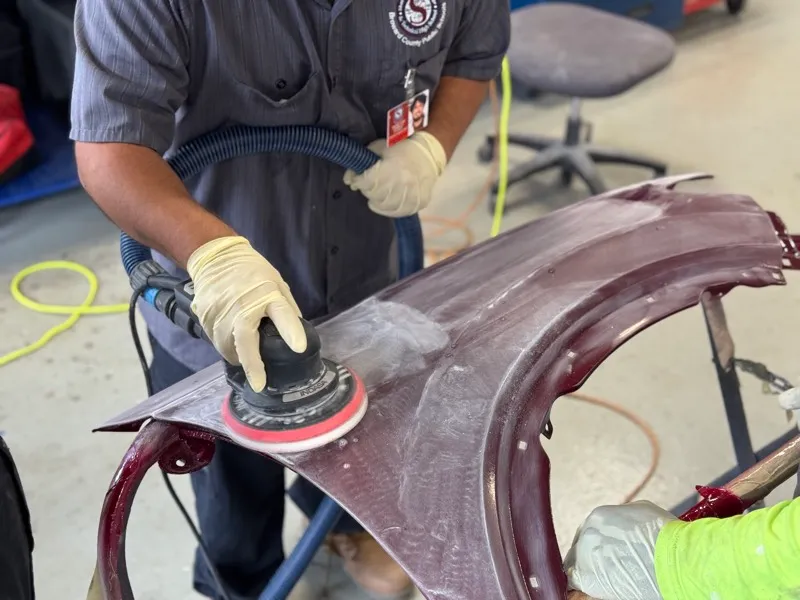
Which of the following is a correct safety practice when using a power sander?

  1. ASand directly along panel edges for best results.
  2. BFocus sanding efforts on body lines to blend them.
  3. CStay away from panel edges and body lines.
  4. DIncrease sander pressure at edges and body lines.
Show answer

Correct answer: C. Staying away from panel edges and body lines is correct practice because a power sander removes material fast, and edges and character lines concentrate the pressure so the abrasive quickly burns through the coating and rounds off or distorts the line. Answer A is incorrect because sanding directly along a panel edge cuts through paint almost instantly and can thin the metal edge itself. Answer B is incorrect because focusing on body lines with a power sander erases the crisp line the finish needs; body lines are finished carefully by hand. Answer D is incorrect because increasing pressure at edges and lines makes burn through and distortion happen even faster.

Question 8 · B3-B

After fitting a replacement front fender, the technician uses a straightedge and notices the fender surface is recessed compared to the door surface. How would this condition be correctly described?

  1. APositive flushness -- the fender is sticking out
  2. BFore/aft misalignment -- the fender needs to move forward
  3. CNegative flushness -- the fender is set in from the door
  4. DVertical misalignment -- the fender is too low
Show answer

Correct answer: C. A fender surface that sits recessed compared with the door surface is correctly described as negative flushness because the panel is set in from the adjacent panel along the in-out direction. Answer A is incorrect because positive flushness describes a panel sticking outward beyond the adjacent panel, which is the opposite of a recessed fender. Answer B is incorrect because fore and aft misalignment describes a panel needing to move forward or rearward, which is a different plane than the in-out flushness condition being measured. Answer D is incorrect because vertical misalignment refers to up-and-down height differences, not the in-out recessed relationship the straightedge revealed.

Question 9 · B3-C

What is true about rough filler and how filler should be applied on the first pass?

  1. ARough filler takes extra time to sand, and filler should be applied in thin, even coats
  2. BRough filler sands quickly, and filler should be applied in thin coats
  3. CRough filler takes extra time to sand, and filler should be applied thick on the first pass
  4. DRough filler sands quickly, and filler should be applied thick on the first pass
Show answer

Correct answer: A. Rough filler does take extra time to sand, and filler should be applied in thin, even coats. When filler is applied properly in thin, even layers it levels out and requires less sanding to shape, whereas a rough, heavy application leaves ridges and high spots that consume much more sanding time. Applying thin coats also reduces trapped air and pinholes. Answer B is incorrect because it wrongly claims rough filler sands quickly, which is false even though thin coats are correct. Answer C is incorrect because although it correctly notes rough filler takes extra time to sand, it wrongly calls for a thick first pass. Answer D is incorrect because it wrongly claims rough filler sands quickly and that filler should be applied thick on the first pass; both are false and lead to more work.

Question 10 · B3-D

Which resource is used to determine required replacement parts following an airbag deployment?

  1. AThe vehicle's warranty booklet
  2. BThe dealership's sales brochure
  3. CThe vehicle owner's manual
  4. DVehicle service information
Show answer

Correct answer: D. Vehicle service information is the resource used to determine required replacement parts following an airbag deployment, because it is written for technical repair use and specifies which restraint system components must be replaced after deployment. Technicians rely on it together with the manufacturer's Airbag Parts Replacement Recommendations matrix and collision estimating guides. Answer A is incorrect because the warranty booklet covers coverage terms, not replacement part requirements. Answer B is incorrect because a dealership sales brochure is marketing material and contains no repair specifications. Answer C is incorrect because the owner's manual is written for the vehicle operator and does not list required repair parts.

Question 11 · B3-E

What is the purpose of using insulated clamps during resistance spot welding?

  1. ATo reduce the squeeze time needed
  2. BTo increase the current delivered to the weld
  3. CTo eliminate the need for a work clamp
  4. DTo prevent the clamp from acting as a shunt
Show answer

Correct answer: D. Insulated clamps are used during resistance spot welding to prevent the clamp from acting as a shunt. A shunt is an unintended current path, and if the clamp conducts current it will divert some of the welding current away from the intended weld path, producing a weak or incomplete weld. Insulating the clamp forces the current to travel through the workpiece where the weld is needed. Answer A is incorrect because insulated clamps do not reduce required squeeze time. Answer B is incorrect because insulated clamps do not increase the current delivered to the weld, they simply keep current on the correct path. Answer C is incorrect because insulated clamps do not eliminate the need for a work clamp, they still hold the parts while preventing current diversion.

Question 12 · B3-F

What can result from mixing different paint systems on the same job?

  1. AImproved adhesion between the layers
  2. BA faster overall cure with no drawbacks
  3. CA poor finish or incompatible materials
  4. DBetter color hiding with fewer coats
Show answer

Correct answer: C. Answer C is correct because the products in a refinish system are formulated and tested together, so substituting across lines can leave materials that do not work with one another. Answer A is incorrect because adhesion between layers is precisely what a matched system is designed to guarantee. Answer B is incorrect because cure behavior is one of the things that becomes unpredictable when systems are mixed. Answer D is incorrect because hiding depends on the color and its application rather than on combining systems.

Question 13 · B3-A

The 4000 series aluminum alloy, which uses silicon as its primary alloying element, is classified as which type?

  1. ANon-heat-treatable alloy
  2. BHeat-treatable alloy
  3. CSolution-annealed alloy
  4. DPrecipitation-hardened alloy
Show answer

Correct answer: A. The 4000 series uses silicon as its primary alloying element and is non-heat-treatable, because silicon lowers the melting point and improves the fluidity of the molten aluminum, making the 4000 series the standard choice for aluminum welding filler wire, and the most common aluminum electrode, 4043, is a 4000 series silicon alloy. Answer B is incorrect because silicon in this series does not enable a heat-treatment strengthening response, so it is not heat-treatable. Answer C is incorrect because solution annealing is a heat-treatment step with no strengthening effect on this non-heat-treatable series. Answer D is incorrect because precipitation hardening is not how the 4000 series is strengthened.

Question 14 · B3-B

Which tool is dragged across a panel surface to reveal high and low spots by contacting the high areas and skipping the low areas?

  1. AA long board sander
  2. BA metal file
  3. CA cheese grater
  4. DAn air file
Show answer

Correct answer: B. A metal file is dragged across a panel surface to reveal high and low spots. As the file moves, its teeth contact and cut the high areas, leaving bright file marks on the raised metal, while skipping over the low areas that the teeth cannot reach, so the pattern of marks maps the panel's contour and shows exactly where the highs and lows are. Answer A is incorrect because a long board sander is an abrasive finishing tool used to level filler or primer, not a file dragged to read metal high and low spots. Answer C is incorrect because a cheese grater is a plastic body rasp used to shave down curing body filler, not a tool for checking metal panel highs and lows. Answer D is incorrect because an air file is a powered abrasive sanding tool used for material removal rather than for revealing panel contour by contacting high spots.

Question 15 · B3-C

Which sealer contains 100 percent solids and is used to fill larger voids at panel joints or holes?

  1. AA chip guard
  2. BA solid seam sealer
  3. CA thin-bodied sealer
  4. DA brushable seam sealer
Show answer

Correct answer: B. Answer B is correct because solid seam sealers containing 100 percent solids are used to fill larger voids at panel joints or holes, and an all-solids material does not shrink back as it dries. Answer A is incorrect because chip guard is a rubberized coating used along the lower rocker panel to resist stone chips. Answer C is incorrect because a thin-bodied sealer flows into narrow seams rather than filling a large void. Answer D is incorrect because brushable seam sealer is the type used on interior body seams where appearance is not important.

Question 16 · B3-D

Which statement concerning minor cut and crack adhesive repairs is incorrect?

  1. AMaximum strength requires 3 to 12 hours of curing time
  2. BThe parts should be allowed to warm to 70 degrees F before applying the adhesive
  3. CThe adhesive is applied after the accelerator
  4. DBoth sides of the cut or crack must be sprayed with accelerator
Show answer

Correct answer: D. Spraying both sides of the cut or crack with accelerator is the incorrect statement. Proper procedure sprays accelerator on only one side of the crack, then applies the adhesive to that same side so the adhesive contacts the accelerator and cures quickly and completely. Answer A is incorrect because as the answer choice allowing 3 to 12 hours of curing time for maximum strength is accurate for these adhesive repairs. Answer B is incorrect because as the answer choice it is true that the parts should be allowed to warm to 70 degrees F before the adhesive is applied, since cold plastic slows curing and weakens the bond. Answer C is incorrect because as the answer choice applying the adhesive after the accelerator is the correct sequence, so the statement is true.

Question 17 · B3-E

What is a primary application of projection welding in vehicle body assembly?

  1. AWelding skin panels to door frames along visible exterior seams
  2. BJoining roof panels to body sides with a continuous watertight seam
  3. CAttaching fasteners to structural members
  4. DWelding fuel tank halves together to form an airtight container
Show answer

Correct answer: C. Projection welding is widely used for attaching fasteners such as nuts, bolts, and studs to structural members in vehicle body assembly. The projections formed on the fastener concentrate the welding heat at specific contact points when flat electrode faces press the parts together, allowing a precise, strong attachment without distorting the surrounding structure. Answer A is incorrect because skin panels are joined to door frames by resistance spot welding rather than projection welding, and welding along visible exterior seams is not a projection welding application. Answer B is incorrect because joining roof panels with a continuous watertight seam is the province of resistance seam welding, whose roller electrodes produce overlapping spots that form a sealed seam. Answer D is incorrect because welding fuel tank halves into an airtight container is also a seam welding application, projection welding produces localized welds at formed projections, not continuous sealed seams.

Question 18 · B3-F

Which of these plastic materials is fiber-reinforced?

  1. APolypropylene (PP)
  2. BAcrylonitrile Butadiene Styrene (ABS)
  3. CThermoplastic Olefin (TPO)
  4. DSheet Molding Compound (SMC)
Show answer

Correct answer: D. SMC, sheet molded compound, is a thermoset plastic reinforced with chopped glass fibers and compression-molded into body panels, and that fiber reinforcement dramatically increases its strength and stiffness compared with unreinforced plastics. Answer A is incorrect because PP, polypropylene, is an unreinforced thermoplastic and carries no reinforcing fiber. Answer B is incorrect because Acrylonitrile Butadiene Styrene (ABS) is an unreinforced thermoplastic as well, with no glass fiber reinforcement. Answer C is incorrect because TPO is an unreinforced thermoplastic used for flexible parts like bumper covers, with no fiber content.

Question 19 · B3-A

What is the function of the oxygen cutting hole in an oxyacetylene cutting tip?

  1. ATo add flux to improve slag removal.
  2. BTo produce the preheating flame that brings the metal to ignition temperature.
  3. CTo provide a gas shield around the cut to prevent oxidation.
  4. DTo direct the high-pressure oxygen blast that cuts the metal.
Show answer

Correct answer: D. The center oxygen cutting hole directs a high-pressure blast of pure oxygen at the preheated metal, rapidly oxidizing the hot steel and burning a clean channel called the kerf through it. The preheat holes first raise the metal to ignition temperature, then the operator opens the cutting oxygen valve and this concentrated oxygen stream performs the actual cut. Answer A is incorrect because flux is not delivered through the cutting tip, oxyacetylene cutting relies on oxidation rather than flux for slag control. Answer B is incorrect because producing the preheating flame is the function of the surrounding preheat holes, not the center cutting hole. Answer C is incorrect because the oxyacetylene cutting process does not use a shielding gas around the cut, that concept belongs to processes such as Metal Inert Gas (MIG) welding.

Question 20 · B3-B

Which type of energy absorber works in a way similar to a shock absorber?

  1. AThe piston type
  2. BThe foam pad type
  3. CThe bonded isolator type
  4. DThe fascia
Show answer

Correct answer: A. The module's key pairs the piston type with a shock-absorber-like action. It is gas charged and damps the impact by controlled movement rather than by crushing. Answer B is incorrect because the foam pad type uses a thick urethane pad that compresses on impact. Answer C is incorrect because the bonded isolator uses a rubber pad, much like an engine mount. Answer D is incorrect because a fascia is the urethane or plastic covering over the bumper, not an absorber.

Ready for the Real Thing?

These 20 questions are a sample. The ASE B3 Test Simulator gives you thousands of Non-Structural Analysis and Damage Repair questions in a timed, Prometric-style test, with instructor narration, flashcards and a pass-probability score that tells you when you are ready.

See the ASE B3 Simulator

More Free Practice Tests

Also useful: what the test center is like and the collision repair glossary.

📬 Monthly ASE Tips in Your Inbox

Short, actionable tips each month to help you pass your ASE B-Series test. Free forever, no spam, unsubscribe anytime.