Study Guide
ASE B4 Study Guide: Structural Analysis and Damage Repair
50 scored questions, 75 minutes, 4 content areas. Here is what to study and in what order.
ASE B4 at a Glance
The ASE B4 Structural Analysis and Damage Repair test is one of five ASE collision repair and refinish certification tests. It has 50 scored questions plus 10 unscored research questions (60 in all), a 75-minute time limit, and is taken on a computer at a Prometric test center. Every question is multiple choice with four answers and one correct answer.
The scored questions are split across 4 content areas:
- Frame Inspection and Repair: 16 questions
- Unibody and Unitized Structure Inspection, Measurement, and Repair: 18 questions
- Stationary Glass: 4 questions
- Welding, Cutting, and Joining: 12 questions
Passing ASE B2, B3, B4 and B5 earns ASE Master Collision Repair and Refinish Technician status.
Certification is renewed every five years with a shorter recertification test. Check ase.com for current registration and fees. ASECollisionTestPrep.com is an independent study resource and is not affiliated with ASE.
Start Here
The ASE B4 Structural Analysis and Damage Repair test is 50 scored questions in 75 minutes, split almost evenly between full-frame and unibody structural work, with welding, cutting and joining as the third pillar and stationary glass as the fourth.
The measuring vocabulary (datum, centerline, body zero, mash, sag, sidesway, twist, diamond) and the OEM's rules on heat, sectioning and steel type decide most questions. This guide walks the four content areas by weight and ends with a 30-day plan.
Where the 50 scored questions come from
- A. Frame Inspection and Repair1632%
- B. Unibody and Unitized Structure Inspection, Measurement, and Repair1836%
- C. Stationary Glass48%
- D. Welding, Cutting, and Joining1224%
Why technicians fail this test
- Heat and steel: ultra-high-strength and boron steels are not straightened with heat or repaired at all under most OEM procedures; the test rewards the maker's limit, not the shop's habit.
- Measuring order: length (mash, diamond), width (sidesway), height (sag, kickup) and twist are diagnosed from datum, centerline and body-zero planes, and the question asks which dimension a reading describes.
- Sectioning only where the OEM allows it and with the joint it specifies; anchoring and pulling in the direction opposite the impact, in sequence.

Written by Mr. Hernandez Collision Repair Instructor at Sheridan Technical College, five years teaching the ASE B-Series. About the instructor
A. Frame Inspection and Repair
What to focus on
- Three-dimensional measuring and the tram gauge as the first check; lift, anchor and support before any pull.
- Mash, sag and kickup, sidesway, twist and diamond: what each one is, which reference plane shows it, and the order of repair.
- Frame horns, side rails, cross members and brackets: repair or replace per the OEM; stress relieving, corrosion protection and mounting-point diagnosis after.
Trap: A reading from datum is height, from centerline is width, from body zero is length; the question names the plane and the wrong answers name the wrong damage type.
All 15 official tasks in this area
- Diagnose, repair, verify, and document repairs on underbody and upperbody structural damage using three-dimensional measuring systems (mechanical, electronic/computerized, laser), and dedicated or universal fixtures, in accordance with manufacturer specific procedures/industry guidelines.
- Check the vehicle with a tram gauge to determine further diagnostic procedures.
- Lift, anchor, and support vehicle for repair and realignment.
- Repair and align mash/collapse damage (change in length from body zero).
- Repair and align sag/kickup damage (change in height from datum).
- Repair and align sidesway/sway damage (change in width from centerline).
- Repair and align twist damage (vertical misalignment in the center section).
- Repair and align diamond damage.
- Diagnose, repair, or replace damaged frame, frame horns, side rails, cross members, frame brackets, supplemental restraint system (SRS) and advanced driver assistance systems (ADAS) sensor mounting locations, and front, rear, or center sections in accordance with manufacturer specific procedures/industry guidelines.
- Replace protective coatings, restore corrosion protection to repaired or replaced frame areas and anchoring locations.
- Repair or replace stress-cracked frame members in accordance with manufacturer specific procedures/industry guidelines.
- Diagnose damaged mounting locations for steering, suspension, and powertrain components, which can cause vibration, steering, and wheel alignment problems, in accordance with manufacturer specific procedures/industry guidelines.
- Perform stress-relieving procedures in accordance with manufacturer specific procedures/industry guidelines.
- Determine the direction of impact and the extent of direct and indirect damage.
- Identify the frame type and composition; plan the methods and sequence of repair in accordance with manufacturer specific procedures/industry guidelines.
B. Unibody and Unitized Structure Inspection, Measurement, and Repair
What to focus on
- The same measuring and damage types applied to unibody structure, plus the structural composition and the methods and sequence the OEM gives.
- Front, center and rear section components (aprons, strut towers, rails, cowl, pillars, roof, quarters, rear rails): repair, align or replace per the OEM.
- Supplemental restraint and advanced driver assistance components in the structure, stress relieving, corrosion protection, and restoring noise, vibration and harshness foams.
Trap: Sectioning questions want the OEM location and joint; an answer that sections in a crush zone or reinforcement is wrong on every vehicle.
All 17 official tasks in this area
- Diagnose, repair, verify, and document repairs on underbody and upperbody structural damage using three-dimensional measuring systems (mechanical, electronic/computerized, laser), and dedicated or universal fixtures, in accordance with manufacturer specific procedures/industry guidelines.
- Check the vehicle with a tram gauge to determine further diagnostic procedures.
- Lift, anchor, and support vehicle for repair and realignment.
- Repair and align mash/collapse damage (change in length from body zero).
- Repair and align sag/kickup damage (change in height from datum).
- Repair and align sidesway/sway damage (change in width from centerline).
- Repair and align twist damage (vertical misalignment in center section).
- Diagnose damaged mounting locations for steering, suspension, and powertrain components, which can cause vibration, steering, and wheel alignment problems, in accordance with manufacturer specific procedures/ industry guidelines.
- Identify, diagnose, repair, or replace the supplemental restraint system (SRS) and advanced driver assistance systems (ADAS) sensor component mounting locations (collision avoidance, adaptive cruise control, park assist, etc.).
- Determine the direction of impact and the extent of direct and indirect damage.
- Identify the structural composition; plan the methods and sequence of repair, in accordance with manufacturer specific procedures/ industry guidelines.
- Repair, align, and/or replace center section components (cowl, bulkhead, roof, roof rails, pillars, floor, stationary glass openings, door openings, rocker panels, and crossmembers).
- Repair, align, and/or replace rear section components (quarter panels, rear compartment opening, package shelf, wheelhouse assemblies, rear body panel, rails, floor pans, crossmembers, and the mounting points of suspension and powertrain components).
- Repair, align, and/or replace front section components (aprons, strut towers, upper and lower rails, crossmembers, and the mounting points of steering, suspension, and powertrain components).
- Perform stress-relieving procedures in accordance with manufacturer specific procedures/ industry guidelines.
- Replace protective coatings; restore corrosion protection to repaired or replaced unibody structural areas and anchoring locations.
- Restore noise, vibration, harshness (NVH) materials and structural foams in accordance with manufacturer specific procedures/ industry guidelines.
C. Stationary Glass
What to focus on
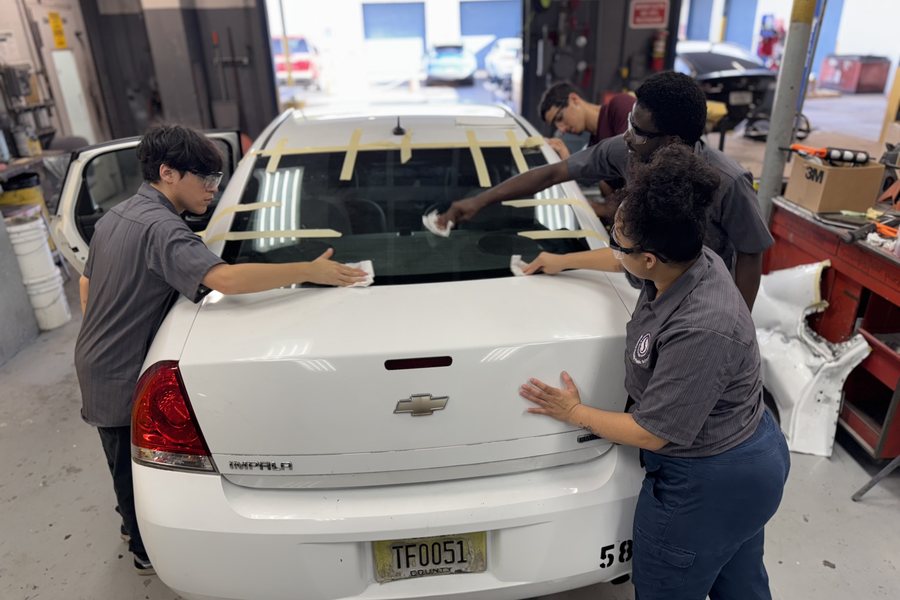
- Modular and stationary glass removal and replacement, including heated, acoustic and sensor-equipped glass.
- Pinch weld preparation, primer and adhesive selection, and safe drive-away time per the adhesive maker and the OEM.
- Recalibration of cameras and sensors mounted to the glass after replacement.
Trap: Safe drive-away time and pinch weld priming come from the urethane maker's sheet; the shop's usual number is not the answer.
All 3 official tasks in this area
- Identify, remove and/or replace front and rear modular/stationary glass, including heated, non-heated, and glass equipped with electronic accessories (cellular, satellite, collision avoidance, antenna, rain sensor, etc.) in accordance with manufacturer specific procedures/ industry guidelines.
- Identify, remove and/or replace side and roof modular/stationary glass including glass equipped with electronic accessories in accordance with manufacturer specific procedures/ industry guidelines.
- Determine correct pinch weld preparation, adhesive selection and application in accordance with vehicle manufacturer specific procedures/adhesive manufacturer directions for use.
D. Welding, Cutting, and Joining
What to focus on
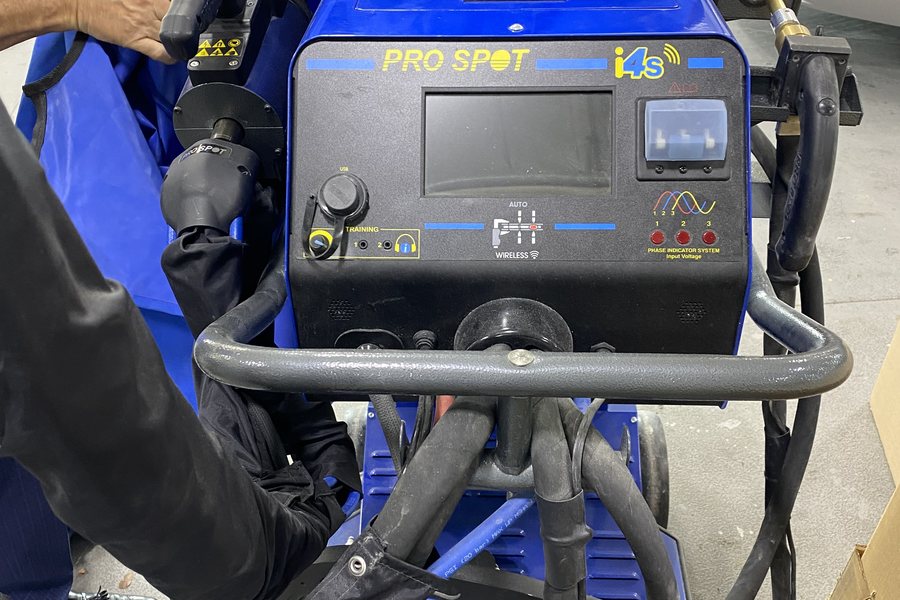
- Joining process by structural composition: GMA welding, squeeze-type resistance spot welding, MIG brazing, rivet bonding, adhesive, per the OEM.
- Setup for steel and aluminum, push and pull technique, gun angle, joint types and weld types, test welds and destructive tests.
- Cutting process by material (abrasive, mechanical, plasma), protecting vehicle systems, corrosion protection before and after.
Trap: Aluminum and steel are never welded with the same wire, gas or gun; mixed-material questions are testing contamination and the OEM's joining method.
All 15 official tasks in this area
- Identify structural composition; determine the correct joining process in accordance with vehicle manufacturer specific procedures/ industry guidelines.
- Set up and adjust welding equipment for the material to be welded (steel, aluminum).
- Determine proper welding technique (push, pull, and gun angle) for the type of welds being made.
- Determine correct welding process in accordance with vehicle manufacturer specific procedures/ industry guidelines (GMAW, MIG/MAG, MIG brazing, Squeeze-Type Resistance Spot); identify the electrode, wire type, diameter, and gas to be used in specific welding situations.
- Protect all vehicle systems and components from damage during welding and cutting operations.
- Prepare the metal to be joined; assure good joint fit-up.
- Identify the type of weld/bonded joint (butt, butt with backing, lap, etc.) for the repair being made.
- Determine the correct type of weld (continuous, stitch, skip, plug, spot, etc.) and preparation for each specific welding operation.
- Identify the proper cutting process (abrasive, mechanical, plasma arc) for different materials and locations in accordance with manufacturer specific procedures/industry guidelines.
- Remove damaged structural steel and aluminum components; replace in accordance with vehicle manufacturer specific procedures/industry guidelines.
- Restore protective coatings; restore corrosion protection before or after welding operation.
- Remove and install welding/weld-bonded panels according to manufacturer specific procedures/industry guidelines.
- Perform test weld; visually evaluate and destructive test each weld type (continuous, skip, STRSW, plug, etc.).
- Identify structural composition; determine correct riveting process (rivet joining, rivet bonding, etc.), size and type of rivet, and adhesive to be used in specific joining situations in accordance with vehicle manufacturer specific procedures/ adhesive manufacturer directions for use.
- Set up, adjust, and test rivet equipment for the material to be joined.
A 30-Day ASE B4 Study Plan
Diagnostic, Unibody and measuring
Take a full timed practice test. Then Unibody Inspection, Measurement, and Repair (36 percent): reference planes, damage types, repair order, section components, SRS and ADAS in the structure.
Frame Inspection and Repair
32 percent: the same damage types on full frames, frame member repair or replacement, stress relieving, mounting-point diagnosis, corrosion protection.
Welding, Cutting, and Joining
24 percent: processes by material, steel versus aluminum setup, joint and weld types, test welds, cutting processes, protecting systems. Add Stationary Glass.
Review and timed tests
Two full timed practice tests on different days, every miss reviewed against the task list. Stop new material 48 hours before the test.
Key Terms to Know
375 more in the ASE B4 glossary, each with a plain-words definition.
ASE B4 Study Guide FAQ
- How long should I study for the ASE B4?
- Four weeks at an hour a day. Unibody and frame measuring and repair are 34 of the 50 scored questions, so the first two weeks live there.
- What should I study first for the ASE B4?
- The measuring vocabulary: datum, centerline, body zero, mash, sag, kickup, sidesway, twist and diamond. Nearly every structural question uses it.
- Does the ASE B4 cover aluminum?
- Yes. Welding, Cutting, and Joining asks for steel and aluminum setup, contamination control and the OEM joining method, and the structural areas ask for steel type identification.
- Where can I practice ASE B4 questions free?
- The free ASE B4 practice test on this site has 20 questions written in the ASE style with the answer and the reason, no sign-up.
More on the ASE B4 Test
- How to Pass the ASE B4 Structural Analysis & Damage Repair Test
- What Is ASE Collision Repair Certification? The Five Tests, Which One to Take First, and What Master Status Means
- What Tesla Requires for Rivets and Structural Adhesive, and Why Ford, GM and Stellantis Answer It Differently
- ASE B4 Structural: The 5 Most-Missed Topics
Next Steps
ASE®, the ASE logo, and "ASE Certified" are registered trademarks of the National Institute for Automotive Service Excellence. This site is an independent study resource and is not affiliated with, endorsed by, or sponsored by ASE. Content areas, question counts and pass requirements follow ASE's published test specifications.