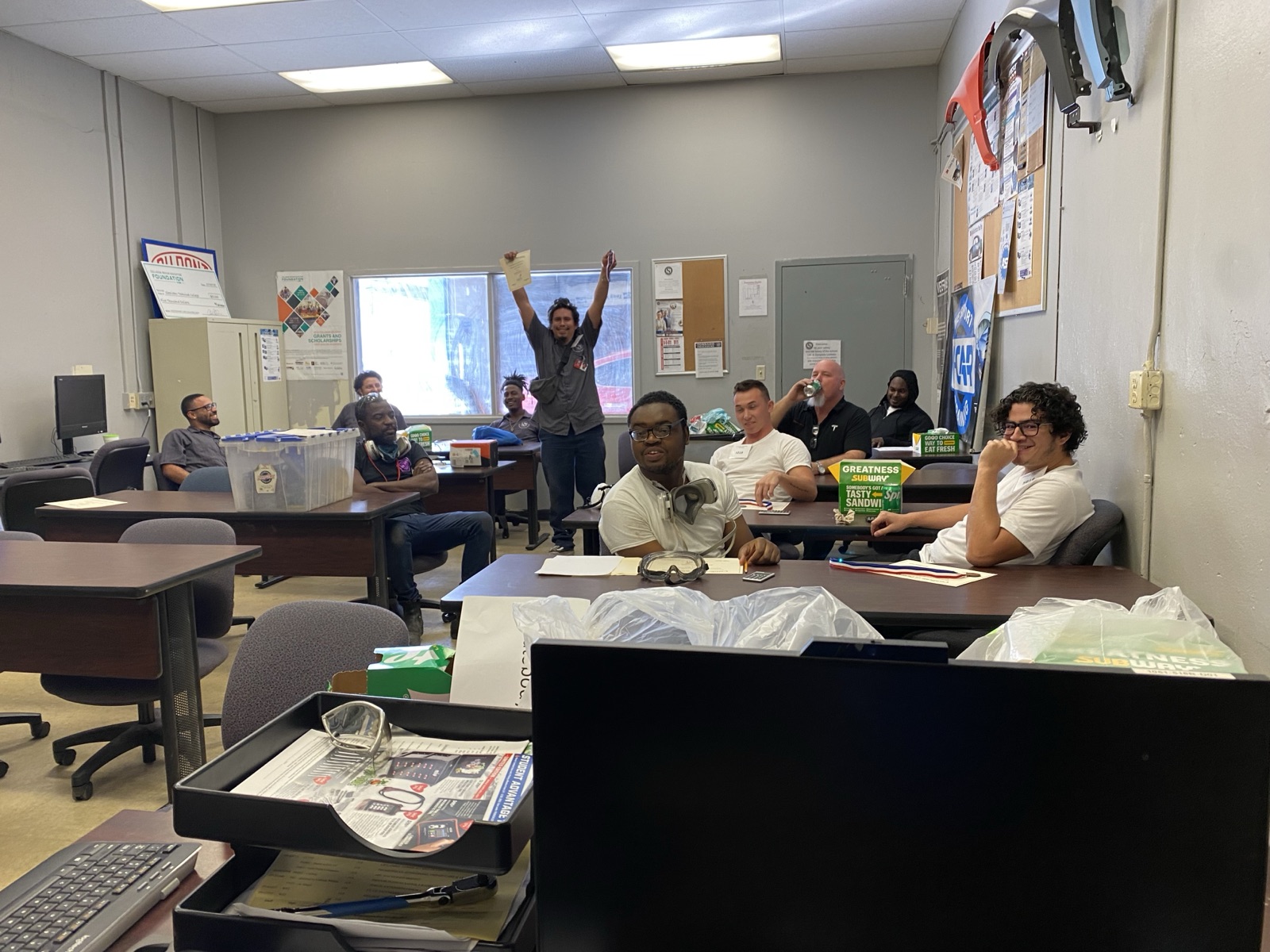
The ASE Entry-Level collision tests are for students in a collision repair and refinish program, and for other newcomers who want a credential that says they are ready for the workplace; no work experience is required. You prepare by studying each test in proportion to its content areas and by practicing against the real number of scored questions, the recommended time and the real pass mark, because those three numbers are fixed and published.
That is the short answer. The rest of this article is the detail a student, a parent or a new instructor needs: who can sit the tests, how a school runs them, what the scoring rules are, and a study plan built on how each test is weighted.
Who takes the ASE Entry-Level collision tests
The National Institute for Automotive Service Excellence (ASE) runs the Entry-Level program through the ASE Education Foundation. Its FAQ describes the tests as intended for students finishing a program of technical study in collision repair and refinishing, and for other people seeking a credential that shows workforce readiness. Both youth and adults take them. In practice the people who sit them are:
- High school students in a collision repair and refinish program, often in their last year.
- Adult students at a technical college or adult education center.
- Career changers and apprentices who want a first credential before they have the two years of experience the professional tests require.
There is no experience requirement and no prerequisite test. Each test stands on its own, so a student can take one, two or all five.
ASE is clear that this is not the same certification experienced technicians earn. The Entry-Level tests are designed and calibrated for people preparing to enter the trade. The professional ASE B-Series tests (ASE B2 to ASE B6) require documented work experience and are taken at a Prometric test center; our guide to what ASE collision certification is covers that side.
The five collision tests and how they are weighted
Every test is keyed to the task list in the ASE accreditation standards for collision programs. Four tests have 40 scored questions; Fundamentals has 60. The numbers below are the scored questions per content area from ASE's test specifications, and they are the most useful study tool you have, because they tell you where the points are.
Painting and Refinishing (PR), 23 of 40 to pass
- Paint Mixing, Matching, and Applying: 9
- Surface Preparation: 8
- Safety Precautions: 7
- Paint Defects, Causes and Cures: 7
- Spray Gun and Related Equipment Operation: 5
- Final Detail: 4
Non-Structural Analysis and Damage Repair (NS), 22 of 40 to pass
- Outer Body Panel Repair, Replacements, and Adjustments: 9
- Preparation: 8
- Metal Finishing and Body Filling: 8
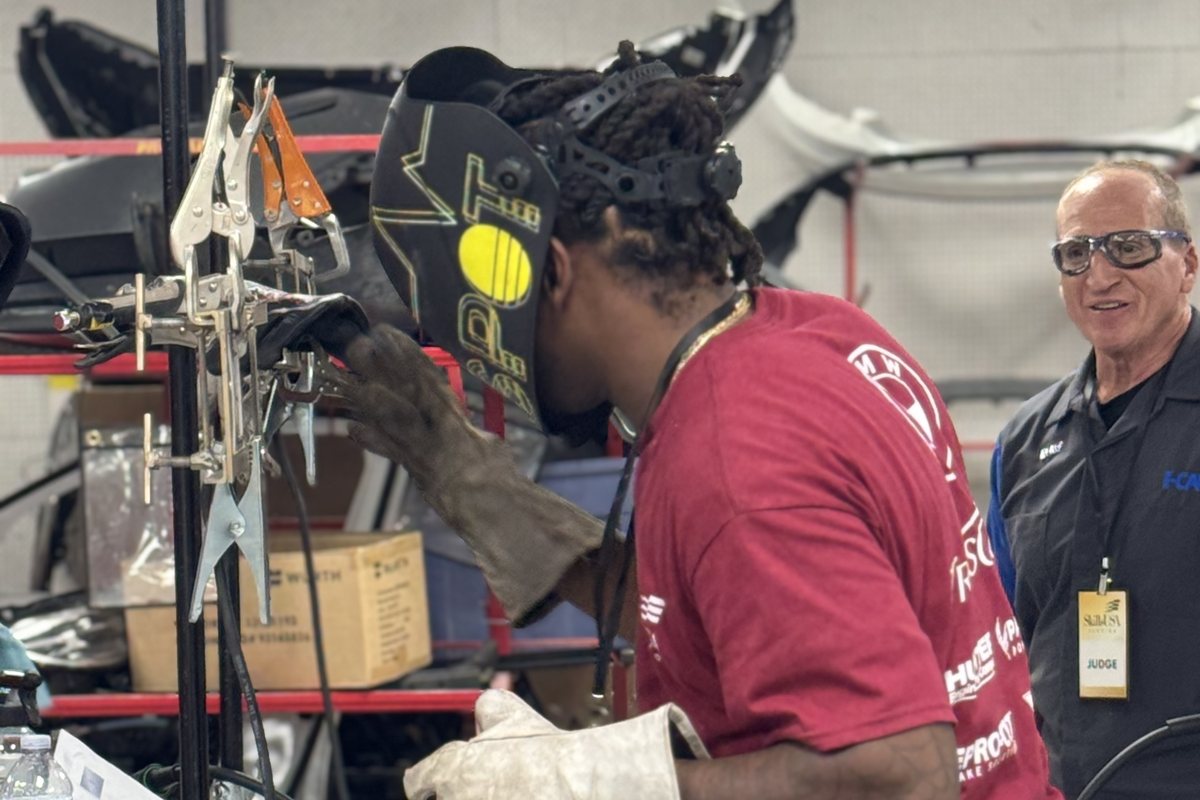
- Metal Welding, Cutting, and Joining: 8
- Plastics, Adhesives, and Welding: 4
- Moveable Glass and Hardware: 3
Structural Analysis and Damage Repair (SR), 22 of 40 to pass
- Unibody and Unitized Structure Inspection, Measurement, and Repair: 14
- Metal Welding, Cutting, and Joining: 14
- Frame Inspection and Repair: 10
- Stationary Glass: 2
Mechanical and Electrical Components (ME), 22 of 40 to pass
- Suspension and Steering: 9
- Electrical: 8
- Restraint Systems: 6
- Heating and Air Conditioning: 5
- Cooling Systems: 4
- Brakes: 3
- Drive Train: 3
- Fuel, Intake and Exhaust Systems: 2
Collision Repair and Refinish Fundamentals (CF), 36 of 60 to pass. Thirteen content areas across the whole trade. The heaviest are Refinishing: Surface Preparation (11), Non-Structural Repair: Outer Body Panels (7) and Non-Structural Repair: Metal Finishing and Body Filling (7). The rest run from 2 to 5 questions each, including damage analysis, estimating, vehicle construction, safety regulations and high voltage safety.
Read those lists before you open a book. On the Structural test, welding is worth as many points as unibody measurement. On Mechanical and Electrical, restraint systems outweigh brakes two to one. On Fundamentals, surface preparation alone is close to a fifth of the test.
How a school gives the tests
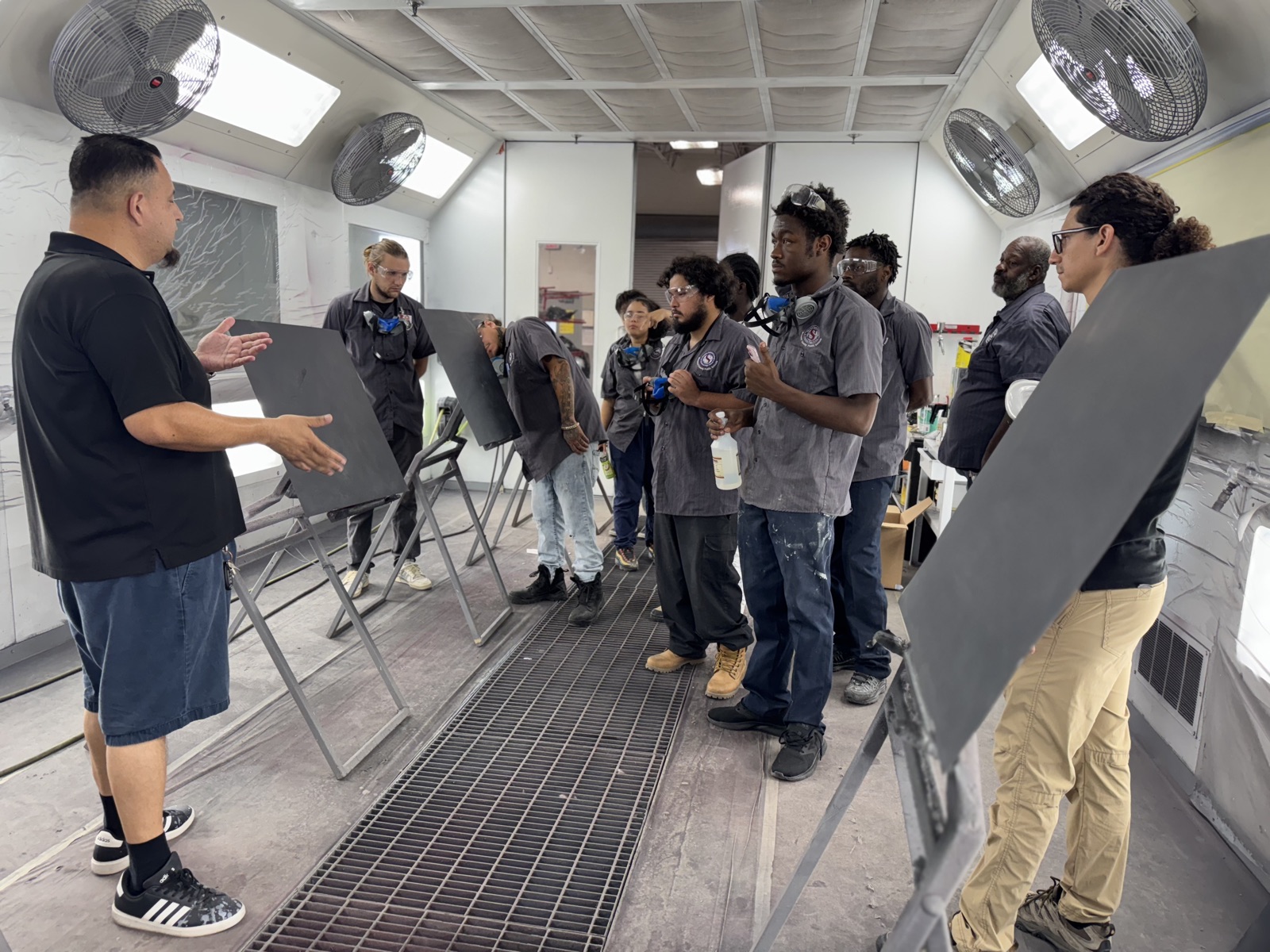
The Entry-Level tests are not booked by the student at a Prometric center. ASE's FAQ describes every purchase and every test session through a school or test site that has registered with ASE:
- The school buys a seat for each student. One seat covers every test in the collision series for the academic year, which runs July 1 to June 30. Unused seats expire on June 30.
- The instructor schedules the tests, at any point in the year. ASE suggests three ways to use them: at the end of the program to show workplace readiness, at the end of a course, or as a pre-test and post-test to measure what a class learned.
- A proctor runs the session. The proctor must be a staff member who is not an automotive instructor. The proctor checks the student's identity, signs in, unlocks the test and watches the session.
- The test is online, on a school computer in Google Chrome. ASE recommends a screen of at least 17 inches because some questions carry detailed pictures.
- It is closed book. No notes, no textbook, no phone.
Two calendar facts catch schools out every year. ASE takes the system down for maintenance in February and July (the 2027 windows are February 17 to 21 and all of July), and the fall and spring windows use different test forms built to the same difficulty.
Time, scoring and retests
ASE recommends scheduling 60 minutes for each test with 40 scored questions and 90 minutes for Fundamentals. The system keeps a session open for up to twice that, which leaves room for students who need extra time. Each test can also carry up to 20 unscored questions that ASE uses to try out new items. They are not marked and they do not count, so the only safe habit is to answer every question.
The pass marks were not picked by a committee guessing how hard a question looks. ASE set each one with real students: instructors named students they judged should pass and should not pass, the groups were tested, and the cut score was placed where it misclassified the fewest of them. That is why the marks differ slightly between tests.
If a student misses, the same seat covers one retest per test in the academic year. The retest cannot start until the eighth day after the first attempt, because ASE requires seven full calendar days in between. An instructor can allow a third attempt with an additional seat. Plan the first attempt early enough that the eighth day still falls before June 30.
What a pass earns
Every student gets a score report showing how many questions they answered correctly in each content area, with a pass or fail for each test. A student who passes one or more tests receives an ASE Entry-Level certificate, printed at the school, naming every area passed. It is valid for two years and is not renewable. Schools may also order the uniform patch and hand it to students who pass.
The two-year limit is the point. The certificate covers the gap between school and the professional tests. By the time it expires, a working technician has the experience to sit the ASE B-Series tests at Prometric, and those certifications last five years.
How to prepare: a plan built on the weighting
I give my own students the same advice every year: the content-area numbers above are the plan. Here is how to use them.
- Find your weak areas first. Take a full-length practice test cold, with the clock running, before any studying. The total does not matter yet. The content-area breakdown does.
- Spend study time in proportion to points. For the Structural test, that means as many hours on welding, cutting and joining as on unibody measurement, and far fewer on stationary glass. For Painting and Refinishing, paint defects deserve a full week even if your program covered them in two days.
- Learn the rule, not the shop habit. The questions are keyed to the task list, so the right answer is the procedure the vehicle maker or the product data sheet calls for. When a shop shortcut and the written procedure disagree, the test wants the procedure.
- Read the explanation on every practice question, including the ones you got right. Knowing why the other three choices are wrong is what moves a score.
- Practice against the real clock and the real mark. A student who has finished three full practice tests in 60 minutes and seen 22 or 23 of 40 come up on the screen is not meeting the format for the first time on test day.
- Take Fundamentals last if you are sitting more than one. It is the longest test, it covers the whole trade, and it rewards everything the other four taught you.
The four subject tests line up with the professional tests, so our study guides for the subject are useful even at the entry level: ASE B2 for Painting and Refinishing, ASE B3 for Non-Structural, ASE B4 for Structural and ASE B5 for Mechanical and Electrical. Study at the depth the entry-level task list asks for; the professional guides go further than you need.
Practice for all five tests
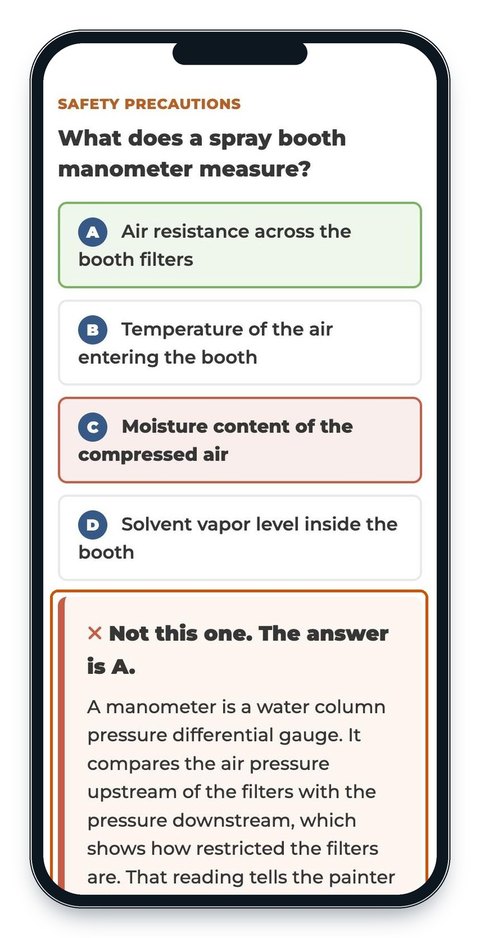
Our ASE Entry-Level practice tests cover all five collision tests, with full tests that carry the same scored questions as the real test (40, or 60 on Fundamentals) plus unmarked extra questions the way the real test does, ASE's recommended time and the real pass mark, plus drills on any single content area. Five free questions sit on the page with no sign-up, so a student can see the format in two minutes. Instructors who want the whole class on it can read how one school license works in our Entry-Level launch article, and on our schools page.
If you are a student, find out this week which content area costs you the most points. If you teach, have the class take one full practice test cold before the spring window and look at the content-area breakdown together.
Testing rules, pass marks and dates are from the ASE Education Foundation's Entry-Level FAQ (updated August 1, 2026) and collision test specifications (effective July 1, 2025); ASE reissues both, so confirm the current versions on ase.com before you plan a test date. ASE is a registered trademark of the National Institute for Automotive Service Excellence; this site is not affiliated with ASE.

Discussion
Join the discussion — sign in to comment.
Comments are reserved for registered students and technicians. Your name will be pulled from your profile automatically.
Log In Register