Most of the collision students I teach have never heard of the ASE Entry-Level tests until the week they take one. Their parents have never heard of them at all. That is a shame, because for a student who is still in a program, these five tests are the first line on a resume that a shop owner actually recognizes, and the student can earn it before graduation, without a single day of shop experience.
This week we launched practice tests for all five. This article is the explanation I wish every one of my students, and every instructor running a collision program, had in hand at the start of the year: what the ASE Entry-Level collision series is, what is on each test, what a pass earns, and how to get ready for it.
What the ASE Entry-Level series is
The National Institute for Automotive Service Excellence (ASE) runs two tiers of testing. The professional tests, the ones working technicians take at a Prometric test center, are the ASE B2 to ASE B6 series on the collision side. Those require two years of hands-on experience, or a mix of training and experience, before a pass turns into a certification.
The entry-level tests sit underneath them. They are run by the ASE Education Foundation, taken online at the student's own school with a proctor in the room, and designed, in ASE's words, to show "a satisfactory level of practical knowledge-based readiness for the workforce" in a student starting a career in the trade. No experience is required. The school signs up for the program, buys seats, and schedules the testing window, usually near the end of a term.
Source: ASE Education Foundation, Entry-Level Testing.
The five collision tests
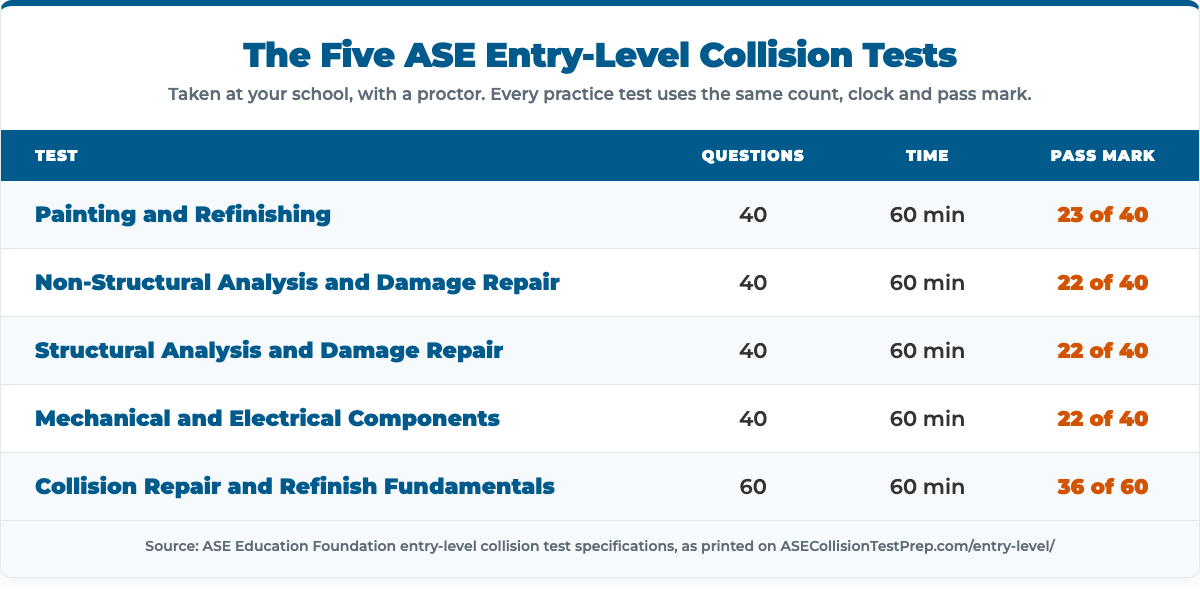
ASE's own list for the collision repair and refinish series has five tests. Four of them line up with the four hands-on professional tests, at a student's depth. The fifth is new in the current specifications and covers the whole trade on one paper.
| Test | Questions | Time | Pass mark |
|---|---|---|---|
| Painting and Refinishing | 40 | 60 minutes | 23 of 40 |
| Non-Structural Analysis and Damage Repair | 40 | 60 minutes | 22 of 40 |
| Structural Analysis and Damage Repair | 40 | 60 minutes | 22 of 40 |
| Mechanical and Electrical Components | 40 | 60 minutes | 22 of 40 |
| Collision Repair and Refinish Fundamentals | 60 | 60 minutes | 36 of 60 |
Each test is split into content areas with a fixed number of questions per area. Painting and Refinishing, for example, draws 7 questions on safety precautions, 8 on surface preparation, 5 on spray gun and related equipment operation, 9 on paint mixing, matching and applying, 7 on paint defects and their cures, and 4 on final detail. Structural Analysis and Damage Repair puts 14 of its 40 questions on unibody inspection, measurement and repair and another 14 on metal welding, cutting and joining, so a student who is weak on welding has very little room to make it up elsewhere.
The Fundamentals test is the one instructors should look at closely. Its 13 content areas run from damage analysis and estimating through refinishing, non-structural repair and mechanical and electrical components to workplace, personal and high-voltage safety. It is the only entry-level test that touches estimating, and it is the broadest paper a collision student will see before the professional series.
The full task lists for all five, every task ASE names, are printed on our ASE Entry-Level page, one tab per test.
What a pass earns
Two things, and the second is the one students care about.
An ASE Entry-Level certificate with the student's name on it, valid for two years. It goes straight on a resume, and a shop manager who has hired from a school program before knows what it means.
The uniform patch. Schools order the ASE Entry-Level insignia from the Foundation and hand it out to students who pass. For a 17-year-old, a patch on the sleeve of the shop shirt is worth more than the certificate in the folder, and it is the thing that gets the next student in the class to study.
There is one more point that matters for a student planning ahead. The entry-level pass is not the professional ASE B-series certification. The experience requirement still applies to the professional test, and it is still taken at a Prometric center. What the entry-level pass does is prove the student can learn the material in test form, which is exactly the skill the professional test measures two years later.
Your First
ASE Patch
The ASE Entry-Level patch is handed out by schools to students who pass. It is the first ASE credential a collision student can earn, and it can be on a shop shirt before graduation.
ASE®, the ASE logo, and "ASE Certified" are registered trademarks of the National Institute for Automotive Service Excellence. asecollisiontestprep.com is not affiliated with, endorsed by, or sponsored by ASE.
Why students fail it
I have proctored enough of these to know the pattern, and it is not a knowledge problem most of the time.
They have never seen the question format. A student can strip a fender, prime it and block it perfectly and still miss a question about surface preparation, because the question asks which grit to featheredge with and gives four plausible grits. Shop skill and test skill overlap, but they are not the same skill.
They have never worked against a clock. Forty questions in sixty minutes is ninety seconds a question. A student who reads slowly, or who rereads every stem twice, runs out of time on the last ten and guesses. The Fundamentals test is worse: sixty questions in the same hour.
They do not know where they are weak. A student who thinks of themselves as "a paint person" has no idea that the Painting and Refinishing test puts 7 of its 40 questions on paint defects and their cures, an area most programs cover in a week.
Every one of those is fixable with practice, which is the point of what we built.
What we launched
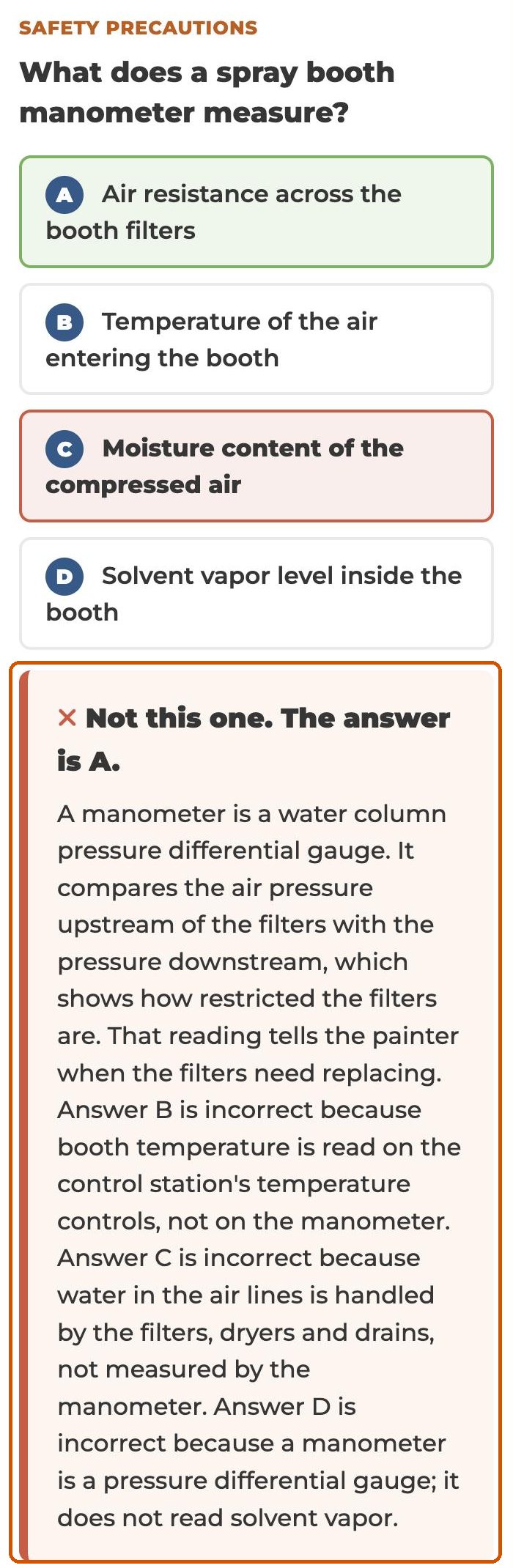
The new practice tests run inside the same practice test simulator our ASE B2 to ASE B6 students use, on a phone or a laptop. For each of the five entry-level tests, a student gets:
- Full practice tests with the real question count, the real 60-minute clock and the real pass mark, so the first time they feel the clock is not the day it counts.
- Every answer explained, right and wrong. The explanation of why the other three choices are wrong is where most of the learning happens.
- Twenty-question drills on any single content area, so the "paint person" can spend an evening on nothing but paint defects.
- Scores and best score saved on the dashboard, so the student and the instructor can both see the trend.
The question bank was built from the ASE task lists for each test, and every question states the general rule the task list names rather than a particular shop's habit. Where a fact comes from a vehicle maker's repair procedure, the procedure is the source.
Each test is $49 for 90 days, bought one test at a time. It is billed once and nothing renews on its own, which matters when the buyer is a 16-year-old with a debit card.
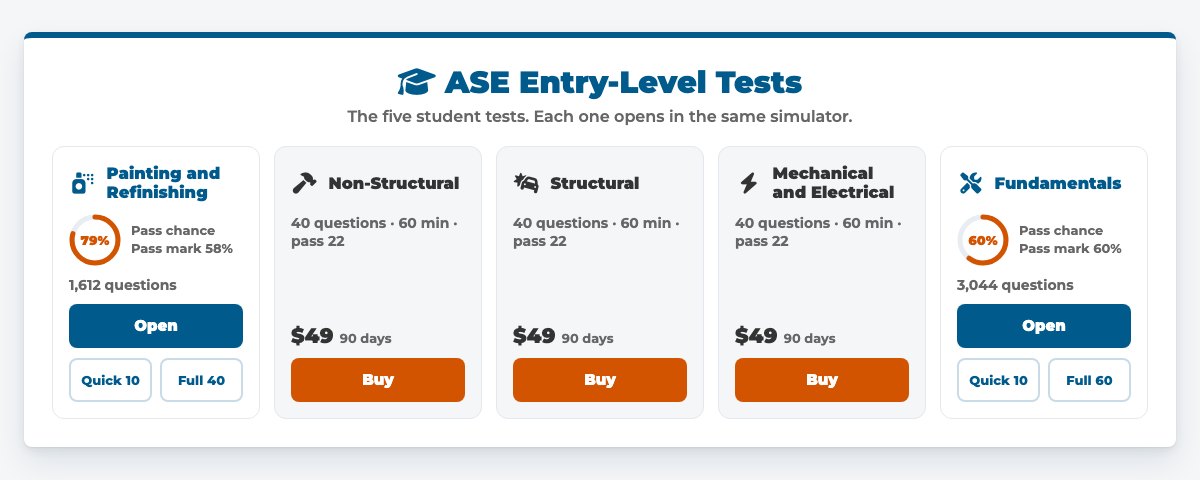
Before anyone pays, there are five free questions from the Painting and Refinishing practice test on the page, with no sign-up. Pick an answer, check it, read why. That is the whole experience in two minutes.
For instructors: one license covers both tracks
If you run a program, the entry-level tests are almost certainly already on your calendar, and the question is how to get a class of 20 ready without building the practice material yourself.
A school license on our For Schools page covers each student spot for both tracks: the ASE Entry-Level tests and the professional ASE B2 to ASE B6 tests, for the term of the license. A student who passes the entry-level test in the spring and graduates into a shop in the summer keeps studying for the professional test on the same spot. Nothing extra to buy when a student moves up.
The instructor side gives you a class roster, each student's scores and weakest areas, and the ability to run a paced practice test with the whole class answering on their phones while the question sits on the projector. It is the closest thing to the real proctored session a class can rehearse.
One more date for program directors. The ASE Education Foundation released new Collision Program Standards on August 1, 2026, and every accreditation application must meet them from January 1, 2027. The Fundamentals task list is part of the new standard, which is a good reason to put that test in front of students this year rather than next.
How to use the practice tests in a program
This is the sequence I use with my own students, and it fits in the last six weeks before the school's testing window.
- Week one: a cold full test. No studying first. The score does not matter; the content-area breakdown does. Every student leaves with their two weakest areas.
- Weeks two to four: drills on the weak areas. Twenty questions a day, read every explanation, including the ones they got right. Ninety seconds a question, timed.
- Week five: a second full test. Most students move 6 to 10 questions on this one. The ones who do not are the ones who need the instructor's time.
- Week six: the real thing. Fundamentals last if a student is taking more than one, because it is the longest paper and the broadest.
A student who has done that has felt the clock three times and read three or four hundred explanations before the proctor logs them in. That is a different student from the one who walks in having only ever been tested on a shop floor.
The short version
The ASE Entry-Level collision series is five tests a student takes at school, with no experience required, that earn a certificate and a patch a shop recognizes. Four match the subjects of ASE B2 to ASE B5. The fifth, Fundamentals, covers the whole trade and is the one to plan for. Practice tests for all five are live now, $49 per test for 90 days, five free questions to start, and one school license covers both the entry-level and the professional tracks.
If you teach, send your students to the free questions this week and see which content area the class stumbles on first. If you are the student, go find out whether you are really "a paint person."
ASE Entry-Level Practice Tests
One test at a time. Billed once, nothing renews.
- Full practice tests, real count, clock and pass mark
- Every answer explained
- 20-question content-area drills
- Scores saved on your dashboard
- Class roster and weakest areas
- Paced live practice tests
- Quote, purchase order or card
- Students keep the spot when they move up
ASE® and the ASE logo are registered trademarks of the National Institute for Automotive Service Excellence. We offer practice ASE tests and are not affiliated with or endorsed by ASE.

Discussion
Join the discussion — sign in to comment.
Comments are reserved for registered students and technicians. Your name will be pulled from your profile automatically.
Log In Register