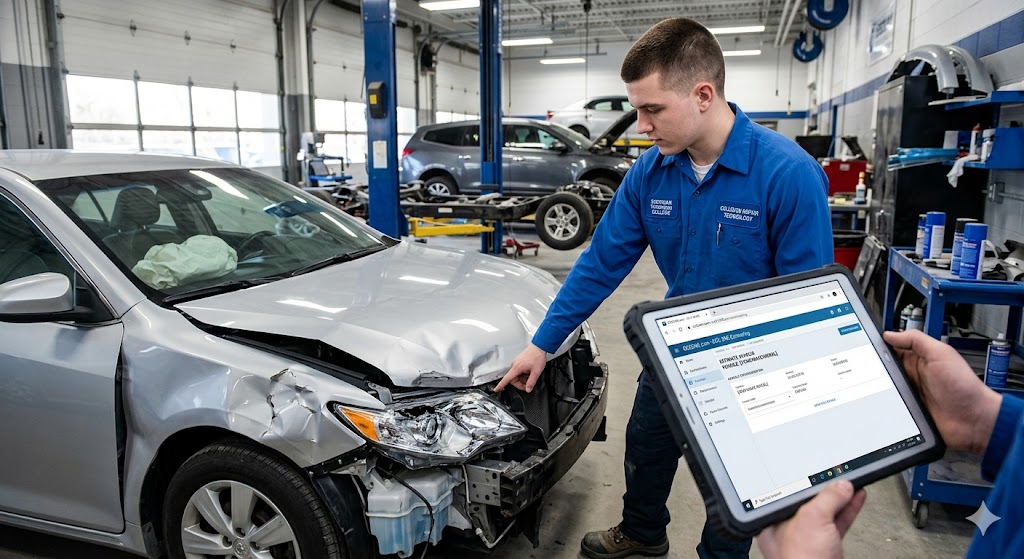
The Art of the Estimate
While the ASE B2 exam focuses on the booth, the ASE B6 is all about the blueprint. To pass this exam, you have to look past the smashed plastic and identify the structural shifts underneath, and document every single one of them in a way that holds up against an insurance auditor, an OEM repair procedure, and the customer staring at you across the counter.
PRO-TIP: On the ASE B6 exam, always look for the "indirect damage." If a car was hit in the front, the test often asks about gaps in the rear doors or buckles in the roof.
This guide walks you through what the ASE B6 actually tests, the trap-question patterns that catch experienced estimators, and a 30-day study plan that puts the certificate on your wall.
What the ASE B6 Exam Actually Looks Like
Before you spend an hour memorizing P-Page footnotes, know what you're walking into:
- 60 scored questions plus a handful of unscored research questions you can't tell apart from the real ones
- 75 minutes on the clock, about 75 seconds per question
- Passing score: roughly 70% (ASE doesn't publish the exact cutoff, it floats based on question difficulty)
- Delivered at Prometric testing centers on a locked-down computer. No phone, no notes, no scratch paper unless they hand it to you
- Four answer choices per question, single best answer. No "select all that apply"
- Five question formats to recognize on sight: standard, Technician A / Technician B, EXCEPT, MOST likely, LEAST likely
- Results are immediate, PASS or FAIL the moment you click Finish
ASE charges a registration fee plus a per-test fee, and the Prometric center charges a separate sitting fee, check ase.com for current pricing, since the fees rise every year.
The Six Content Areas (And Where the Test Actually Lives)
ASE breaks the ASE B6 into six content areas with roughly this weighting:
| Content Area | Approx. % | ~ Questions |
|---|---|---|
| Damage Analysis | 27% | 16 |
| Estimating | 30% | 18 |
| Vehicle Construction | 13% | 8 |
| Parts Identification & Sources | 8% | 5 |
| Customer Relations & Sales Skills | 8% | 5 |
| Legal & Environmental Practices | 13% | 8 |
Damage Analysis and Estimating combined = 57% of the test. If you nail those two content areas, you've effectively solved 34 of 60 scored questions before you ever see the customer-relations or environmental items. That's where your study hours belong.
Content Area 1: Damage Analysis (16 questions)
This is where the "physics of energy transfer" lives. On the shop floor, we often look at a hit and say, "Yeah, that rail is moved." On the ASE B6 exam, that's not enough. You have to categorize damage exactly the way ASE expects.
The Three Types of Damage
- Primary Damage. The "point of impact." Obvious, the smashed bumper, the crushed fender.
- Secondary Damage. Where the energy traveled. A buckled roof skin from a front-end hit, a kinked quarter panel because the floor pan shifted. Miss this in your analysis and you're leaving money on the table AND putting a structurally unsound car back on the road.
- Induced Damage. Damage caused by the vehicle's own components during the hit. Think of a hood being pushed back into the cowl, or a radiator support hitting the engine.
The ASE B6 will hand you a scenario describing direct impact and then ask "what is MOST likely also damaged?", that's the indirect/secondary damage question every time.
The Inspection Sequence
The textbook inspection sequence on a heavy hit:
- Safety first. Disconnect battery (negative first), check for fluid leaks (fuel, coolant, hydraulic), check for airbag deployment.
- Pre-repair scan. Every modern vehicle gets a diagnostic scan before any teardown, captures pre-existing codes AND new collision-related codes.
- Visual exterior inspection. Photograph everything before you touch a fastener.
- Structural inspection. Open the doors (test gaps and operation), check the trunk/hood alignment, look down the body lines for "kicks."
- Mechanical inspection. Wheel alignment readings, steering column travel, suspension geometry.
- Disassembly to confirm. Now you tear down to verify the energy path and document additional damage.
- Post-disassembly measurement. 3D measuring on the frame/unibody if structural movement is suspected.
- Supplement documentation. Whatever you find post-teardown gets added to the supplement, not absorbed into your original line items.
The ASE B6 trap: a question describes a tech who starts tearing into the door before scanning or checking SRS. Wrong every time. Safety and scan always come first.
Total Loss Threshold
Most states use a total-loss threshold of 75-80% of ACV (actual cash value), if estimated repair cost exceeds that percentage, the vehicle is declared a total loss. Some states use different thresholds, but the ASE B6 expects you to know:
The other number the customer feels personally is the deductible, and some shops advertise paying it for them. That offer carries real legal weight in several states: see what waiving a deductible actually costs a shop.
- TLT (Total Loss Threshold) is a state-set percentage
- Salvage value subtracts from the repair-vs-replace math
- Diminished value is a separate concept, the value the vehicle loses simply because it was in a collision, even after proper repair
If the repair cost plus salvage cost exceeds market value, it's a total loss. The exam will give you the numbers and expect you to do the arithmetic in your head.
Content Area 2: Estimating (18 questions)
The biggest section by question count. The ASE B6 wants to confirm you can write a damage report that stands up to insurance scrutiny, OEM procedures, and customer review, all at once.
P-Pages (Procedure Pages)
P-Pages are the "included" and "not-included" operations documentation built into your estimating system (CCC, Audatex/AudaExplore, Mitchell). They tell you:
- What's included in a labor time (e.g., R&I of a fender typically includes removal/replacement of basic trim and badges).
- What's NOT included and must be itemized separately (e.g., wheel alignment, headlamp aim, ADAS calibration, broken clips, corrosion protection on cut edges).
The ASE B6 loves P-Page questions. Memorize the universal "not-included" categories:
- Refinish operations (color sand, polish, edge prime, jambs, underside), these are billed separately from R&R labor
- Pulls and structural setup, not included in panel R&R labor
- Diagnostic scans (pre and post), separately billed
- ADAS calibrations (static, dynamic, or both depending on system), separately billed
- Headlamp aim, separately billed
- Wheel alignment, separately billed when steering/suspension was disturbed
- Test drive, included on some operations, not others (P-Page specifies)
- Hazardous material disposal, separately billed
- Cover car/mask vehicle, included in refinish, not in R&R
- Sublet labor (glass, ADAS, wheel alignment when sent out), separately billed with markup
R&R vs. R&I
Two acronyms that decide your labor billing:
- R&R (Remove and Replace), old part comes off, new part goes on. Full labor time per the manual.
- R&I (Remove and Install), same part comes off, same part goes back on (e.g., removing a fender to gain access for a quarter panel repair). Typically billed at a portion of R&R time, per the P-Page.
If you bill R&R when it's actually R&I, that's overbilling, supplement gets kicked back by the insurer. If you bill R&I when it's actually R&R, you're working for free.
Refinish Time Calculations
The ASE B6 expects you to know how the estimating systems calculate refinish:
- Single-stage, base time, no clear
- Two-stage (basecoat / clearcoat), base time plus a clear allowance
- Three-stage (pearl or candy), additional letdown allowance
- Tri-coat, a step beyond three-stage for some manufacturer specials
Overlap and major adjacent panels add or subtract time depending on the estimating system. Generally:
- First major panel: 100% refinish time
- Each additional adjacent panel: 50% (the "adjacent" or "overlap" allowance)
- Edges, jambs, underside, separately specified
Storage, Towing, and Diagnostic Times
The exam expects you to know which non-repair items are billable:
- Storage, typically billed per day after the vehicle becomes "ready" or after a defined holding window
- Towing, billed at sublet plus markup
- Diagnostic time, the labor hours actually spent diagnosing, separate from the scan tool charge
Content Area 3: Vehicle Construction (8 questions)
You can't write a defensible estimate if you don't know what you're looking at. The ASE B6 expects you to identify:
- Body-on-frame (truck/SUV construction) vs. unibody (most passenger cars) vs. space frame (some aluminum vehicles, some EVs)
- High-strength steel grades, HSS, AHSS, UHSS, boron, and the implications for repair vs. replacement
- Aluminum panels and structures, repair restrictions, dedicated bay requirements
- Composite panels, fiberglass, SMC, carbon fiber, each with its own repair methodology
- Crumple zones and energy management, designed to absorb impact and protect the safety cage
- Safety cage components, A-pillars, B-pillars, rocker boxed sections, roof rails, generally not repairable, must be replaced per OEM procedure
When the exam gives you a vehicle make/model/year, you should be able to infer the construction type and the implications for repair planning. Late-model German luxury sedans are often mixed-material (steel safety cage with aluminum closures). Late-model pickup trucks are increasingly aluminum-bodied on a steel frame. Each has different repair process implications.
Content Area 4: Parts Identification & Sources (5 questions)
Small section, easy points. Memorize the parts categories:
- OEM (Original Equipment Manufacturer), new part from the vehicle manufacturer
- CAPA (Certified Automotive Parts Association) / NSF (National Science Foundation), certified aftermarket parts that meet specific quality standards
- Aftermarket non-certified, cheaper third-party parts, quality varies
- LKQ (Like Kind & Quality), used parts from salvage vehicles, condition-graded
- Reconditioned / refurbished, repaired used parts (alloy wheels, bumpers, headlamps)
- Remanufactured, rebuilt assemblies (alternators, starters)
The ASE B6 will ask about which part type is appropriate for a given scenario (newer vehicle under warranty → OEM; older vehicle outside warranty → CAPA acceptable; structural component → almost always OEM). The exam also tests:
- Insurance carrier guidelines on parts (most insurers allow aftermarket/LKQ for certain components but require OEM for safety-critical and structural items)
- State law on aftermarket parts, some states require customer consent before non-OEM parts are used
- Recall and warranty implications, OEM is required for warranty-related repairs
Content Area 5: Customer Relations & Sales Skills (5 questions)
Often dismissed as "soft skills." Don't make that mistake, five questions is five questions.
- Initial customer contact. Documenting the customer's stated concerns separately from your visual findings. The customer says "it pulls right." You document both that complaint AND your road-test findings.
- Setting expectations on repair time, cost, and outcomes. Underpromising and overdelivering beats the reverse.
- Explaining the supplement process. Customers panic when they hear "supplement." Walk them through what it means (additional damage found during teardown that wasn't visible at first estimate) before the bill goes up.
- Disclosing non-OEM parts when used, required by law in many states.
- Final delivery walk-around. Demonstrate the repair, hand over the keys, explain the warranty.
The ASE B6 may give you a scenario about a customer dispute and ask "what should the estimator do FIRST?", the answer is almost always "listen to the customer's concern fully before responding," not "tell them they're wrong" or "show them the invoice."
Content Area 6: Legal & Environmental Practices (8 questions)
Easy points if you've taken your environmental training seriously.
- Hazardous waste manifests. Used solvent, paint sludge, oil-soaked rags, refrigerants, all require manifested disposal by a licensed hauler. Never down the drain. Never in regular trash.
- Refrigerant handling. R-134a and R-1234yf must be recovered with EPA-certified equipment by a Section 609 certified technician before any AC component is opened.
- VOC (Volatile Organic Compound) regulations. State and federal limits on solvent emissions from spray booths, HVLP/RP guns and compliant clears are part of compliance.
- OSHA right-to-know. SDS (Safety Data Sheets) accessible on-site, hazard communication training for employees.
- Customer privacy. Personally identifiable information from estimates and insurance documents must be protected.
- State-specific licensing. Shop business license, employee technician licenses where required (varies by state).
- Truth-in-billing. Charging for operations not performed is fraud, period.
The "ASE Trap": Hidden Mechanicals on a Heavy Hit
The biggest trap technicians fall into on the ASE B6 exam is focusing solely on the "metal and paint." The exam heavily tests your knowledge of mechanical and electrical systems affected by the collision.
The Trap: A question might ask what to check FIRST after a significant side-impact. Your instinct might be "measure the B-pillar." Wrong. In the world of the ASE B6, the priority is often safety systems and fluid leaks. You have to know the specific sequence for checking SRS (Airbag) systems and steering column collapse. Daily shop habits might have you tearing down the door first, but the exam wants you to prioritize the safety-critical components that determine if the car is a total loss before you ever touch a visual repair.
Worked example, the SRS-first sequence:
A heavy side-impact comes through the front door. Body lines are pushed, the B-pillar is deformed, and the dispatcher wants the estimate by lunch. What do you do first?
- NOT "set up the 3D measuring system on the B-pillar." Measurement is essential, but later in the sequence, after safety.
- NOT "start writing the R&R for the outer door skin to order parts." Parts can't be ordered until you've confirmed the vehicle isn't a total loss.
- YES: "Inspect the SRS (airbag) systems, seat belt pretensioners, and check for fluid leaks." Safety systems and hazards first, every single time, that's what ASE rewards, and what an OEM inspection procedure documents.
This is the pattern across every ASE B6 question that starts with "what should the estimator do FIRST" on a heavy hit: safety > scan > visual > teardown > measurement > supplement. Get the order right and you've earned the question.
Shop Habits vs. Test Answers
Here's the pattern across every content area: the ASE B6 rewards the answer your OEM service manual, estimating-system P-Pages, and state law would give. Front-office shortcuts are the wrong answer almost every time.
| ❌ Shop Habit | ✅ Test-Correct Answer |
|---|---|
| "Skip the pre-repair scan, no warning lights are on." | Always scan before and after every repair. |
| "Tear into the door first to see what's broken." | Safety systems and fluid leaks first, then visual disassembly. |
| "Eyeball the rail, looks straight enough." | Confirm with 3D measuring before writing the estimate. |
| "Bury the alignment in the labor time." | Wheel alignment is a separately-itemized "not-included" operation per the P-Page. |
| "ADAS calibration? Just clear the codes and send it." | Static and/or dynamic ADAS calibration per OEM procedure, billed separately. |
| "Use aftermarket parts to keep the cost down." | State law / insurance guidelines / customer disclosure all matter, and structural and safety parts are typically OEM-required. |
| "Skip the post-repair scan." | Post-repair scan documents that no codes remain, required by OEM and most insurers. |
A 30-Day ASE B6 Study Plan That Actually Works
Reading the estimating-system user guide cover-to-cover is overkill. Here's the schedule I tell my students to follow:
Days 1-5: Map the territory. Take a full 60-question diagnostic across all six content areas. Note your weakest area by percentage. Most estimators come out weak on P-Pages or on vehicle-construction questions, that's where your study hours belong.
Days 6-15: Drill the heavy hitters. Damage Analysis (27%) and Estimating (30%) are 57% of the test. Pound through 50-question drills on each, every other day, until your accuracy is above 85% on both.
Days 16-22: P-Page flashcards. Make a deck where the front is the operation name (e.g., "R&R front bumper cover") and the back is the included/not-included list. Run the full deck both directions until you can name every separately-billed operation from memory.
Days 23-26: Mixed-mode mastery. Take three full 60-question simulated exams under timed conditions. No looking up answers mid-test. Review every miss the next day and write down the rule the question was testing.
Days 27-29: Vehicle construction, parts, legal. Block out one session on construction types and HSS grades, one on parts categories (OEM, CAPA, LKQ), and one on environmental/legal items. Smaller content areas, easy losses if you skip them.
Day 30: Light review + rest. Skim your flashcards, get sleep, eat breakfast. The estimator who shows up rested beats the one who crammed all night every single time.
Day-of-Exam Tactics
You earned the prep. Don't blow it at Prometric with bad test-taking:
- Arrive 30 minutes early. Late = automatic forfeit. Bring your ASE registration confirmation and a photo ID.
- Pace yourself. 75 seconds per question. If you're past 2 minutes on one, flag it and move on.
- Use the elimination method. Two wrong answers are usually obvious. Of the remaining two, pick the one that matches the P-Page or the OEM procedure, not the shop shortcut.
- Watch for "EXCEPT" and "LEAST LIKELY" wording. "All of the following are included operations EXCEPT..." If you skim, you'll pick a correctly-included operation and lose the point.
- Technician A / Technician B questions. Read both statements carefully and evaluate each one independently. "Both" and "neither" are valid answer choices, they catch guys who only read Tech A.
- Don't second-guess. Your first instinct is usually right if you studied. Change an answer only if a later question reminded you of a fact you'd forgotten.
This Is What You're Working Toward
ASE Certified
Damage Analysis & Estimating Specialist
The official patch awarded when you pass the ASE B6. Recognized by every insurance DRP and shop owner who values a defensible estimate.
ASE®, the ASE logo, and "ASE Certified" are registered trademarks of the National Institute for Automotive Service Excellence. asecollisiontestprep.com is not affiliated with, endorsed by, or sponsored by ASE.
Stop Guessing. Start Passing.
You don't have time to fail this test and pay the retake fee. You're an estimator, or you want to be one. You need the ASE Certified Damage Analysis & Estimating credential to move into the front office, qualify for a Production Manager role, or step up to ASE Master Collision Repair & Refinish status.
At asecollisiontestprep.com, we've stripped away the fluff. We don't give you a 600-page estimating manual; we give you the patterns and procedures you need to pass.
- Unlimited practice attempts. Drill the ASE B6 questions until you can spot the trap answers in your sleep.
- Real ASE-style questions across all six content areas, with the same five question formats (standard, Technician A/B, EXCEPT, MOST likely, LEAST likely) you'll see at Prometric.
- Category-by-category breakdown after every test so you know exactly which content area needs more work.
- Key terms flashcards, certification-style 60-question exams, and a Prometric-style simulator so the real test feels like a Tuesday.
- Transparent pricing. No subscriptions. No "gotcha" renewals.
PRO-TIP: Every ASE B6 question that mentions an OEM repair procedure or a P-Page included/not-included operation has the same right answer, follow the procedure / itemize per the P-Page. When in doubt between shop shortcut and the documented standard, pick the documented standard. It's the right answer 95% of the time.
The ASE B6 is the gateway to the front office. Stop leaving your career progression to chance.
Choose Your ASE B6 Access
One-time payment. No subscriptions and no recurring fees, ever.
- Prometric-style exam simulator
- 1000+ practice questions
- Digital flashcards
- Weakness drills
- Web or mobile access
- Everything in Simulator Access
- Full ASE Academy lesson course
- Step-by-step guided study path
- Hands-on labs and key-term training
The Simulator and the Simulator + ASE Academy bundle are both available now. All sales are final.


Discussion
Join the discussion — sign in to comment.
Comments are reserved for registered students and technicians. Your name will be pulled from your profile automatically.
Log In Register