
Estimating Is the Skill That Pays Bills
In a collision shop, the estimator decides whether the shop makes money on a job or loses money. They decide whether a customer's vehicle gets repaired correctly or gets a band-aid fix that fails later. They're the bridge between insurance adjusters, repair techs, and customers.
The ASE B6 Damage Analysis & Estimating test is built to certify that an estimator actually understands what they're doing, beyond just clicking line items in CCC ONE, Mitchell, or Audatex.
Let me walk you through how to read a damage estimate the way the ASE B6 wants you to think, the terms and concepts that show up most often, and a study sequence that gets you to the certificate without burning months.
The ASE B6 Test Structure
60 scored questions, 75 minutes (note: the ASE B6 is slightly shorter than the other B-Series tests, which are 65 questions in 90 minutes). Content areas:
- Damage Analysis (~16 questions, 27%)
- Estimating (~18 questions, 30%)
- Vehicle Construction (~8 questions, 13%)
- Parts Identification and Sources (~5 questions, 8%)
- Customer Relations and Sales Skills (~5 questions, 8%)
- Legal and Environmental Practices (~8 questions, 13%)
Damage Analysis plus Estimating combined is 57% of the test. That's your prime study target. Vehicle Construction and Legal/Environmental are easier points if you take them seriously.
The Three Most Important Estimating Terms
R&R vs. R&I
You will see this distinction tested repeatedly. Memorize it cold.
- R&R (Remove and Replace). The part comes off the vehicle and a NEW part goes on. You're removing damaged, installing replacement.
- R&I (Remove and Install). The same part comes off and goes back on. You're removing it to gain access to repair other damage, then reinstalling the same part.
A door is R&I if you take it off to repair the underlying quarter panel, then reinstall the same door. The door is R&R if you're replacing the door itself with a new part.
Estimates often have line items for both R&R and R&I in the same job. Reading them wrong means you scope the job wrong, the parts order is wrong, the labor calc is wrong, and the supplement process gets ugly.
Repair Time vs. Refinish Time
Estimating software gives you:
- Repair time. Labor to fix the dent, replace the panel, perform body repair.
- Refinish time. Labor to paint the panel after repair.
- Two-stage refinish allowance. Extra time for basecoat / clearcoat applications. Most modern vehicles.
- Three-stage refinish allowance. Pearl or candy finishes that require an additional letdown coat.
- Color blend allowance. Extra time when blending into adjacent panels.
- Overlap deduction. Refinish time reduction when adjacent panels share setup and overlap painting operations.
The ASE B6 asks specifically about adding and deducting these correctly. A common trap: forgetting to add the two-stage refinish allowance when the vehicle uses a basecoat / clearcoat system (which is almost every modern vehicle).
OEM vs. Aftermarket vs. LKQ vs. Reconditioned vs. Remanufactured Parts
- OEM. Original Equipment Manufacturer. Branded factory parts. Most expensive, required for warranty and OEM-certified repairs.
- Aftermarket non-certified. Made by third-party manufacturers to fit, varies in quality.
- CAPA / NSF certified aftermarket. Aftermarket parts that meet a certifying body's quality standards.
- LKQ. Like Kind and Quality. Used or salvage parts, condition-graded.
- Reconditioned / refurbished. Repaired used parts (alloy wheels, bumpers, headlamps).
- Remanufactured. Rebuilt assemblies (alternators, starters).
Insurance estimates may require certain part types per the customer's policy. The ASE B6 will give you scenarios. "The insurance policy specifies LKQ parts. What is the next step?" Answer involves communicating with the customer about quality differences and getting written authorization, plus checking state-law disclosure requirements.
P-Pages: The Universal "Included" and "Not-Included" Cheat Sheet
P-Pages are the included and not-included operations documentation built into CCC, Mitchell, and Audatex. The ASE B6 loves P-Page questions. The included / not-included split decides which operations get itemized separately and which are bundled into a line item's labor time.
Universal "not-included" operations (must be itemized separately):
- Refinish operations (color sand, polish, edge prime, jambs, underside).
- Pulls and structural setup (not included in panel R&R labor).
- Diagnostic scans (pre and post).
- ADAS calibrations (static, dynamic, or both depending on system).
- Headlamp aim.
- Wheel alignment (when steering or suspension was disturbed).
- Test drive (included on some operations, not others; P-Page specifies).
- Hazardous material disposal.
- Cover car / mask vehicle (included in refinish, not in R&R).
- Sublet labor (glass, ADAS, alignment when sent out, with markup).
When the ASE B6 gives you a scenario about whether to bill an operation separately, default to "check the P-Page." If the answer choice says "follow the P-Page" or "itemize separately per the procedure," that's typically the test-correct answer.
How a Pro Reads an Estimate Top to Bottom
When the ASE B6 shows you a sample estimate (or describes one in a scenario), here's the order of reading.
1. Vehicle Identification
- Year, make, model, trim, VIN.
- Mileage (affects parts decisions and total loss thresholds).
- Pre-existing damage notation.
If anything's missing or inconsistent (VIN doesn't match body type), the estimate is suspect and the test rewards you for catching the inconsistency.
2. Damage Map / Damage Photos Section
Modern estimates have photos with annotations:
- Direct damage (the impact area).
- Secondary damage (transferred from primary impact).
- Pre-existing damage (PEA, pre-existing accident).
The ASE B6 expects you to recognize:
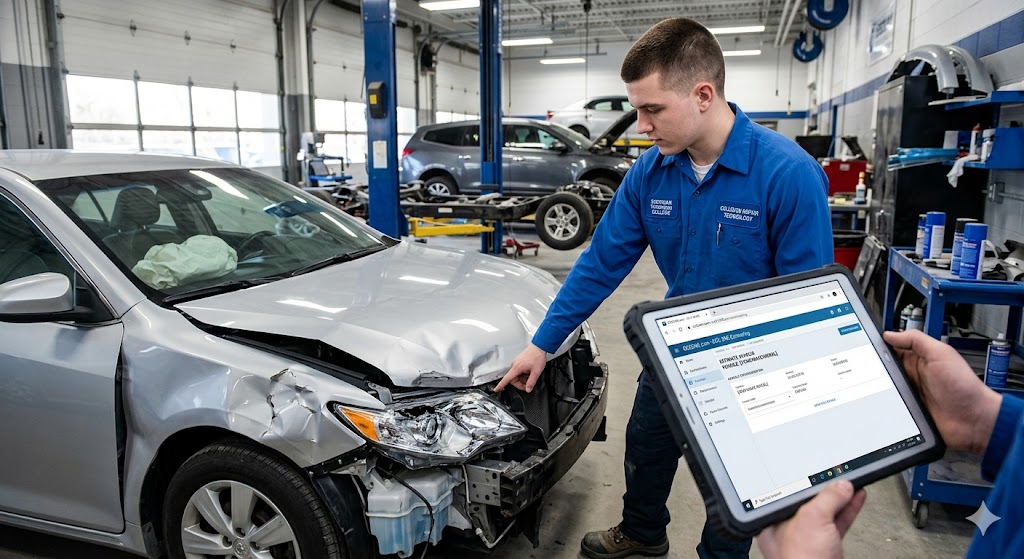
- Front impact: check radiator support, frame rails, suspension geometry, A-pillars at the cowl.
- Side impact: check rocker, B-pillar, opposite door for unibody twist, floor pan.
- Rear impact: check trunk floor, rear rails, fuel tank and system, rear suspension.
- Rollover: check roof rails, A-pillars, B-pillars, glass, suspension all corners.
Secondary damage is the most common missed item. A front impact strong enough to deform the radiator support almost certainly affected the upper tie bar and possibly the strut towers. If those aren't on the estimate, the estimate is incomplete and the test will reward you for naming the missing items.
3. Line Items
Each line item should have:
- Part name.
- OEM / Aftermarket / LKQ designation.
- Part number.
- Quantity.
- List price.
- Labor operation (R&R, R&I, repair, refinish).
- Labor hours.
Common errors to spot:
- Missing fasteners and clips. Many panels require new fasteners or clips that aren't in the standard labor allowance.
- Missing one-time-use parts. Headlight bolts, certain bumper retainers, airbag-related fasteners are often one-time-use per OEM. Reusing them is wrong and the test rewards catching it.
- Missing R&I operations. To get to a damaged radiator, you have to R&I the fan, the grille, possibly the bumper. If those aren't on the estimate, the labor allowance won't cover the actual work.
- Wrong labor operation. Billing R&R when the part is actually R&I (overbilling) or R&I when the part needs to be replaced (underbilling).
4. Sublet and Outside Operations
Items sent to outside specialists or billed with markup:
- Wheel alignment.
- ADAS calibration (radar, camera, lidar). Increasingly common.
- Glass replacement (if specialty).
- Frame straightening (if shop lacks equipment).
- Pre-scan and post-scan (most insurers now require both, billed separately per the P-Page).
The ASE B6 specifically tests ADAS pre and post scan procedures. Most modern vehicles require a scan before repair and a scan after to verify all modules are functioning and re-calibrate as needed. Skipping the post scan is a documented insurance and OEM violation.
5. Calculations Section
At the bottom of the estimate:
- Parts total.
- Labor total (often split by body labor, refinish labor, mechanical labor, each at a different shop rate).
- Sublet total.
- Sales tax (varies by state, often applied to parts and sublet but not labor).
- Total estimated cost.
- Customer's deductible.
- Insurance company's responsibility.
The ASE B6 has calculation questions where you'll be given line items and asked to compute the total. Practice these. Make sure you know:
- Labor hours × labor rate = labor cost.
- Refinish hours × refinish rate (often different from body labor rate).
- Tax applied only to specified line items per state law.
Damage Analysis Beyond the Software
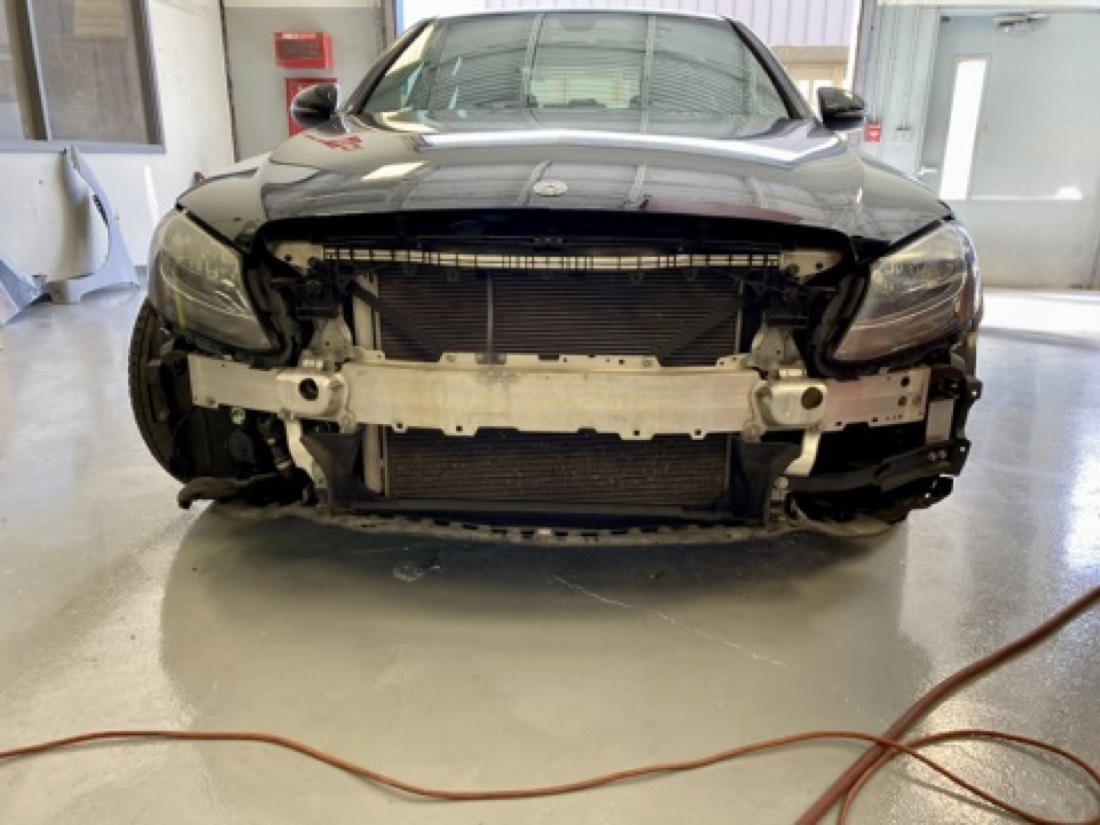
The ASE B6 doesn't just test estimating software entry. It tests damage analysis judgment.
Pre-Scan and Post-Scan
- Pre-scan. Performed before repair work. Identifies all stored DTCs (Diagnostic Trouble Codes), tells you what modules were affected by the collision, and creates documentation.
- Post-scan. Performed after repair. Verifies no remaining DTCs, confirms all systems functional, and creates closing documentation.
Most modern insurance contracts require both. The ASE B6 will ask scenarios about when each is performed and what they're used for. Default answer when in doubt: "scan before and after every repair."
Hidden Damage Recognition
Common hidden damage patterns the test rewards you for catching:
- Suspension geometry shifts. Front impacts often bend lower control arms or knuckles, even when the visible damage is "just bumper and grille."
- Frame rail kinks. Compressed rails after front impact, identified by 3D measuring against the OEM datum.
- HVAC condenser bends. Often missed. Only show up as poor AC performance after repair.
- Wiring harness damage. Pinches behind the bumper or under the radiator support.
- ADAS sensor misalignment. Even when the bracket looks fine, the sensor may have shifted on its mount and require calibration.
A complete estimate accounts for hidden damage allowance OR documents the need for a supplement after teardown. Either approach is defensible. Pretending there's no possible hidden damage is not.
Total Loss Calculations
- Actual Cash Value (ACV). What the vehicle was worth pre-loss.
- Total Loss Threshold (TLT). Typically 70 to 80% of ACV depending on state and insurance carrier.
- If estimated repair cost plus salvage exceeds threshold, vehicle is declared total loss.
The ASE B6 will give you scenarios. "Vehicle ACV is $12,000. Repair estimate is $9,500. The state threshold is 70%." That's $8,400. Repair exceeds threshold, recommend total loss. Be ready to do the arithmetic in your head.
Also know:
- Diminished value. The value the vehicle loses simply because it was in a collision, even after proper repair. Separate from repair cost.
- Salvage value. What the wrecked vehicle is worth as parts or scrap. Subtracts from the repair-vs-replace math.
Customer Relations: Don't Skip This Section
5 questions on customer relations seems small, but it's easy points if you take it seriously.
- Disclosure of part types. Customers must be told if aftermarket or LKQ parts are being used. Required by law in many states.
- Authorization requirements. Supplements require customer authorization before work proceeds.
- Repair timeline communication. Customers should be given a realistic timeline, including parts wait times and sublet operation scheduling.
- Vehicle safety inspection results. Customer must be informed if any safety-related items (brakes, tires, steering) were found beyond the collision damage.
- Diminished value disclosure. In some states, the customer must be informed about the potential for diminished value claims against the at-fault party's insurance.
The ASE B6 wants you to recognize that a damage estimate isn't just a number. It's a communication tool between shop, insurer, and customer.
Shop Habits vs. Test Answers on the ASE B6
The pattern across every content area: the ASE B6 rewards the answer your OEM service manual, your estimating-system P-Pages, and state law would give. Front-office shortcuts are the wrong answer almost every time.
| ❌ Shop Habit | ✅ Test-Correct Answer |
|---|---|
| "Skip the pre-repair scan, no warning lights are on." | Scan before and after every repair. Document both. |
| "Tear into the door first to find more damage." | Safety systems and fluid leaks first, then visual disassembly. |
| "Bury the alignment in the labor time." | Wheel alignment is a separately-itemized not-included operation per the P-Page. |
| "ADAS calibration? Just clear the codes and send it." | Static and/or dynamic ADAS calibration per OEM procedure, billed separately. |
| "Use aftermarket parts to keep the cost down." | State law / insurance guidelines / customer disclosure all matter, and structural and safety parts are typically OEM-required. |
| "Skip the post-repair scan." | Post-repair scan documents that no codes remain. Required by OEM and most insurers. |
| "Eyeball the rail, looks straight enough." | 3D measure against the OEM datum before declaring the rail in spec. |
| "Reuse the airbag-related fasteners." | One-time-use parts per OEM. Replace and itemize on the estimate. |
How to Study for the ASE B6
- Get familiar with at least one estimating software. CCC ONE, Mitchell, or Audatex. Most shops use one of these. Even if you're new, request shadowing time with the shop estimator.
- Practice calculations. Labor plus refinish plus tax problems. Drill them.
- Study common damage patterns by impact direction. Front, side, rear, rollover. Each has expected primary plus secondary damage.
- Memorize R&R vs R&I distinction. This is one of the most-tested concepts on the ASE B6.
- Memorize P-Page not-included operations. ADAS, alignment, headlamp aim, refinish, scans, sublet markup.
- Take a full ASE B6 practice simulation under timed conditions. Get used to scanning long estimate scenarios quickly.
A 30-Day ASE B6 Study Plan
Days 1 to 5: Take a full 60-question diagnostic on the simulator. Note your weakest categories.
Days 6 to 14: Drill Damage Analysis and Estimating in 50-question sets every other day. These two categories are 57% of the test.
Days 15 to 21: Build a P-Page flashcard deck. Front: operation name. Back: included or not-included plus the universal exceptions list. Run both directions until automatic.
Days 22 to 26: Three full 60-question timed simulations. Review every miss.
Days 27 to 29: Vehicle construction, parts categories, legal and environmental review. One session each.
Day 30: Light review. Sleep. Show up rested.
The Mindset That Passes the ASE B6
Reading an estimate as a pro means asking "what's NOT on this estimate that should be?" not just verifying the line items that ARE on it.
That's what the ASE B6 grades. Develop the habit of reading skeptically. Every estimate is incomplete until proven otherwise. Every line item is suspect until the P-Page confirms it. Every scan that's missing is a documentation gap. Every aftermarket part choice requires customer disclosure.
Pass the ASE B6 and you'll be a better estimator at work too. That's the real win.
Estimate Audit Checklist by Impact Direction
A common ASE B6 question pattern hands you a damage scenario and asks what's missing from the estimate. Memorize this checklist by impact type.
Front impact, moderate severity.
- Pre-scan and post-scan documented.
- Radiator support inspected and itemized.
- Upper tie bar and strut tower inspected.
- HVAC condenser inspected.
- Frame rails measured against OEM datum.
- Front suspension geometry (control arms, knuckles, tie rods) inspected.
- Headlamp aim listed as a separately-itemized operation.
- ADAS calibration listed if the vehicle has front-facing radar or camera.
Side impact, moderate severity.
- Pre-scan and post-scan documented.
- Rocker panel section per OEM-specified location.
- B-pillar inspected (typically not repairable, replacement at factory joint).
- Side curtain airbag inspection (one-shot deployment, replace if deployed).
- Floor pan inspected for buckling.
- Door alignment after structural repair.
- Opposite-side door gaps checked for unibody twist.
Rear impact, moderate severity.
- Pre-scan and post-scan documented.
- Trunk floor inspected.
- Rear frame rails measured.
- Fuel system inspected (filler neck, vent lines).
- Rear suspension components inspected.
- Rear ADAS sensors (parking sensors, blind spot radar) listed for recalibration.
- Exhaust hangers and alignment.
Rollover.
- Roof rails and pillars all inspected.
- All glass replaced (urethane bond compromised by roll forces).
- Headliner and interior trim removal and reinstall.
- Suspension geometry on all four corners.
- All ADAS sensors recalibrated.
When the ASE B6 asks "What is missing from this estimate?" run the impact-direction checklist mentally and find the gap.
Common Sublet Operation Mistakes
Sublet operations are where estimates leak money or get flagged by audits. The most common mistakes:
- Marking ADAS calibration as included instead of sublet. ADAS calibration is almost always separately billed, often sublet to a specialized provider. The P-Page is explicit.
- Skipping pre-scan and post-scan documentation. Most insurers require both for any DTC-eligible repair.
- Bundling alignment into body labor. Wheel alignment is a not-included operation when suspension components were disturbed.
- Forgetting headlamp aim. Required after almost any front-end repair that affected the headlamp position.
- Missing the sublet markup. Sublet operations are billed at the sublet cost plus a markup percentage per shop policy. Forgetting the markup is leaving money on the table.
The ASE B6 will test all of these patterns. If a question describes a tech billing alignment as included or skipping the post-scan, that tech is wrong.
Diminished Value: The Conversation Customers Need
Diminished value (DV) is the loss in market value a vehicle suffers simply because it was in a collision, even after proper repair. The ASE B6 tests your awareness of DV as a customer-relations topic and an estimating-system flag.
Three flavors of DV:
- Inherent DV. The default value loss from having a collision history on the vehicle's record.
- Repair-related DV. Additional value loss caused by repairs that fall short of factory standards or use non-OEM parts.
- Immediate DV. The temporary value loss while the vehicle is in process (rarely relevant to the customer's claim).
The customer's path to recover DV varies by state. In some states the at-fault party's insurer must pay DV; in others the customer's own policy may include it; in many it requires a separate claim. The ASE B6 expects you to know that DV exists, that the estimator should disclose its potential, and that it's a conversation to have early in the customer relationship rather than a surprise at handover.
Choose Your ASE B6 Access
One-time payment. No subscriptions and no recurring fees, ever.
- Prometric-style exam simulator
- 1000+ practice questions
- Digital flashcards
- Weakness drills
- Web or mobile access
- Everything in Simulator Access
- Full ASE Academy lesson course
- Step-by-step guided study path
- Hands-on labs and key-term training
The Simulator and the Simulator + ASE Academy bundle are both available now. All sales are final.

Discussion
Join the discussion — sign in to comment.
Comments are reserved for registered students and technicians. Your name will be pulled from your profile automatically.
Log In Register