
The Industry Has Already Decided. But Both Are on the Test.
For decades, solvent-borne paint systems were the standard in U.S. collision shops. Then VOC (Volatile Organic Compound) regulations tightened in California, the Northeast, and several other regions, and waterborne basecoats became required by law in those areas. The industry transition has been gradual but real, and the ASE B2 in 2026 tests both technologies.
If you trained on one and not the other, you're in the same position as most working painters. This article walks through both, the application differences, the booth requirements, the VOC regulatory landscape, the test content on each, and how to study them so you're ready regardless of which technology your shop uses.
What Waterborne Actually Means
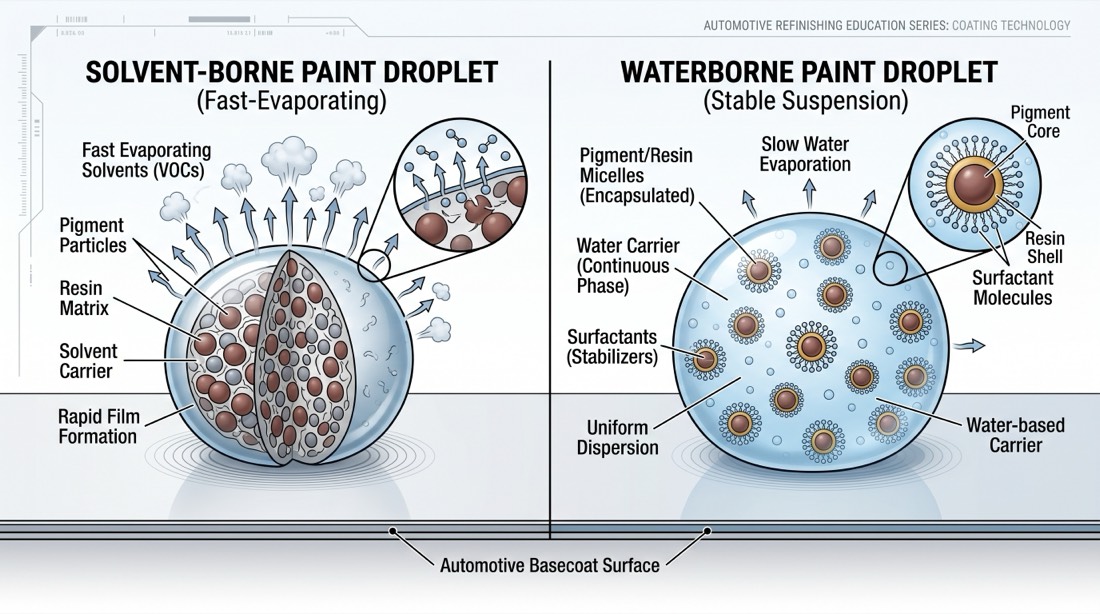
A common misconception: "waterborne" doesn't mean the paint is water. It means the carrier solvent has been partly or mostly replaced with water as the primary diluent.
A waterborne basecoat typically contains:
- Pigments (the color particles).
- Resins (the binders that hold pigments to the substrate after drying).
- A water-based carrier (the diluent that suspends the pigment and resin during application).
- Small amounts of co-solvents and additives.
A solvent-borne basecoat contains the same pigments and resins, but the carrier is an organic solvent (ketones, esters, hydrocarbons) instead of water.
Both systems eventually leave behind a solid color film on the panel. The difference is what evaporates during the drying stage.
Why the Industry Moved to Waterborne
VOC regulations. Specifically:
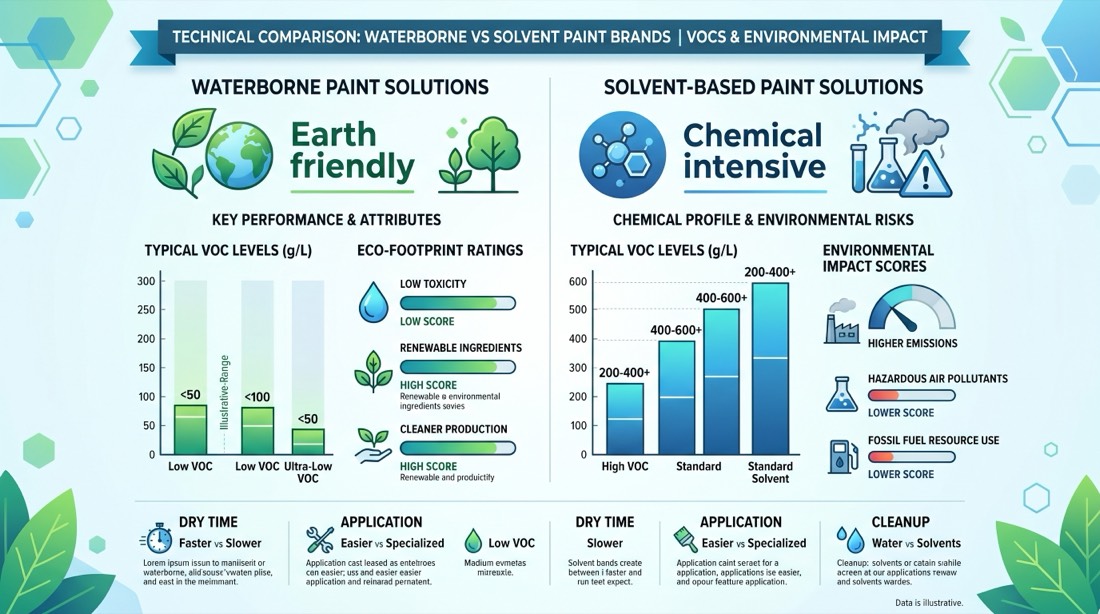
- California Air Resources Board (CARB) and many South Coast Air Quality Management District rules limit VOC emissions from automotive refinishing operations. Waterborne basecoats meet these limits; most legacy solvent-borne basecoats do not.
- EPA NESHAP Rule 6H sets federal VOC limits that, while less strict than California, still drive most modern systems toward waterborne basecoat.
- State-level rules in the Northeast (New York, New Jersey, Massachusetts, Connecticut, etc.) and parts of the Midwest mirror the California approach.
The compliance pathway: waterborne basecoat with a solvent-borne clearcoat. The basecoat side carries most of the VOC reduction because it's the highest-volume paint material applied per job. Clearcoat in many modern systems remains solvent-borne (low-VOC formulations exist but are still the minority of clearcoat market).
Application Differences
For painters trained on solvent who are transitioning to waterborne (or for ASE B2 candidates who need to know both), here are the key application differences.
Mixing and Pot Life
- Solvent: mix per TDS ratio, typically 4:1:1 or 2:1 with hardener and reducer. Pot life depends on the activator chemistry; commonly 2 to 4 hours at 70°F.
- Waterborne: mix per TDS ratio, often pre-thinned from the can but may require water addition. Pot life is typically longer than solvent because the water doesn't react with the resin the way solvent-borne hardener does.
Spray Gun Setup
- Solvent: typically 1.2 to 1.3 mm fluid tip for basecoat. Air pressure per gun manufacturer (typically 10 PSI at the cap for HVLP).
- Waterborne: typically 1.2 to 1.3 mm fluid tip (often slightly larger like 1.3 mm because of higher viscosity). Air pressure may run slightly higher than solvent. Specialized waterborne guns (some SATA, DeVilbiss, and Iwata models) are optimized for waterborne with specific air cap designs.
Application Technique
- Solvent: standard flash time between coats (typically 5 to 10 minutes depending on temperature and humidity). Visual cue: paint goes from glossy to matte as solvent evaporates.
- Waterborne: longer flash time required because water evaporates slower than solvent under standard booth conditions. Many shops use booth airflow assistance (booth blowers turned on between coats, or dedicated waterborne drying systems) to speed flash. Visual cue: paint goes from glossy/wet to a matte powdery appearance as water flashes out.
Booth Requirements
- Solvent: standard spray booth airflow handles solvent flash adequately.
- Waterborne: dedicated airflow during flash periods. Many shops install air movers (large booth-rated fans) or upgrade to booth packages designed for waterborne. The "blow-dry between coats" approach is the standard.
Recoat Window
- Solvent: typical recoat window of 30 minutes to several hours depending on basecoat formulation.
- Waterborne: similar recoat windows once flashed, but the flash itself takes longer.
Cleanup
- Solvent: clean gun and equipment with paint manufacturer's gun wash (typically a solvent-based product).
- Waterborne: clean gun with the paint manufacturer's waterborne cleaner (water-based product). Don't use solvent gun wash on a waterborne gun without flushing per the TDS, or the gun's residual solvent will contaminate the next waterborne job.
Finish Quality Comparison
Modern waterborne and modern solvent basecoats deliver comparable finish quality when applied correctly. The ASE B2 doesn't claim one is universally "better" than the other; it tests the procedure differences.
Where waterborne has an edge:
- Metallic orientation can be slightly more consistent because the slower flash allows more uniform flake settling.
- Color match on modern OEM colors developed for waterborne systems.
- Reduced overspray (some painters report slightly less booth haze).
Where solvent has an edge:
- Faster flash time in standard booths without airflow assistance.
- Familiar workflow for painters trained on solvent.
- Slightly more forgiving on application technique inconsistencies.
VOC Compliance Patterns on the ASE B2
The exam tests VOC compliance concepts directly. The patterns:
- Question identifies your region as VOC-restricted (California, Northeast). The correct procedure typically involves waterborne basecoat.
- Question identifies your shop as using waterborne basecoat. Specific waterborne application requirements (longer flash, airflow assistance, specialized gun cleaner) apply.
- Question describes a tech mixing solvent into a waterborne basecoat to "thin" it. Wrong. Waterborne is thinned with water per the TDS only.
- Question asks about VOC reporting requirements. Shops in regulated regions must track and report VOC emissions per state or federal rules.
How to Study Both Systems
If your shop uses solvent and you're studying for the ASE B2, learn the waterborne concepts from manufacturer training resources or this article. The test will ask waterborne questions regardless of which technology you use day-to-day.
If your shop uses waterborne, learn the solvent concepts because the test will ask both.
The core memorization:
| Solvent-Borne Basecoat | Waterborne Basecoat |
|---|---|
| Carrier: organic solvent. | Carrier: water with co-solvents. |
| Flash: 5 to 10 minutes typical. | Flash: longer, often booth airflow assisted. |
| Standard booth airflow adequate. | Air movers or specialized booth for flash. |
| Higher VOC emissions. | Lower VOC emissions. Regulatory compliant. |
| Standard gun cleanup with solvent gun wash. | Water-based gun cleaner. |
| Required by neither regulation nor preference; legacy default. | Required by California and many Northeast state regulations. |
| Comparable finish quality when applied correctly. | Comparable finish quality when applied correctly. |
Shop Habits vs Test Answers
The pattern across waterborne vs solvent questions: the test rewards manufacturer-TDS procedure recall, not shop tradition.
| ❌ Shop Habit | ✅ Test-Correct Answer |
|---|---|
| "Same flash time as solvent." | Waterborne requires longer flash, often with airflow assistance. |
| "Add reducer to thin waterborne." | Waterborne is thinned with water per the TDS, not solvent reducer. |
| "Clean the gun with the same gun wash." | Use waterborne-specific gun cleaner. Solvent gun wash contaminates. |
| "Just use solvent here, no one's checking VOC." | If you're in a regulated region, waterborne is required. Compliance is non-negotiable. |
| "Waterborne doesn't apply to my shop." | Both technologies are tested on the ASE B2 regardless of your shop's system. |
| "Flash dries faster if I turn up the booth temperature." | Booth airflow is more effective than temperature for waterborne flash. |
A 14-Day Plan to Master Both Systems
If you have 2 weeks to study and want to cover both technologies adequately:
Days 1-3: Read the manufacturer TDS for the system your shop currently uses. Memorize mix ratios, flash times, recoat windows.
Days 4-7: Read the manufacturer TDS or training materials for the system your shop does NOT currently use. Memorize the same parameters.
Days 8-10: Drill 30-question simulator sets on the Paint Mixing, Matching, and Applying category. Focus on questions that mention waterborne or solvent specifically.
Days 11-12: Take a full 65-question ASE B2 simulator under timed conditions. Review every miss.
Days 13-14: Final flashcard review and a second simulator if your score is below 85%.
VOC Regulatory Reality Check
For painters who haven't engaged with VOC compliance directly:
- CARB regulations apply throughout California for automotive refinishing.
- State-level VOC rules apply in most of the Northeast (NY, NJ, CT, MA, RI, NH, ME, VT, MD, DE, PA), parts of the Midwest (IL, MI, OH, WI), and some Western states (OR, WA, CO).
- Outside regulated regions, solvent basecoat is still legal but increasingly less common as OEMs and paint manufacturers prioritize waterborne in their refresh cycles.
- Federal EPA NESHAP 6H sets baseline VOC limits that apply nationally to automotive refinishing operations of certain size thresholds.
The trajectory across the industry is clear: waterborne basecoat is the default direction. The ASE B2 reflects this, with waterborne content increasing in recent test revisions.
The Clearcoat Side
For completeness: clearcoat in 2026 is still predominantly solvent-borne. Most U.S. shops shoot solvent clear over either solvent or waterborne basecoat. Low-VOC clear formulations exist but are not yet the market default.
The ASE B2 reflects this. Most clearcoat questions assume solvent clearcoat regardless of whether the basecoat was solvent or waterborne.
If your shop has transitioned to waterborne clearcoat, study the manufacturer TDS specifically; the application differences vs solvent clear are similar to the basecoat differences (longer flash, dedicated cleanup, specific gun setup).
Where to Start This Week
The ASE B2 doesn't favor one technology over the other. It tests both. The painter who passes the test understands the procedure for whichever system the question describes.
Build a flashcard deck of the parameter differences (mix, flash, cleanup, booth requirement, VOC compliance). Drill the Paint Mixing, Matching, and Applying category on the simulator. By test day, you should be able to read a question identifying solvent or waterborne and immediately know the procedure-correct answer.
The waterborne vs solvent debate is over in regulated regions. The ASE B2 has caught up. Make sure your study has too.
Common Misconceptions Worth Correcting
A few patterns I see in painters new to either system that the ASE B2 tests for.
Misconception 1: "Waterborne paint can be cleaned up with water."
Partially true and dangerous to assume. Waterborne basecoat thinned with water can be wiped with water immediately after spraying, but once flashed, the resin film is no longer water-soluble. Cleanup of the gun and equipment requires the manufacturer's waterborne-specific cleaner (which is water-based but formulated with additives that prevent the residual paint from drying inside the gun).
Misconception 2: "Solvent gun wash works on waterborne guns if I flush thoroughly."
In practice, residual solvent in the gun contaminates waterborne basecoat applied next. Manufacturers and the ASE B2 specify dedicated cleaning products for each system.
Misconception 3: "Waterborne and solvent are interchangeable as long as the color matches."
Wrong on multiple levels. Mixing the two systems on a single panel causes adhesion failures and color match problems. The ASE B2 tests this distinction directly.
Misconception 4: "Waterborne is always lower quality than solvent."
Modern waterborne basecoats deliver finish quality comparable to or better than solvent in many applications. The OEM color development pipeline has shifted heavily toward waterborne, and the original color formulations are often waterborne-native.
How Booth Design Affects Each System
Some booths are easier to convert from solvent to waterborne than others. The ASE B2 may test booth concepts indirectly through application-condition questions.
Downdraft booths are the easiest to optimize for waterborne. Air movers or booth airflow boost during flash periods works naturally with the downward air movement.
Semi-downdraft and crossdraft booths may require more specialized accessories (booth-rated fans, dedicated waterborne dryer attachments) to achieve consistent waterborne flash.
Bake cycle considerations. Waterborne basecoat doesn't typically require a different bake schedule than solvent (the clearcoat over waterborne usually drives the bake), but during the basecoat flash itself, the booth airflow matters more for waterborne than for solvent.
Paint Manufacturer System Compatibility
A reminder that's worth repeating because it shows up on the test.
Within a paint manufacturer's product line, the system components are designed to work together. Sealer from one system is engineered to bond to basecoat from the same system. Clear from one system is engineered to chemically interface with the basecoat from that system.
Mixing components across manufacturers (basecoat from one brand, clear from another) is wrong on the ASE B2 every time. The test answer is always "use products from the same paint manufacturer's system per the manufacturer's recommendations."
This applies to both waterborne and solvent. The same logic that says "don't put solvent reducer in waterborne basecoat" also says "don't put a different brand's clear over this brand's basecoat."
Where the Industry Is Heading Next
For perspective: the trajectory beyond the current solvent-vs-waterborne split.
- VOC regulations continue to tighten. More states adopt California-style rules each year. The waterborne basecoat market share continues to grow.
- Low-VOC clearcoats are slowly gaining market share. Most are still solvent but with reduced VOC content. Eventually waterborne clearcoat may become the standard.
- UV-cure systems are emerging in specialty applications. The ASE B2 has begun including UV-cure clearcoat content in recent test cycles.
- Custom and specialty finishes (matte clears, ceramic clears, multi-stage candies) increasingly drive premium pricing in shops that offer them.
The ASE B2 will continue updating to reflect industry direction. A painter who passes today still needs to maintain through Renewal App quizzes to stay current with future cycle updates.
The Bottom Line
For the ASE B2 specifically:
- Know waterborne and solvent procedures both.
- Memorize the key parameter differences (flash, airflow, cleanup, regulatory).
- Don't confuse cleanup products between systems.
- Treat manufacturer TDS as the authoritative reference.
- Follow VOC compliance rules in regulated regions.
A painter who studies both systems passes the ASE B2 regardless of which one their shop uses. The painter who only knows one is rolling the dice on which system shows up most on their particular exam form.
A Day-in-the-Life Comparison
To make the systems concrete: here's how a typical color repair plays out under each system.
Solvent basecoat workflow on a single-panel repair:
- Prep is complete; sealer is flashed.
- Mix solvent basecoat per TDS ratio. Pot life starts.
- Apply first basecoat. 5 to 8 minute flash at 70°F. Visual cue: paint goes matte.
- Apply second basecoat. 5 to 8 minute flash. Matte again.
- Apply control coat if metallic. 5 minute flash.
- Switch to clearcoat. Apply clear.
Waterborne basecoat workflow on the same repair:
- Prep is complete; sealer is flashed.
- Mix waterborne basecoat per TDS ratio. Pot life starts (typically longer than solvent).
- Apply first basecoat. Activate booth air movers. 10 to 15 minute flash at 70°F. Visual cue: paint goes from glossy to a powdery matte.
- Apply second basecoat. Air movers again. 10 to 15 minute flash.
- Apply control coat if metallic. Flash with air movers.
- Verify flash by tape test or moisture meter per the manufacturer's TDS.
- Switch to clearcoat (typically still solvent-borne). Apply clear.
The total time per panel can be slightly longer with waterborne because of the longer flash. The booth airflow assistance closes much of the gap.
Why the Industry Will Probably Standardize on Waterborne
Looking 5 to 10 years ahead, the conditions favor waterborne becoming the de facto standard nationally, not just in regulated regions:
- VOC regulations continue to expand to additional states.
- Insurance carriers increasingly audit DRP shops for environmental compliance.
- OEM color development pipelines have shifted to waterborne-native formulations, meaning new colors come out for waterborne first and solvent matches lag.
- Paint manufacturer support and product development priority is on waterborne lines.
- New painter training programs (including most trade school curricula) are moving toward waterborne as the primary system.
For working painters who haven't transitioned yet, the longer the gap before transition, the steeper the learning curve becomes when the shop eventually switches. Building waterborne familiarity now (through TDS study, ASE B2 prep, manufacturer training) reduces the disruption when the change comes.
For ASE B2 candidates, this means waterborne content in the test will continue to grow in future test cycles. Studying both systems now positions you for current and future tests.
Painter Skill Transfers Between Systems
Some good news for painters worried about the transition: most application skill transfers cleanly between solvent and waterborne. Distance, overlap, travel speed, panel reading, color matching judgment, and metallic orientation all work the same way on both systems.
What changes:
- The visual cues during flash (waterborne goes powdery; solvent goes matte).
- The flash time required between coats.
- The booth airflow management.
- The cleanup procedure.
Everything else (the actual spraying motion and technique) is the same. A senior painter on solvent typically becomes proficient on waterborne within 5 to 10 jobs of focused practice. The skill isn't reset; it's transferred with adjustments.
The ASE B2 may test specific procedure differences (cleanup, flash times) but the core spraying technique questions apply equally to both systems.
The Comparison Summary
Solvent and waterborne basecoats differ in chemistry and procedure but produce comparable finish quality when applied correctly. Regulated regions require waterborne; unregulated regions still allow solvent. Both technologies are tested on the ASE B2. The painter who studies both passes regardless of which system shows up most.
Build the parameter flashcards. Drill the simulator. Run a TDS for each system. By test day you'll be confident on both, and your career will be ready for whichever system the next shop you work in uses.
Choose Your ASE B2 Access
One-time payment. No subscriptions and no recurring fees, ever.
- Prometric-style exam simulator
- 1000+ practice questions
- Digital flashcards
- Weakness drills
- Web or mobile access
- Everything in Simulator Access
- Full ASE Academy lesson course
- Step-by-step guided study path
- Hands-on labs and key-term training
The Simulator and the Simulator + ASE Academy bundle are both available now. All sales are final.


Discussion
Join the discussion — sign in to comment.
Comments are reserved for registered students and technicians. Your name will be pulled from your profile automatically.
Log In Register