Don't Let Metallic Mottling Kill Your ASE B2 Score
Listen up. You can be the best painter in the shop, but the ASE B2 Painting & Refinishing exam doesn't care about your "feel" for the gun or how many custom flakes you've laid down. It cares about the science and the standard.
If you've ever pulled a car out of the booth only to see "tiger stripes" or mottling in a high-metallic silver, you know the frustration. In the shop, you might just "dust" a control coat and move on. On the ASE B2 exam, they want to know why it happened and the exact technical procedure to prevent it.
This guide walks you through every content area on the ASE B2, the trap-question patterns ASE loves, and a 30-day study plan that actually puts a certificate on your wall.
What the ASE B2 Exam Actually Looks Like
Before you study a single flash time, you need to know what you're walking into:
- 65 questions total, 55 of which are scored. The other 10 are unscored research questions, and you can't tell them apart from the real ones, so answer every question
- 90 minutes on the clock, about 83 seconds per question
- Passing score: roughly 70% (ASE doesn't publish the exact number, the cutoff floats based on question difficulty)
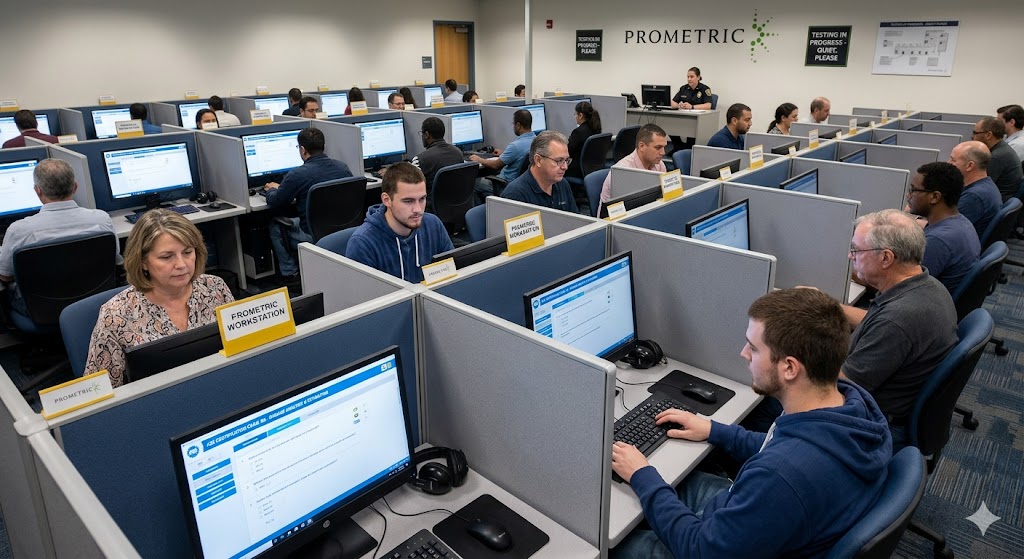
- Delivered at Prometric testing centers on a locked-down computer. No phone, no notes, no scratch paper unless they hand it to you
- Four answer choices per question, single best answer. No "select all that apply"
- Results are immediate, you'll see PASS or FAIL the moment you click Finish
That 83-seconds-per-question math is important. You don't have time to deliberate. If you have to think about whether a 1.3 mm fluid tip is for base or clear, you've already lost. The questions you know cold are how you bank the time you'll need on the tough ones.
The Six Content Areas (And Where the Test Actually Lives)
ASE breaks the ASE B2 into six official content areas. These are the published 2026 test specifications, and the question counts are out of the 55 scored questions. Memorize this, it tells you exactly where to spend your study hours:
| Content Area | Questions | % of Test |
|---|---|---|
| A. Surface Preparation | 15 | 27% |
| B. Spray Gun Operation and Related Equipment | 6 | 11% |
| C. Paint Mixing, Matching, and Applying | 15 | 27% |
| D. Solving Paint Application Problems | 8 | 15% |
| E. Finish Defects, Causes, and Cures | 6 | 11% |
| F. Safety Precautions | 5 | 9% |
| Total | 55 | 100% |
Notice that Surface Preparation and Paint Mixing are tied as the two heaviest areas at 27% each, and together they are 54% of the test. Show up green on prep and you're cooked before you ever load a gun. Add Solving Paint Application Problems and those three areas are 69% of your score.
Content Area 1: Surface Preparation (15 questions)
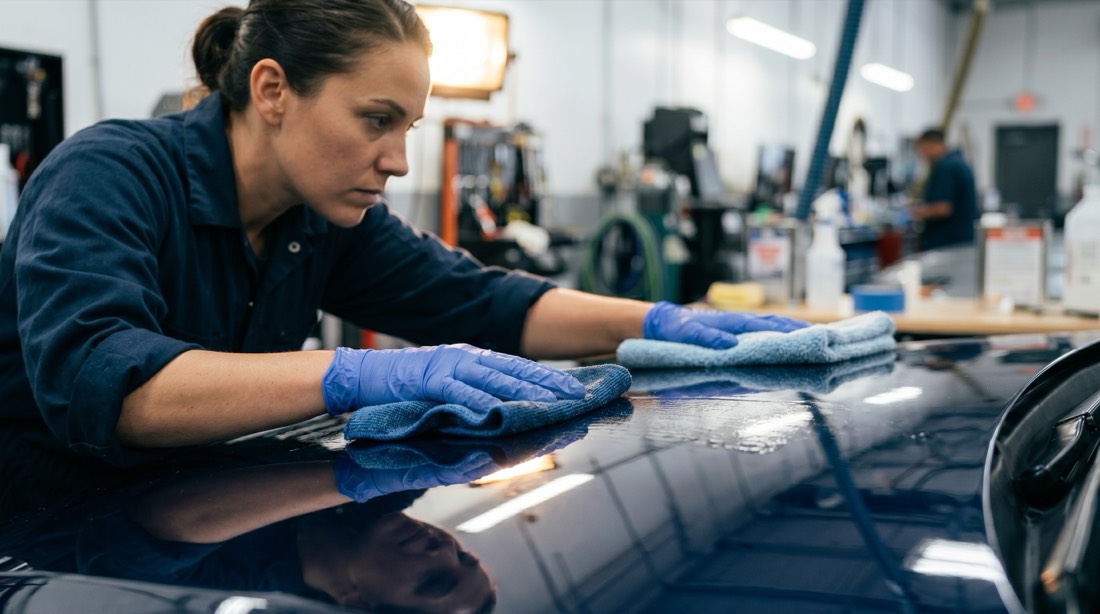
This is where painters who "skipped school but learned on the floor" lose the most ground. Prep questions test whether you know why a step exists, not just that it exists.
What you need to own cold:
- Substrate identification. Steel vs. aluminum vs. galvanized vs. SMC vs. fiberglass vs. plastic (rigid vs. flexible). Each one demands a different adhesion promoter and abrasive grit. Aluminum requires a self-etching primer or DTM epoxy, never an acid etch that will eat the soft metal.
- Sanding grits by stage. Bare metal feather edge: 80 grit. Body filler shaping: 80 → 180. Primer-surfacer block: 180 → 320. Pre-sealer scuff: 400-600. Pre-clear blend area: 800-1000 wet or with a gray scuff pad. Trap to watch: ASE expects 320 (sometimes 400) before sealer for solvent-based systems, not 600. 600 is a base-only or blend grit.
- Cleaning sequence. Wash with soap and water before you sand. Wax-and-grease remover after sanding. Tack cloth right before paint. Reverse that order and you grind silicones into the substrate and detonate the job with fisheyes.
- Featheredging. A proper feather edge is roughly 1/2 inch per coat layer (paint, primer, e-coat, metal). You're trying to taper through every layer so the new coat has something to bite without a visible edge.
- Plastic prep. Always identify the polymer (ISO symbol on the back), flame-treat or use an adhesion promoter on polyolefins (PP, TPO, PE). Flexible parts need a flex additive in the clear or the finish will crack the first time the bumper takes a hit.
The ASE trap here: they will describe a fast-and-dirty shop habit and tempt you to pick it. "The painter sands with 220, then sprays sealer." Wrong. The textbook answer is to refine that 220 scratch with 320 before sealer or you'll see scratch read-through within a week.
Content Area 2: Spray Gun Operation and Related Equipment (6 questions)
Only 6 questions, but they're easy points if you know your equipment.
- HVLP vs. RP vs. conventional. HVLP runs 10 psi or less at the cap, required by air-quality regulations in most states. RP (Reduced Pressure) runs slightly higher cap pressure with better transfer efficiency for clearcoat. Conventional is legacy, not the answer on a modern test unless the question specifically asks about an older shop.
- Fluid tip sizing. Base: 1.2-1.3 mm. Clear: 1.3-1.4 mm. Primer-surfacer: 1.6-1.8 mm. Single-stage: 1.4-1.5 mm. If you see 1.8 paired with base, that's the wrong answer.
- Gun distance, angle, overlap. 6-8 inches perpendicular to the panel, 50% overlap for solid colors, 75% overlap for metallics (this is the answer to the mottling question every single time). Travel speed should keep a wet edge without running, typically about 1 foot per second.
- Air supply. Clean, dry air. Coalescing filter at the booth, desiccant dryer for humid days. Water in the line is the #1 cause of fisheyes that aren't silicone-related.
- Gun cleaning. Solvent through the gun, brush the air cap, never soak the gaskets in lacquer thinner, modern guns use solvent-resistant seals, but extended soaking still kills them. ASE will offer "soak overnight in lacquer thinner" as a tempting answer. Don't bite.
Content Area 3: Paint Mixing, Matching, and Applying (15 questions)
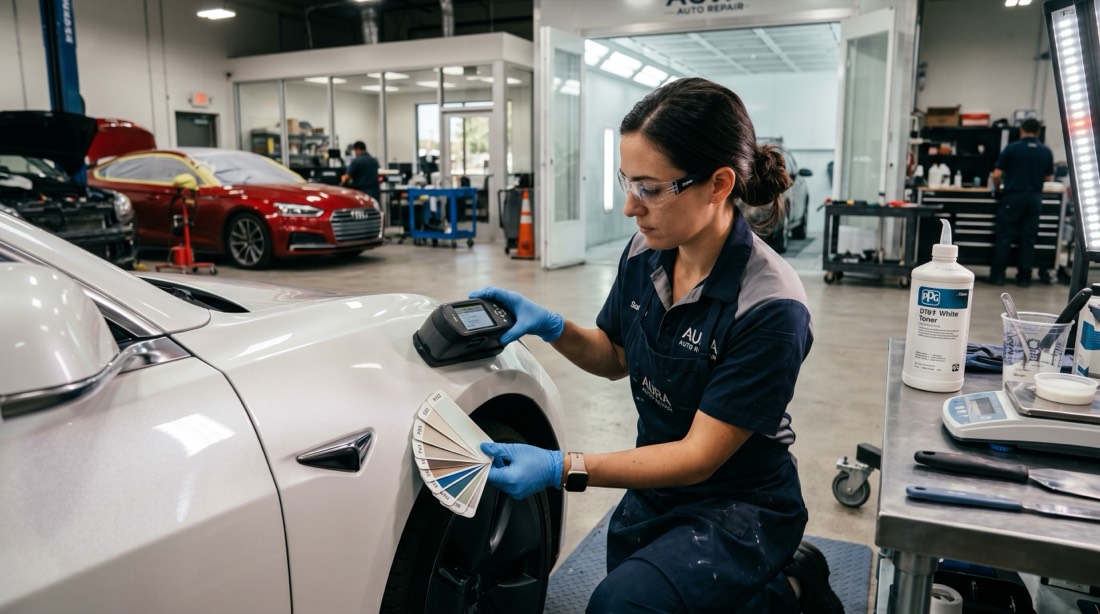
This is where the conversation from the top of this article lives, metallic orientation, flash times, and the variables that decide whether a panel looks like a mirror or a striped sock.
Mixing fundamentals:
- Mix ratios are not suggestions. A 4:1:1 basecoat means 4 parts color, 1 part reducer, 1 part hardener (or activator depending on the system). Eyeballing a "splash more reducer" answer is shop habit, not test-correct. The test wants the published TDS ratio.
- Pot life. Once activator hits the mix, the clock starts. Most modern clears run 2-4 hours of pot life at 70°F. Hotter booth = shorter pot life. If a question describes a clear that "got cloudy in the cup after 90 minutes in a 90° booth," that's pot life exhaustion, not contamination.
- Reducer selection by temperature. Fast reducer for cold booths (under 65°F), medium for normal (65-80°F), slow for hot (80°F+). Use a slow reducer on a 60° day and the paint never flashes, solvent pop and sags everywhere. Use a fast reducer on a 95° day and you get dry spray, mottling, and orange peel.
- Viscosity. Measured with a Zahn or Ford cup, in seconds. Specific to the product, you can't memorize a universal number. The exam may show you a TDS excerpt with a viscosity spec; your job is to recognize that "if it's measured in seconds with a cup, it's viscosity."
Color matching:
- Three dimensions of color: hue, value (lightness), and chroma (saturation). A color that's "too dark" needs more reducer or more distance to lighten the metallic. "Too light" needs less reducer or closer distance.
- Letdown panels and test sprout cards. Before you commit to the customer's car, you spray a test card with the exact gun settings and reducer you'll use on the job. Skip this step and you're betting the whole repair on a guess.
- Blending vs. full panel. If a question mentions a 3-stage pearl or a high-mica candy color, blending into the adjacent panel is almost always the right answer over a hard edge at the seam.
Application, the mottling question you came here for:
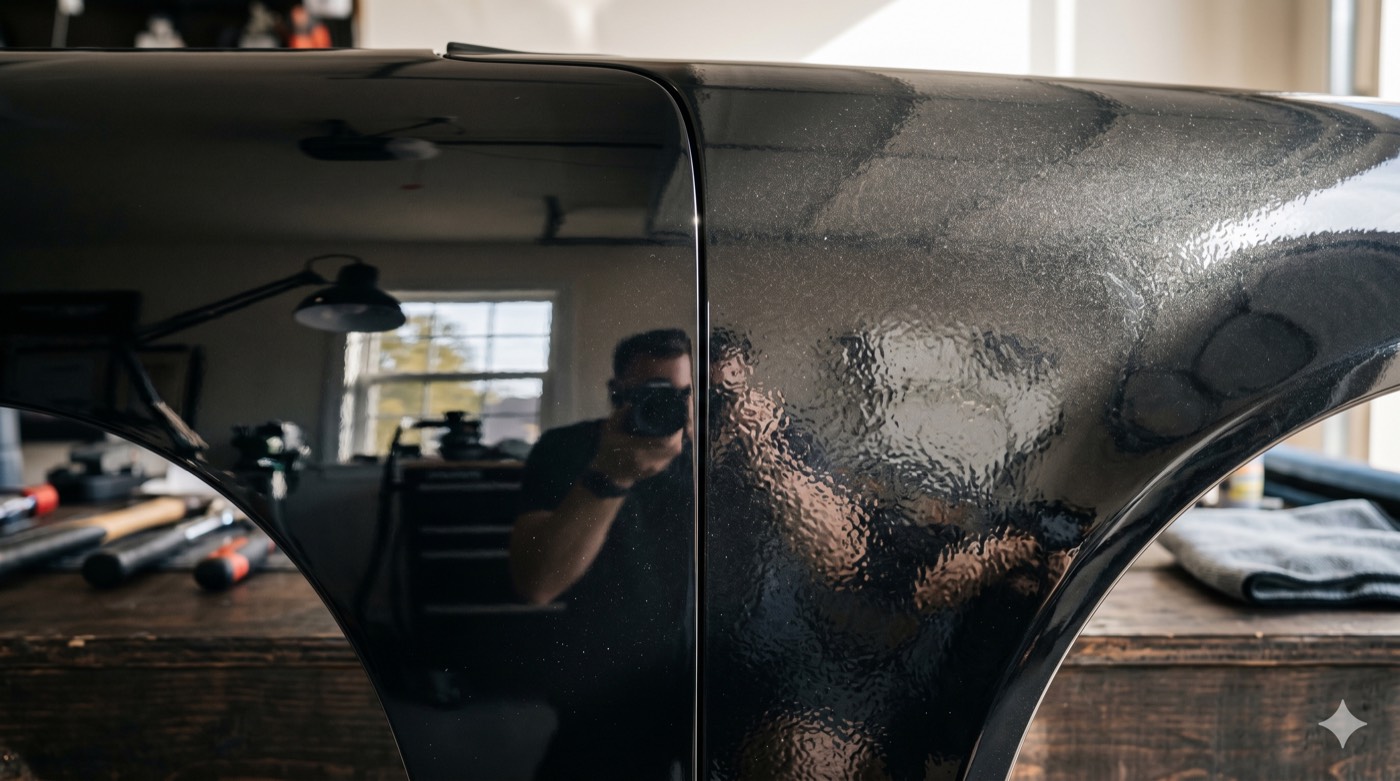
Mottling, that cloudy, uneven distribution of metallic flakes, is usually a failure of solvent evaporation and spray technique. When the basecoat stays "wet" too long, the metallic flakes have time to swim around and bunch up instead of laying flat and uniform.
To keep your metallics consistent, you have to master the variables:
- Flash times. This is where most guys fail. If you rush the second coat before the first has fully flashed, you're inviting the solvents to trap those flakes in a cluster.
- Spray pattern overlap. We all know the 50% rule, but for high-metallic finishes, the ASE standard leans toward a 75% overlap to ensure even distribution.
- Air pressure & distance. High heat or low humidity can cause the solvent to "flash" in the air, leading to dry spray, which is just as bad as mottling. You need the right reducer for the booth temperature, period.
- Control coat / mist coat. A light, even closing coat sprayed at slightly higher distance can orient the flakes uniformly. ASE recognizes this technique, it just wants you to know that the root cause still needs to be diagnosed (wrong reducer, wrong overlap, wrong distance) rather than masked.
Content Area 4: Solving Paint Application Problems (8 questions)
These questions describe a problem in a sentence or two and ask you to identify the cause. Train your brain to match symptom → root cause → corrective action.
The top patterns ASE loves:
- Runs and sags. Cause: too much material at once, too close, too slow travel, reducer too slow for booth temp. Fix: identify which variable, correct it on the next panel. Test won't usually ask "how to sand out a run", it'll ask "what caused the run."
- Dry spray / overspray on the panel. Cause: gun too far, pressure too high, reducer too fast, ambient temp too high. The cluster of symptoms is your tell, overspray with poor flow + grainy texture = dry spray, not just bad transfer.
- Orange peel. Cause: insufficient atomization (low air pressure, fluid tip too large, viscosity too high) or insufficient flow-out (reducer too fast, booth too cold). The fix is one variable at a time, bump pressure 5 psi, retest.
- Fisheyes. Cause: silicone contamination (tire dressing, hand lotion, even some shop sealants). Fix: clean substrate with the manufacturer's recommended wax/grease remover. ASE will offer "add fisheye eliminator to the clearcoat" as bait, that's a band-aid, not a fix.
- Solvent pop. Cause: trapped solvent boiled out of the film during force-dry or recoat-too-soon. Fix: longer flash, slower reducer, lower booth temp during application.
The diagnostic shortcut: every application problem comes back to one of four variables, air, paint, gun, painter. If you can name which variable is off, you can pick the right answer.
Content Area 5: Finish Defects, Causes, and Cures (6 questions)
Defect questions are the second-half cousin of application problems, they cover failures that show up after the paint is dry.
- Die-back (loss of gloss over time). Cause: solvent trapped in the film, insufficient final flash before stacking, force-dry too soon. Cure: full repaint, longer flash.
- Solvent pop (cratering). Same root as application solvent pop, but if the panel is already dry, you're sanding it flat and respraying.
- Cracking / checking. Cause: film too thick, too many coats, incompatible products, flexible part without flex additive. Cure: strip and respray with proper film build.
- Wrinkling / lifting. Cause: solvent in the new coat attacks the old finish. Almost always a recoat over an unsealed enamel or a single-stage that wasn't fully cured. Cure: seal it first next time.
- Adhesion failure / delamination. Cause: contaminated substrate, wrong primer, missed scuff sand, no adhesion promoter on plastic. Cure: strip back to a sound substrate and start over.
- Blushing (milky finish on humid days). Cause: moisture trapped in lacquer-type finishes. Cure: slow reducer / retarder, lower humidity.
- Bleeding (stain through new color). Cause: old red, dark, or solvent-sensitive substrate bleeding pigment through new color. Cure: seal with a bleed-blocking primer/sealer.
Memorize this pairing. For every defect, ASE wants you to give back the cause and the cure. Flashcards on this section pay off harder than any other study tool.
Content Area 6: Safety Precautions (5 questions)
The "easy" section if you take it seriously and the disaster section if you don't.
- Respirators. Supplied-air respirator (SAR) is the OSHA-required PPE when spraying any isocyanate-containing material (most modern clears, hardeners, and 2K primers). A half-mask cartridge respirator is not sufficient for iso work, this is a guaranteed ASE B2 question.
- Booth airflow. Downdraft, semi-downdraft, crossdraft. Downdraft pulls overspray down through the floor grates and is the cleanest setup for color match. Understand the airflow type of the booth you're being asked about, it affects flash time and defect risk.
- Hazardous waste. Used solvent, paint sludge, contaminated rags = hazardous waste, manifested and disposed of by a licensed hauler. Never down the drain. Never in regular trash.
- SDS (Safety Data Sheet), formerly MSDS. 16 sections, OSHA-mandated, kept accessible in the shop. The ASE B2 may ask which section covers first-aid, exposure limits, or PPE.
- Fire safety. Paint solvents are flammable; storage requires a UL-listed flammable cabinet, grounded containers, and no ignition sources. A spray booth is a Class I, Division 1 location.
This section is high-leverage because it's mostly memorization. Eight questions you can get right with one focused study session.
The "ASE Trap": Shop Habits vs. Test Answers
Here's where they try to catch you: in a real shop, if you see mottling, you might just crank up the pressure and mist a coat from 12 inches away. Don't pick that answer on the test.
The ASE exam looks for the textbook-proper correction. For mottling, they want you to identify that inconsistent spray gun distance or improper flash time was the root cause. If a question asks how to adjust for a metallic that's appearing too dark, the "test-correct" answer is often increasing the air pressure or distance slightly to allow the flakes to stand up (lighten). In the shop, we just call it "tuning." On the ASE B2, it's about understanding fluid dynamics.
A few more shop-vs-test pairings to internalize:
| ❌ Shop Habit | ✅ Test-Correct Answer |
|---|---|
| "Sand it with 220 and shoot sealer." | Refine the scratch to 320 before sealer. |
| "Add a splash of fisheye eliminator." | Identify and remove the silicone source, clean with the proper wax-and-grease remover. |
| "Force-dry hot to get it out the door." | Allow full flash and recommended cure to prevent die-back and solvent pop. |
| "Eyeball the mix." | Mix to the published TDS ratio with a measuring stick or scale. |
| "Half-mask is fine for one panel." | Supplied-air respirator for any isocyanate-containing material, no exceptions. |
The pattern is always the same: ASE rewards the answer your TDS, your training program, and OSHA would give. Shop shortcuts are the wrong answer almost every single time.
A 30-Day ASE B2 Study Plan That Actually Works
Most guys "study" by reading the same page twice and calling it a day. Here's the schedule that puts the certificate on your wall:
Days 1-5: Map the territory. Take a 65-question diagnostic on every content area, even the ones you think you've got. Note your weakest area by percentage. That's where you'll spend the most hours.
Days 6-15: Drill the heavy hitters. Surface Preparation and Paint Mixing are tied at 27% each, which is 54% of the test between them, and adding Solving Paint Application Problems brings the total to 69%. Pound through 50-question drills on each, every other day, until your accuracy on all three is above 85%.
Days 16-22: Defects & cures flashcards. Make a deck (or use our Key Terms tool) where the front is the defect name and the back is cause + cure. Run the full deck both directions until you can name every pairing in under 5 seconds.
Days 23-26: Mixed-mode mastery. Take three full 65-question simulated exams under timed conditions. No looking up answers mid-test. Review every miss the next day.
Days 27-29: Safety & equipment. Block out one full study session on Safety Precautions and one on Spray Gun Operation. These are the easiest 11 questions on the whole exam, don't leave them on the table.
Day 30: Light review + rest. Skim your flashcards, get sleep, eat breakfast. The painter who shows up rested beats the painter who crammed all night every single time.
Day-of-Exam Tactics
You earned the prep. Don't blow it at Prometric with bad test-taking:
- Arrive 30 minutes early. Late = automatic forfeit. Bring your ASE registration confirmation and a photo ID.
- Pace yourself. 83 seconds per question. If you're past 90 seconds on one, flag it and move on. Come back at the end.
- Use the elimination method. Two wrong answers are usually obvious. Of the remaining two, pick the one that matches the TDS / textbook, not the shop shortcut.
- Watch for "EXCEPT" and "LEAST LIKELY" wording. ASE flips the question on you. "All of the following cause orange peel EXCEPT..." If you skim, you'll pick a correct cause and get the question wrong.
- Don't second-guess. Your first instinct is usually right if you studied. Change an answer only if you have a concrete reason, usually because a later question reminded you of a fact you'd forgotten.
This Is What You're Working Toward
ASE Certified
Collision Technician
The ASE Collision Technician patch, recognized by every shop owner who values certified skill. The ASE B2 Painting and Refinishing exam is one of the milestones on the way there.
ASE®, the ASE logo, and "ASE Certified" are registered trademarks of the National Institute for Automotive Service Excellence. asecollisiontestprep.com is not affiliated with, endorsed by, or sponsored by ASE.
Stop Guessing. Start Passing.
You don't have time to fail this test and wait six months to retake it. You're a professional; you need that certification to bump your flat rate or move into a lead painter role.
At asecollisiontestprep.com, we've stripped away the fluff. We don't give you 500-page manuals; we give you the dirt you need to pass.
- Unlimited practice attempts. Drill the ASE B2 questions until you can spot the trap answers in your sleep.
- Study anywhere. Our interface is 100% mobile-friendly. Hammer out a 10-question quiz while you're waiting for the clearcoat to flash or sitting at lunch.
- Transparent pricing. No subscriptions. No "gotcha" renewals. $99 for 30 days of full ASE B2 access, long enough to prep and pass.
- Real ASE-style questions across all six content areas, with the trap-answer patterns built right in so you learn to spot them before test day.
- Key terms flashcards, certification-style 65-question exams, and a Prometric-style simulator so the real test feels like a Tuesday.
PRO-TIP: Don't pick the shop-habit answer on the test. The ASE exam looks for the textbook-proper correction, not what you do to save time in the booth.
Get in, get your certificate, and get back to the booth.
Choose Your ASE B2 Access
One-time payment. No subscriptions and no recurring fees, ever.
- Prometric-style exam simulator
- 1000+ practice questions
- Digital flashcards
- Weakness drills
- Web or mobile access
- Everything in Simulator Access
- Full ASE Academy lesson course
- Step-by-step guided study path
- Hands-on labs and key-term training
The Simulator and the Simulator + ASE Academy bundle are both available now. All sales are final.


Discussion
Join the discussion — sign in to comment.
Comments are reserved for registered students and technicians. Your name will be pulled from your profile automatically.
Log In Register