
The ASE B2 Isn't One Test. It's Six Mini-Tests.
When you sit down for the ASE B2 Painting & Refinishing exam, you'll see 65 questions, and only 55 of them count toward your score. The other 10 are unscored research questions that look identical to the real ones, so you answer every question and let ASE sort it out. Most techs treat it as one giant pool of "painting questions" and study randomly.
Big mistake. The ASE B2 is structured into six distinct task areas, and each area has a specific number of questions. If you know the breakdown, you can prioritize what to study. If you don't, you waste hours on the small sections and miss the big ones.
Here's the actual breakdown, what the test loves to ask in each area, and the math-based study plan I give my students at Sheridan Technical.
The Six ASE B2 Task Areas
These are the published 2026 ASE test specifications. The counts are out of the 55 scored questions, and ASE can revise them between test cycles, so check the current official study guide at ase.com before you build a study plan around them:
| Task Area | Questions | % of Test |
|---|---|---|
| A. Surface Preparation | 15 | 27% |
| B. Spray Gun Operation and Related Equipment | 6 | 11% |
| C. Paint Mixing, Matching, and Applying | 15 | 27% |
| D. Solving Paint Application Problems | 8 | 15% |
| E. Finish Defects, Causes, and Cures | 6 | 11% |
| F. Safety Precautions | 5 | 9% |
| Total | 55 | 100% |
Two categories tie for the top spot: Surface Preparation and Paint Mixing, Matching, and Applying at 27% each, which is 54% of the test between them. Add Solving Paint Application Problems and those three areas account for 69% of your score. That is where the bulk of your study time belongs.
1. Surface Preparation (15 Questions, 27%)
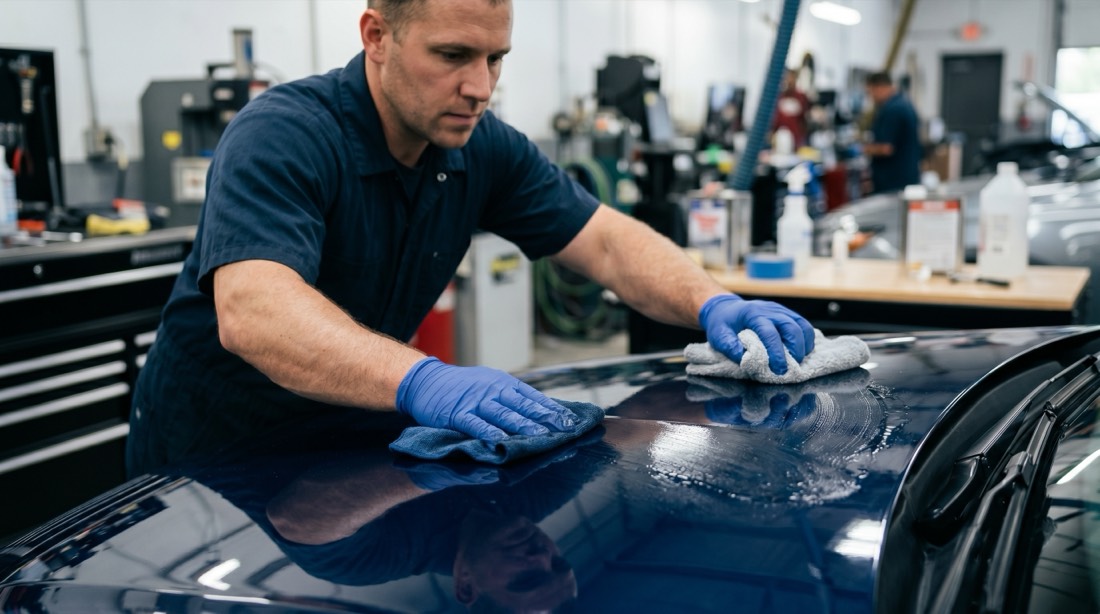
What's tested:
- Substrate identification. Steel, aluminum, galvanized steel, plastic (with sub-types: TPO, PP, PUR, PC, ABS), fiberglass, SMC, composite. Each substrate requires different prep, different primer, different sanding approach.
- Cleaning chemistry. Wax-and-grease remover vs. plastic cleaner vs. isopropyl alcohol. Use the wrong cleaner and you contaminate the surface. Soap and water wash before sanding to remove water-soluble contaminants. Wax-and-grease remover after sanding to remove oils. Tack cloth immediately before paint.
- Sanding grits and sequence. Featheredging starts coarse (80 grit) and steps up. Final pre-paint sand is typically 400 to 500 grit for basecoat, 320 for solvent-based sealer per most TDS.
- Primer selection. Etch primer for bare metal (acid-etch single-component), epoxy primer for corrosion protection and adhesion to multiple substrates, urethane primer-surfacer for filling and sandable build, sealer (non-sandable) for color foundation.
- Masking. Reverse masking, edge sealing, back-masking for blends. The order of masking matters because it affects how the paint edge transitions.
- Featheredging. A proper feather edge tapers through each layer of paint, primer, sealer, e-coat, and bare metal so the new coat has something to grip without a visible step.
- Plastic prep specifics. Identify the polymer (look for the ISO symbol stamped on the back), flame-treat or apply adhesion promoter on polyolefins (PP, TPO, PE), add flex additive to clearcoat on flexible substrates.
The trap: plastic prep questions. Plastic must be cleaned with a plastic-specific cleaner (NOT lacquer thinner or general alcohol that may attack the substrate), then prepared with an adhesion promoter before primer on polyolefins. The test loves this scenario and the wrong answer always sounds like a shop shortcut.
Key memorization:
- Sanding grit progression: 80 → 180 → 320 → 400 → 500 → 800 to 1000 (clear coat polish or blend area).
- Etch primer: 1-component, for bare steel. Don't use on aluminum (acid attacks the metal).
- Epoxy primer: 2-component, for corrosion protection and broad substrate compatibility.
- Urethane primer-surfacer: high-build, sandable, the workhorse repair primer.
2. Spray Gun Operation and Related Equipment (6 Questions, 11%)
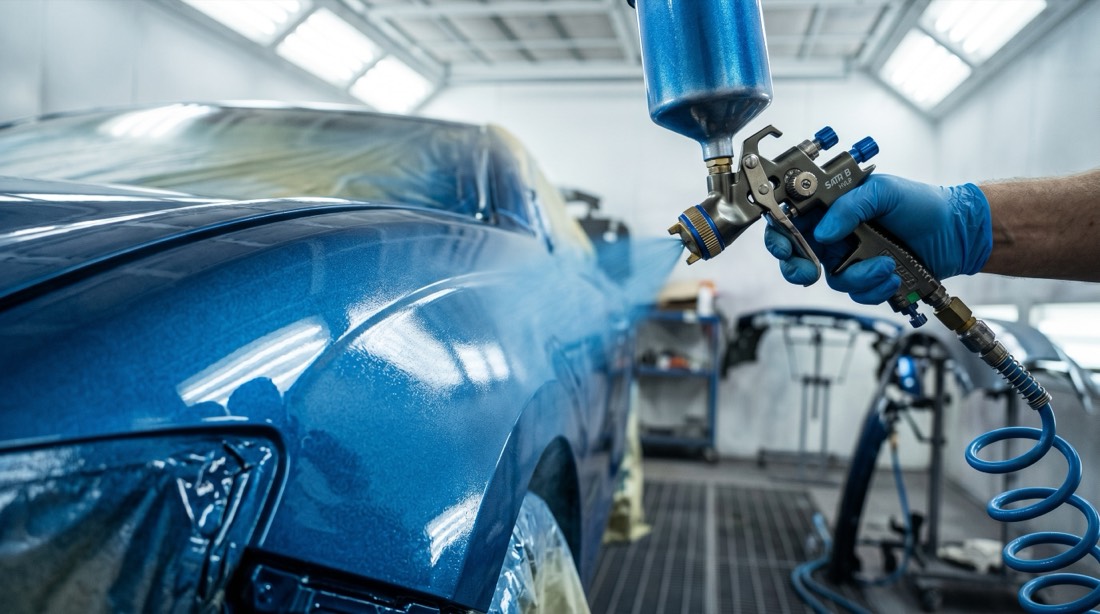
Smallest substantive section but easy points if you know your gun.
- HVLP vs. RP vs. conventional. HVLP (high-volume, low-pressure) is the dominant modern standard. Caps at 10 PSI at the cap. RP (Reduced Pressure) runs slightly higher cap pressure with better transfer efficiency on clearcoat. Conventional is legacy and rarely the right answer on a modern test unless the question specifically asks about an older system.
- Air pressure adjustment. Always read pressure at the gun, not at the regulator. Hose length and diameter affect delivered pressure. Adding hose length adds pressure loss (roughly 1 PSI per 25 feet for typical 3/8 inch hose).
- Fluid tip selection. Smaller (1.2 to 1.3 mm) for basecoats and clearcoats, larger (1.4 to 1.6 mm) for primers, even larger for sealers and primer-surfacers. A 1.8 mm tip paired with basecoat is wrong.
- Spray pattern adjustment. Fan air, fluid control, and air pressure interact. Know which knob controls what (fan width, material flow, atomization quality).
- Gun cleaning. Solvent type matters. Don't use old reducer. Use a dedicated gun wash. Clean the air cap and tip every cleaning. Don't soak gaskets in lacquer thinner overnight, even on solvent-resistant modern seals.
The trap: conversion math. The test gives you a desired cap pressure and asks what the inlet pressure should be given a hose length. Or vice versa. Practice the arithmetic so you're not setting up the equation at the exam.
3. Paint Mixing, Matching, and Applying (15 Questions, 27%)
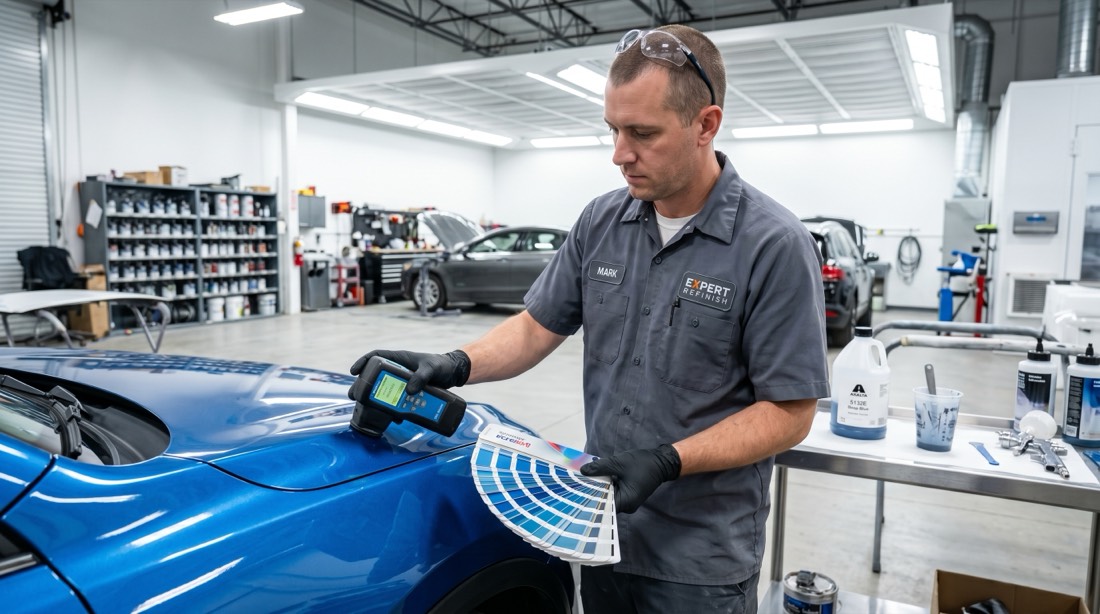
The biggest section. This is where you pass or fail the ASE B2.
What's tested:
- Mixing ratios. Reading a TDS (Technical Data Sheet) and mixing 4:1:1 (or whatever the product calls for). The test will ask quantity calculations. "How much hardener for 16 ounces of base?"
- Color matching theory. Tinting toward light or dark, warm or cool, red, green, yellow, blue shifts. Understanding which tint pulls a panel toward the target color.
- Spectrophotometer use. Modern color matching uses camera or spectrophotometer readings. The test asks about properly cleaning the panel before reading, multiple reading locations, and software interpretation.
- Blendable basecoats. Three-stage paints (basecoat plus pearl midcoat plus clear) require specific application sequences. Skipping or reversing layers gives the wrong shade.
- Application technique. Distance (typically 6 to 8 inches), overlap (50% standard for solid colors, 75% for high-metallic finishes), pass speed, number of coats.
- Pot life. Once activator hits the mix, the clock starts. Most modern clears run 2 to 4 hours of pot life at 70°F. Hotter booth equals shorter pot life.
- Reducer selection by temperature. Fast reducer for cold booths (under 65°F), medium for normal (65 to 80°F), slow for hot (80°F+). Mismatch causes mottling, dry spray, or solvent pop.
The trap: calculation questions.
A paint requires a 4:1:1 mix ratio. You need 32 ounces of ready-to-spray material. How much basecoat, hardener, and reducer do you mix?
Setup: 4 + 1 + 1 = 6 parts. 32 / 6 = 5.33 ounces per part. So 21.3 ounces basecoat, 5.33 ounces hardener, 5.33 ounces reducer.
Practice these calculations before the test. Don't let arithmetic eat your time budget.
4. Solving Paint Application Problems (8 Questions, 15%)
The "what went wrong and how do you fix it" section.
Defects you must identify by description:
- Fisheyes. Silicone contamination. Cause: contaminated surface or contaminated air supply. Cure: clean panel with the recommended wax/grease remover, check air supply filters, eliminate the silicone source. Fisheye eliminator is a band-aid, not a fix.
- Orange peel. Texture from atomization or flow-out issues. Causes: gun too far away, fluid too low, reducer too fast for booth temp, viscosity too high.
- Mottling / tiger striping. Metallic flakes bunching unevenly. Causes: insufficient flash time between coats, gun distance too close, wet basecoats trapping flakes, wrong overlap.
- Dry spray. Particles drying before hitting the panel. Causes: gun too far away, air pressure too high, reducer too fast, ambient temp too high.
- Runs and sags. Too much material applied at once. Causes: gun too close, gun too slow, too much overlap.
- Solvent popping. Trapped solvents bursting through the clear coat as they finish evaporating. Causes: insufficient flash time between coats, baking too soon after final coat.
- Wrinkling / lifting. Solvent in the new coat attacking the previous coat. Causes: incompatible products, recoating outside the recoat window, insufficient cure.
Key skill: match symptom to cause to cure. The ASE B2 gives you a symptom description and asks for the most likely cause OR the proper cure.
The diagnostic shortcut: every application problem comes back to one of four variables. Air, paint, gun, painter. If you can name which variable is off, you can pick the right answer.
5. Finish Defects, Causes, and Cures (6 Questions, 11%)
Post-cure defects. Things that show up after the paint has dried.
- Solvent pop (post-cure version). Can appear hours or days after spraying as solvents finish evaporating. Sand flat and respray.
- Die-back. Loss of gloss over time. Cause: improper hardener ratio, insufficient cure, contamination, or solvent trapped in the film.
- Color match drift. Color looks right when wet, wrong when dry. Often due to metallic orientation or wet-on-dry application differences. The "wet eye" trick of the experienced painter catches this before the panel dries.
- Dirt nibs and fisheye craters. From contamination during application. Repair: nib file, sand, polish if minor. Respray if major.
- Adhesion failures. Paint peeling, often at edges or in stress points. Causes: bad prep, contaminated substrate, incompatible primer, missed sanding step.
- Cracking and checking. Film too thick, too many coats, incompatible products, flexible part without flex additive.
- Blushing. Milky finish on humid days, mostly lacquer-type finishes. Cure: slow reducer or retarder, control booth humidity.
- Bleeding. Old dark substrate bleeding pigment through new color. Cure: bleed-blocking sealer or primer.
Repair vs. respray decisions are common test items. Minor surface defects (nibs, light orange peel) can be polished out. Structural defects (mottling, adhesion issues, solvent pop in the film) require respray.
6. Safety Precautions (5 Questions, 9%)
Smallest section. Don't over-study but don't skip.
- Respirator selection. Isocyanate-containing materials (most modern 2K urethanes, clears, primers) require supplied-air respirators, not just charcoal cartridge half-masks. This is a guaranteed test question.
- Booth airflow. Downdraft (cleanest, ideal for metallics), semi-downdraft, crossdraft (older, more overspray drift). Each has different particulate behavior.
- SDS (Safety Data Sheets, formerly MSDS). 16-section OSHA standard. Know which section covers first-aid, exposure limits, PPE.
- Waste handling. Hazardous waste manifests, solvent recovery, RCRA classifications. Used solvent, paint sludge, contaminated rags are hazardous waste. Never down the drain.
- Fire safety. Spray booths are Class I, Division 1 locations. Solvents stored in UL-listed flammable cabinets.
Shop Habits vs. Test Answers on the ASE B2
The pattern across all six categories: ASE rewards the textbook-proper answer, not the shop shortcut.
| ❌ Shop Habit | ✅ Test-Correct Answer |
|---|---|
| "Sand it with 220 and shoot sealer." | Refine to 320 before sealer for solvent-based systems. |
| "Just add fisheye eliminator." | Identify and remove the silicone source. Eliminator is a band-aid. |
| "Eyeball the mix." | Mix to the published TDS ratio with a measuring stick or scale. |
| "Same fluid tip for everything." | 1.2-1.3 mm for base/clear, 1.4-1.6 mm for primer, larger for sealer. |
| "Half-mask is fine for one panel." | Supplied-air respirator for any isocyanate-containing material. |
| "Force-dry hot to get it out the door." | Honor the flash and bake schedule. Forcing it causes die-back and solvent pop. |
| "50% overlap on everything." | 50% for solid colors, 75% for high-metallic finishes. |
| "Same reducer year-round." | Match reducer to booth temperature: fast for cold, slow for hot. |
Your Optimized Study Plan
Based on the question weights:
- Drill Surface Preparation (27%). Spend 27% of study time here.
- Drill Paint Mixing & Color Matching (27%). Spend 27% of study time here.
- Drill Solving Application Problems (15%). Spend 16% of study time here.
- Drill Finish Defects (11%). Spend 12% of study time here.
- Drill Spray Gun Operation (11%). Spend 11% of study time here.
- Brief review of Safety Precautions (9%). Spend 7% of study time here.
That's a math-based study plan. Most techs accidentally invert it. They spend the most time on what feels comfortable instead of what carries the most weight. Don't be that tech.
If you have 30 hours of study time available, that math translates to:
- 8 hours on Surface Preparation.
- 8 hours on Paint Mixing, Matching, and Applying.
- 5 hours on Solving Application Problems.
- 3.5 hours on Finish Defects.
- 3.5 hours on Spray Gun Operation.
- 2 hours on Safety Precautions.
A 30-Day Study Drill Schedule
Days 1 to 5: take a full 65-question diagnostic on the simulator. Note your weakest 3 categories.
Days 6 to 14: drill the big three categories (Surface Prep, Mixing, Application Problems) in 50-question sets, every other day.
Days 15 to 21: add Finish Defects and Spray Gun drills on alternate days. Build a flashcard deck for defect-cause-cure pairings.
Days 22 to 26: take three full 65-question timed simulations. No looking up answers. Review every miss.
Days 27 to 29: safety review, recap of mixing calculation drills, run one more timed simulation.
Day 30: light flashcards. Sleep. Show up rested.
Practice With Category-Level Analytics
The whole point of breaking down the test by category is so you can practice strategically. Generic practice tests don't tell you "you're weak in mixing ratios but strong in masking." You need a simulator that gives you category-level performance data.
After each practice test, look at your weakest 3 categories. Drill them. Take another test. Repeat. Your weak areas climb the rankings until everything's above 85%. Then schedule the real test.
Don't study the ASE B2 like it's one giant subject. It's six subjects with different weights. Study like the test is structured.
Color-Matching Worked Example
Color matching shows up under Paint Mixing, Matching, and Applying. Here's a representative scenario the ASE B2 might describe.
A painter is matching a metallic silver on a 2022 vehicle. The let-down panel comes out slightly darker than the existing finish. The MOST appropriate corrective action is:
The pattern: when the test asks you to "lighten a dark metallic," the answer involves more reducer, slightly more distance, or slightly higher air pressure. When it asks you to "darken a light metallic," the answer involves less reducer, less distance, or lower air pressure. Memorize the direction of each variable.
Spray Gun Math Practice
The ASE B2 sneaks in equipment-math questions like this:
A painter's gun requires 10 PSI at the cap. The shop supplies air through a 50-foot, 3/8 inch ID hose. The regulator pressure should be set to approximately:
Practice five or ten of these conversion problems before test day. The arithmetic isn't hard but the setup eats time if you're working it out from scratch under pressure.
Defect Cause-and-Cure Flashcard Deck
A focused flashcard deck for the Application Problems and Finish Defects categories pays off harder than almost any other study tactic. Build a deck where the front is the defect name and the back is cause + cure.
- Fisheyes: silicone contamination, clean source.
- Orange peel: atomization or flow-out issue, adjust air pressure or fluid tip.
- Mottling: flash time, overlap, gun distance.
- Dry spray: gun too far, pressure too high, reducer too fast.
- Runs / sags: too much material, gun too close, too slow travel.
- Solvent pop: insufficient flash before stacking, force-dry too soon.
- Wrinkling / lifting: solvent attacking previous coat, incompatible products.
- Die-back: improper hardener ratio, insufficient cure, contamination.
- Adhesion failure: bad prep, contaminated substrate, wrong primer.
- Cracking: film too thick, missing flex additive on flexible parts.
- Blushing: trapped moisture, use slow reducer or retarder.
- Bleeding: dark substrate, use bleed-blocking sealer.
Run the deck both directions until you can name every cause-and-cure pairing in under 5 seconds.
What "Above 85%" on the Simulator Actually Means
When I tell students "drill until you're above 85% on every category," the real target is more specific than that.
- Single-run 85% is encouraging but not enough. You can hit 85% on a lucky run.
- Three consecutive runs at 85%+ across all six categories is the bar. That demonstrates you're not getting lucky.
- A timed full-length simulation at 85%+ overall, with no single category below 70%, is the green light to schedule the real test.
Anything below that and you've still got study to do. The simulator's pass-probability score is built specifically to weight your category scores against the real exam's category distribution.
Choose Your ASE B2 Access
One-time payment. No subscriptions and no recurring fees, ever.
- Prometric-style exam simulator
- 1000+ practice questions
- Digital flashcards
- Weakness drills
- Web or mobile access
- Everything in Simulator Access
- Full ASE Academy lesson course
- Step-by-step guided study path
- Hands-on labs and key-term training
The Simulator and the Simulator + ASE Academy bundle are both available now. All sales are final.

Discussion
Join the discussion — sign in to comment.
Comments are reserved for registered students and technicians. Your name will be pulled from your profile automatically.
Log In Register