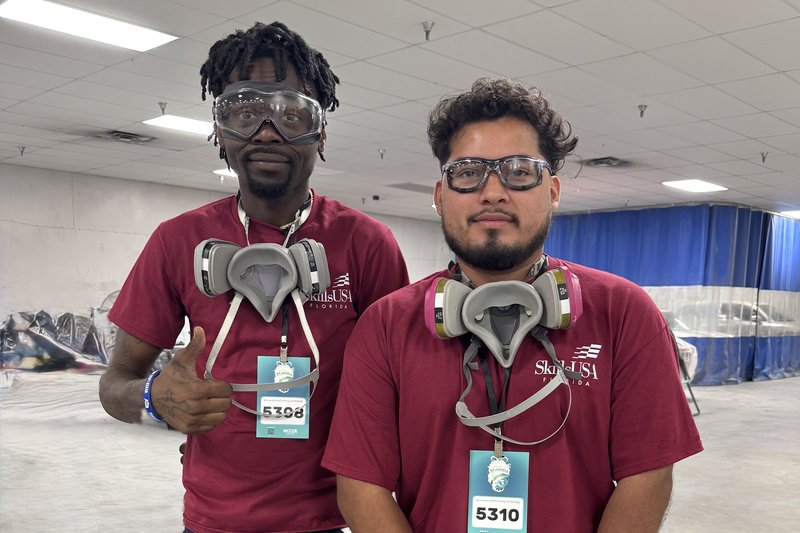
Why These Questions Match the Contest
Every SkillsUSA collision technical standard has a Knowledge Performance section that says where the contest's written test comes from. For Collision Repair Technology, it names the ASE content areas by name:
“preparation, outer body panel repairs, replacements and adjustments, metal finishing and body filling, glass and hardware, welding, cutting and removal, and plastic repair”
SkillsUSA Collision Repair Technology technical standard, Knowledge Performance
Those are the same content areas the ASE B3 Non-Structural Analysis and Damage Repair test is built on, because both come from the same ASE task list. So this practice test is not a loose match to the contest. It is drawn from the areas the standard itself names, 6 of them, spread evenly:
| Content area | Questions here |
|---|
| Preparation | 9 |
| Outer Body Panel Repairs, Replacements, and Adjustments | 9 |
| Metal Finishing and Body Filling | 8 |
| Glass and Hardware | 8 |
| Welding, Cutting, and Removal | 8 |
| Plastic Repair | 8 |
50 questions
Answers and explanations
No sign-up needed
Updated 2026-10-18

Written by Mr. Hernandez Collision Repair Instructor at Sheridan Technical College and a SkillsUSA advisor who has coached competitors to regional and state wins. About the instructor
What This Does Not Cover
Being straight with competitors matters more than a bigger claim. This practice test covers the technical knowledge half of the contest only. It does not prepare you for:
The SkillsUSA Professional Development Test, which every competitor also takes and which is about the SkillsUSA Framework, employability and leadership, not collision work. The skill performance stations, which are hands-on and are judged in the shop. The interview and resume, which carry real points in this contest.
Ask your advisor for the current technical standard on SkillsUSA Pathful and read the whole scoring breakdown before contest day. The knowledge test is points you can bank with study, which is exactly what this page is for.
Preparation · Question 1
For two-sided repairs on Thermoplastic Olefin (TPO) exterior cladding, the reinforcement tape backing is attached using:
- AA laminate material
- BA plastic filler
- CA cyanoacrylate (CA glue)
- DA plastic repair adhesive
Show the answer
Correct answer: D. A plastic repair adhesive
For two-sided repairs on TPO exterior cladding, which is a polyolefin thermoplastic, the reinforcement tape backing is attached to the backside using an appropriate plastic repair adhesive. The adhesive bonds the backing to the cleaned and abraded backside surface and holds it in position to support the front-side repair. Answer A is incorrect because a laminate is a material description rather than an attachment method, so it does not identify how the tape is bonded to the backside. Answer B is incorrect because plastic filler is a front-side surfacing product for leveling and contouring, not a bonding agent for attaching backing. Answer C is incorrect because cyanoacrylate or CA glue is used only to temporarily tack torn edges, not as a permanent backing adhesive.
Outer Body Panel Repairs, Replacements, and Adjustments · Question 2
What is the correct practice when heating an aluminum panel to remove a dent?
- Ause a serrated dolly while heating the panel
- Bmonitor the temperature of the panel
- Creach the annealing temperature before working the metal
- Dheat the metal until it glows a dull red
Show the answer
Correct answer: B. monitor the temperature of the panel
When heating an aluminum panel to remove a dent, the source states that the panel's temperature should be monitored, which is the correct practice. Answer A is incorrect because using a serrated dolly is a tool detail the source does not address in connection with heating aluminum. Answer C is incorrect because reaching the annealing temperature is a specific target the source does not establish as the correct benchmark. Answer D is incorrect because heating the metal until it glows a dull red is a specific target the source does not establish as correct.
Metal Finishing and Body Filling · Question 3
During hot shrinking, why must the technician wait until the heated spot turns black before quenching it with a water sponge?
- ABecause quenching while red hot speeds up the shrinking process
- BBecause quenching while the metal is still red hot is incorrect and must be avoided
- CBecause the water sponge must first be heated to match the panel temperature
- DBecause the panel must cool naturally for at least ten minutes before any water contact
Show the answer
Correct answer: B. Because quenching while the metal is still red hot is incorrect and must be avoided
The procedure requires letting the cherry red spot cool until it turns black before touching it with the water sponge, because quenching while the metal is still red hot is incorrect practice and disturbs the controlled shrink the heat cycle is meant to produce.
Answer A is incorrect because quenching red hot metal is not a shortcut; it is the specific mistake the procedure warns against.
Answer C is incorrect because the sponge is simply wet and cool; there is no requirement to preheat it to panel temperature.
Answer D is incorrect because the process does not call for ten minutes of natural cooling; the visual change from red to black is the cue for quenching.
Glass and Hardware · Question 4
How should sliding sunroof assemblies generally be handled during removal from a vehicle?
- ACut out of the roof with a cutting wheel
- BRemoved as modular assemblies when possible
- CLeft in place during roof skin replacement
- DDisassembled into individual parts before removal
Show the answer
Correct answer: B. Removed as modular assemblies when possible
Sliding sunroof assemblies should generally be removed as modular assemblies when possible because handling the complete unit as one piece simplifies both removal and reinstallation, keeps the internal components aligned, and reduces the risk of damaging the glass, tracks, or drive mechanism. This modular approach also follows typical Original Equipment Manufacturer (OEM) removal sequences. Answer A is incorrect because cutting the assembly out with a cutting wheel would destroy the reusable unit and damage surrounding structure, which is never the intended method. Answer C is incorrect because leaving the sunroof in place during roof skin replacement would obstruct access and prevent proper replacement of the panel, so the assembly must be removed. Answer D is incorrect because disassembling the unit into individual parts before removal is unnecessary, time consuming, and increases the chance of losing or damaging small components.
Welding, Cutting, and Removal · Question 5
How does aluminum welding typically compare to steel welding in terms of amperage and heat transfer?
- AHigher amperage is used, and aluminum transfers heat slowly
- BLower amperage and slower heat transfer are used for aluminum
- CThe same amperage is used, with identical heat transfer
- DHigher amperage is used, and aluminum transfers heat quickly
Show the answer
Correct answer: D. Higher amperage is used, and aluminum transfers heat quickly
Welding aluminum typically requires higher amperage than steel because aluminum conducts and transfers heat very quickly, drawing heat away from the weld zone so more heat input is needed to reach and maintain fusion. Matching the fast heat loss with higher amperage is what allows a sound weld. Answer A is incorrect because although it correctly notes higher amperage, it wrongly claims aluminum transfers heat slowly. Answer B is incorrect because it states lower amperage and slower heat transfer, the opposite of aluminum's behavior. Answer C is incorrect because aluminum does not use the same amperage and identical heat transfer as steel.
Plastic Repair · Question 6
Which of the following plastic materials can be classified as a thermoset?
- APE
- BPolypropylene (PP)
- CPolyurethane (PUR)
- DAcrylonitrile Butadiene Styrene (ABS)
Show the answer
Correct answer: C. Polyurethane (PUR)
Thermoset plastics undergo an irreversible cross-linking reaction during curing that permanently sets their molecular structure, and PUR exists in a thermoset form that is common in automotive bumper covers and is the type most technicians encounter, so PUR is the thermoset among the choices and cannot be re-melted, requiring adhesion weld techniques. Answer A is incorrect because PE, polyethylene, is likewise a thermoplastic and not a thermoset. Answer B is incorrect because PP, polypropylene, is a thermoplastic that can be re-melted and reprocessed. Answer D is incorrect because Acrylonitrile Butadiene Styrene (ABS) is a thermoplastic that softens and can be reshaped with heat rather than being permanently cross-linked.
Preparation · Question 7
On which vehicle area is chip-resistant coating NOT typically applied?
- AUnderside of the deck lid (trunk lid)
- BRocker panel lower body sections
- CBottom edge of door panels
- DDoglegs at the front of the rocker panel
Show the answer
Correct answer: A. Underside of the deck lid (trunk lid)
Chip-resistant coating is typically not applied to the underside of the deck lid, because chip-resistant coating is used only in areas exposed to stone chip impacts from the road surface. Doglegs, rocker panels, and door bottoms all face the road and road spray during normal driving, but the underside of a deck lid is not a stone impact zone and is instead treated with anti-corrosion compound or undercoating if any protection is required. Answer B is incorrect because rocker panel lower body sections are prime stone-impact areas that receive chip-resistant coating. Answer C is incorrect because the bottom edges of door panels face road splash and are standard chip-resistant coating zones. Answer D is incorrect because doglegs at the front of the rocker panel are directly exposed to road debris and do receive chip-resistant coating.
Outer Body Panel Repairs, Replacements, and Adjustments · Question 8
Which tool should be used to remove a door trim panel?
- AForked tool
- BElectric knife
- CSlide hammer
- DPneumatic knife
Show the answer
Correct answer: A. Forked tool
A forked tool, also called a trim panel removal tool, is designed to slip behind the panel and pry the retaining clips loose without tearing the panel or breaking the clips. Its forked shape spreads the load so the panel comes off cleanly. Answer B is incorrect because an electric knife is a cutting tool, not a trim removal tool, and would damage the panel. Answer C is incorrect because a slide hammer is used to pull dents or studs, not to remove trim panels. Answer D is incorrect because a pneumatic knife is also a cutting tool that would damage the panel rather than release clips.
Metal Finishing and Body Filling · Question 9
What is the minimum grit sandpaper that should be used when sanding or grinding aluminum?
- A120 grit
- B80 grit
- C36 grit
- D50 grit
Show the answer
Correct answer: B. 80 grit
80 grit is the coarsest, lowest-numbered abrasive that should be used on aluminum because the metal is softer than steel and cannot tolerate the deep scratch pattern that coarser grits leave behind. Grits below 80 dig too aggressively, gouging and tearing the surface and leaving damage that is difficult to sand out. Answer A is incorrect because although 120 grit is safe on aluminum, it is finer than the minimum being asked for, so it is not the lowest grit that should be used. Answer C is incorrect because 36 grit is far too coarse for aluminum and will tear the soft metal. Answer D is incorrect because 50 grit is still coarser than the 80 minimum and would leave scratches too deep for the aluminum to recover from.
Glass and Hardware · Question 10
How is the Society of Automotive Engineers (SAE) grade of a bolt determined from its head markings?
- ACount the slash marks and add five
- BCount the slash marks and add one
- CCount the slash marks and add two
- DCount the slash marks and add three
Show the answer
Correct answer: C. Count the slash marks and add two
The grade equals the number of radial slash marks plus two, so a bolt with three marks is grade five and one with six marks is grade eight. Answer A is incorrect because adding five would make an unmarked bolt grade five rather than grade two. Answer B is incorrect because adding one would make a three-mark bolt grade four, which is not a standard designation. Answer D is incorrect because adding three would overstate every grade.
Welding, Cutting, and Removal · Question 11
A technician notices a float or ball rising inside a vertical tube on the regulator assembly as shielding gas flows. What instrument is this, and what does it measure?
- ADelivery pressure gauge -- outlet pressure in PSI
- BFlow meter -- volumetric flow rate in CFH or LPM
- CHigh-pressure gauge -- total cylinder content remaining
- DVoltage regulator -- heat setting for the wire
Show the answer
Correct answer: B. Flow meter -- volumetric flow rate in CFH or LPM
The instrument with a float or ball that rises inside a vertical tapered tube is a flow meter, also called a rotameter. As shielding gas passes upward through the tube, it lifts the float to a height proportional to the volumetric flow rate, and the technician reads the value at the float against a scale marked in cubic feet per hour, CFH, or liters per minute, LPM. This lets the welder set the exact volume of shielding gas reaching the weld puddle, which is what protects the molten metal from the atmosphere. Answer A is incorrect because a delivery, or working, pressure gauge also uses a needle dial and reports outlet pressure in PSI, not a floating ball indicating volumetric flow. Answer C is incorrect because a high-pressure gauge shows the total contents or tank pressure remaining in the cylinder using a needle dial, not a rising float, and it reports pressure rather than flow. Answer D is incorrect because a voltage regulator is an electrical control on the welding machine that sets heat range for the wire and has nothing to do with a gas tube containing a rising float.
Plastic Repair · Question 12
What is the defining characteristic of a thermoplastic used on a vehicle?
- AIt cannot be repaired by any method
- BIt hardens into a permanent shape and cannot be softened again
- CIt can be heated and reshaped or welded
- DIt is reinforced with glass fibers
Show the answer
Correct answer: C. It can be heated and reshaped or welded
Answer C is correct because a thermoplastic softens when heat is applied and can be remolded, which is what makes hot-air and airless plastic welding possible on these parts. Answer A is incorrect because thermoplastics are among the most repairable materials on the vehicle, by welding or with adhesives. Answer B is incorrect because that describes a thermosetting plastic, which is set permanently during molding. Answer D is incorrect because reinforcement with glass describes some composites and is not what defines a thermoplastic.
Preparation · Question 13
A technician is preparing to refinish a repaired quarter panel. What is the maximum total paint film build allowed to ensure proper adhesion and avoid paint failure?
- A100 mils
- B2 mils
- C12 mils
- D50 mils
Show the answer
Correct answer: C. 12 mils
Total paint film build should be limited to no more than 12 mils to ensure proper adhesion and avoid finish failure. Once buildup climbs beyond 12 mils the accumulated layers are prone to adhesion problems, cracking, chipping, and solvent entrapment, so 12 mils represents the practical maximum a technician should target on a repaired quarter panel. Answer A is incorrect because 100 mils is an extreme overbuild that would virtually guarantee cracking, delamination, and adhesion loss. Answer B is incorrect because 2 mils would be far too thin to provide adequate coverage and protection and does not represent the maximum allowable build. Answer D is incorrect because 50 mils vastly exceeds safe limits and would cause serious finish failures well before reaching that thickness.
Outer Body Panel Repairs, Replacements, and Adjustments · Question 14
What is the correct definition of adhesive failure in a bond joint?
- AThe adhesive experiences partial bonding — one side adheres but the other does not
- BThe adhesive separates from one or both of the bonded substrates at the bonding interface
- CThe adhesive cures properly but cannot withstand the shear load applied to the joint
- DThe adhesive fails to remain intact within itself — it separates through the middle of the adhesive
Show the answer
Correct answer: B. The adhesive separates from one or both of the bonded substrates at the bonding interface
Adhesive failure occurs when the adhesive separates from one or both of the bonded substrates at the bonding interface, typically caused by contaminated or improperly prepared surfaces. This is distinct from cohesive failure, in which the adhesive fails within itself and splits through the middle, leaving residue on both bonded surfaces. Answer A is incorrect because partial bonding on one side is not the definition of adhesive failure; adhesive failure specifically describes separation at the bonding interface. Answer C is incorrect because curing properly but failing under shear load describes a load-capacity issue, not the interface separation that defines adhesive failure. Answer D is incorrect because failing to remain intact within itself and splitting through the middle describes cohesive failure, not adhesive failure.
Metal Finishing and Body Filling · Question 15
How does the Nyloc self-locking nut prevent loosening under vibration?
- ATwo cantilever arms deflect downward and inward, gripping bolt thread with spring force
- BMolded nylon insert of smaller diameter is cut into by bolt — friction resists loosening
- CFormed to geometric ellipse — elliptical shape creates interference on two sides of bolt
- DThin lock nut beneath Nyloc nut — two nuts jam together for friction lock
Show the answer
Correct answer: B. Molded nylon insert of smaller diameter is cut into by bolt — friction resists loosening
'The Nyloc nut has a built-in molded nylon insert made of smaller diameter than the nut's normal thread. As the nut passes over the bolt thread, the bolt thread cuts into the nylon insert, creating a shock- and vibration-proof nut.' The nylon insert is the key — the insert diameter is smaller than the bolt, so the bolt thread must deform the nylon as the nut is tightened. This creates persistent friction (prevailing torque) that resists rotation in both directions. Answer A describes the Aerotight nut (cantilever arms). Answer C describes the Cleveloc nut (elliptical form). Answer D describes the lock nut/jam nut.
Glass and Hardware · Question 16
What is the minimum recommended calibration interval for a torque wrench under normal use conditions?
- AEvery 6 months
- BOnce a year
- CEvery 5 years
- DEvery 3 years
Show the answer
Correct answer: B. Once a year
Industry standards and most manufacturer recommendations call for torque wrench calibration at a minimum of once per year under normal use conditions. Annual calibration keeps the wrench delivering accurate values within tolerance, which is critical for safety-related fasteners such as wheel lug nuts, brake caliper bolts, and structural components. More frequent calibration is advised in high-volume shops or after a wrench is dropped. Answer A is incorrect because every six months is more frequent than the standard minimum, and while acceptable for heavy use it is not the baseline recommended interval. Answer C is incorrect because a five-year interval is far too long and would let calibration drift go undetected. Answer D is incorrect because a three-year interval likewise exceeds the recommended minimum and risks inaccurate torque.
Welding, Cutting, and Removal · Question 17
Which of these is a function of a Gas Tungsten Arc (GTA) remote foot pedal?
- ASetting the filler rod feed speed.
- BAdjusting arc length physically.
- CAdjusting shielding gas flow rate.
- DAdjusting weld current.
Show the answer
Correct answer: D. Adjusting weld current.
Adjusting weld current in real time is the true function of a GTA remote foot pedal. Answer A is incorrect because filler rod feed is done manually by the welder in GTA welding and is not set by the foot pedal. Answer B is incorrect because arc length is controlled by torch-to-work distance, not the pedal. Answer C is incorrect because shielding gas flow rate is set at the flowmeter, not the foot pedal.
Plastic Repair · Question 18
A hot air welder is being used to repair a plastic part requiring long, continuous welds. Which nozzle type should be used?
- Aedge tip
- Bspeed tip
- Ctacking tip
- Dround tip
Show the answer
Correct answer: B. speed tip
A speed tip is the correct nozzle for long, continuous welds on plastic because its design feeds the filler rod and applies heat continuously, letting the technician lay down a steady, uninterrupted bead rather than stopping and starting. Answer A is incorrect because an edge tip is not the documented nozzle for long, continuous welds. Answer C is incorrect because a tacking tip is used for spot tacking, not for producing a long, continuous weld. Answer D is incorrect because a round tip is not the documented choice for this continuous welding task.
Preparation · Question 19
What is the best method for determining how to select an air purifying respirator?
- ADetermining which filters and cartridges are available in the supply cabinet.
- BReferring to Section 8 of the safety data sheet for APR recommendations.
- CChecking only the type of respirators available for use in the workplace.
- DTreating APR selection as a personal choice, since the type of respirator does not matter.
Show the answer
Correct answer: B. Referring to Section 8 of the safety data sheet for APR recommendations.
Referring to Section 8 of the safety data sheet is the best method for selecting an air purifying respirator, because Section 8 covers exposure controls and personal protection and identifies the specific respirator, filter, and cartridge type appropriate for the product's hazards. Answer A is incorrect because choosing from whatever filters and cartridges happen to be in the supply cabinet ignores the specific hazard and can leave the wearer underprotected. Answer C is incorrect because checking only which respirators the workplace has available skips the hazard specific guidance the Safety Data Sheet (SDS) provides. Answer D is incorrect because APR selection is not a personal choice; the respirator type must match the hazard identified for the product.
Outer Body Panel Repairs, Replacements, and Adjustments · Question 20
Which of the following is applied to bare metal in the weld joint area before welding?
- AWeld-through primer
- BPrimer-surfacer
- CEpoxy primer
- DSelf-etching primer
Show the answer
Correct answer: A. Weld-through primer
Weld-through primer is applied to bare metal in the weld joint area before welding. It provides corrosion protection to metal that will be inaccessible after the panels are welded together, and it is formulated to allow welding through it without significant contamination. Answer B is incorrect because primer-surfacer is a finishing primer applied later in the refinishing process, not before welding. Answer C is incorrect because epoxy primer is applied after welding and cleaning, not to bare metal in the joint before welding. Answer D is incorrect because self-etching primer is also a post-weld coating applied after the joint is cleaned, not a weld-through product.
Metal Finishing and Body Filling · Question 21
What are spoons used for in body repair?
- APaintless dent removal
- BIdentifying high and low spots
- CSpring hammering
- DSanding highly formed areas
Show the answer
Correct answer: C. Spring hammering
A spoon is laid across a high spot and struck with a hammer, spreading the blow over its length so the metal is worked down without concentrated marks. Answer A is incorrect because paintless dent removal uses rods and picks working from behind. Answer B is incorrect because a file or guide coat reads the surface. Answer D is incorrect because sanding is done with abrasives on a suitable backing.
Glass and Hardware · Question 22
The first step in the general procedure for diagnosing a vehicle water leak is:
- AA road test
- BA visual inspection
- CA water hose test
- DA water test stand check
Show the answer
Correct answer: B. A visual inspection
The general procedure for diagnosing a vehicle water leak begins with a visual inspection, followed in sequence by a road test, then water test stands, and finally a water hose test if the leak has not yet been located. Answer A is incorrect because the road test follows the visual inspection rather than starting the procedure. Answer C is incorrect because the water hose test is the final step used when earlier methods have not found the leak, not the first step. Answer D is incorrect because a water test stand check comes later in the sequence, after the initial visual inspection.
Welding, Cutting, and Removal · Question 23
What is correct regarding weld-through primer use and post-weld cleanup?
- AWeld-through primer should not be removed once applied
- BExcess weld-through primer should be removed after welding
- CWeld-through primer eliminates the need for any post-weld cleaning
- DWeld-through primer improves adhesion of refinish materials
Show the answer
Correct answer: B. Excess weld-through primer should be removed after welding
Excess weld-through primer should be removed after welding, because leftover primer sitting on the surface can interfere with the adhesion of the subsequent coatings applied over the repair. Weld-through primers are formulated mainly to provide corrosion protection at the weld joint where bare metal would otherwise be exposed. Answer A is incorrect because excess primer should in fact be removed after welding rather than left in place. Answer C is incorrect because weld-through primer does not eliminate the need for post-weld cleaning; normal cleanup is still required. Answer D is incorrect because weld-through primer does not improve adhesion of refinish materials; its role is corrosion protection, not promoting topcoat bond.
Plastic Repair · Question 24
When adjusting door hinges during a door alignment procedure, at what point should the door striker be installed and adjusted?
- AAt the same time as the hinges
- BThe striker is not adjusted during door alignment
- CAfter the hinges have been set
- DBefore removing and aligning the hinges
Show the answer
Correct answer: C. After the hinges have been set
The striker bolt is installed and adjusted after the hinges have been set. In the door alignment procedure the striker is removed at the very start so it cannot interfere with alignment, and only once hinge alignment is complete is the striker reinstalled and adjusted so the door closes smoothly. Answer A is incorrect because striker adjustment is a separate final step, never done simultaneously with hinge setting, since the door must already hang correctly for the striker to be positioned. Answer B is incorrect because striker installation and adjustment is explicitly the closing step of the door alignment procedure, not something outside it. Answer D is incorrect because before alignment the striker is removed, not installed or adjusted, specifically to keep it out of the way.
Preparation · Question 25
Besides International Organization for Standardization (ISO) codes, what other method identifies a part's plastic type?
- ARefer to another part of the same size
- BTest its flexibility against a similar type of plastic
- CRefer to the service information for that vehicle
- DRefer to the owner's manual
Show the answer
Correct answer: C. Refer to the service information for that vehicle
The service information for that vehicle identifies the plastic type, because the vehicle maker documents the material for each part along with its repair procedure. Answer A is incorrect because two parts of similar size are frequently molded from entirely different plastics. Answer B is incorrect because a flex comparison can suggest a stiffness grouping but cannot name the specific plastic. Answer D is incorrect because an owner's manual covers operation and maintenance, not material composition.
Outer Body Panel Repairs, Replacements, and Adjustments · Question 26
At the rear of the vehicle shown, which panel establishes the reference the others are aligned to?
- AWhichever is fitted first
- BThe rear door
- CThe deck lid
- DThe quarter panel
Show the answer
Correct answer: D. The quarter panel
A quarter panel is welded to the body structure, so it is not adjustable the way a bolted panel is. It forms the opening the other panels must meet. Answer A is incorrect because order is determined by what is fixed, not by what happens to be fitted first. Answer B is incorrect because a door is adjustable at its hinges and is brought to the quarter panel. Answer C is incorrect because a deck lid is adjustable at its hinges and latch and is brought to the opening.
Metal Finishing and Body Filling · Question 27
Corrosion protection material should be kept off which of the following?
- AA welded panel joint
- BThe exhaust system
- CA repaired quarter panel
- DThe undercarriage sheet metal
Show the answer
Correct answer: B. The exhaust system
Answer B is correct because the chapter directs the technician to avoid applying corrosion protection materials to the exhaust system, which runs hot enough to burn a coating off and create smoke and odor. Answer A is incorrect because a welded panel joint is precisely where corrosion protection is needed after the factory coating has been disturbed. Answer C is incorrect because a repaired quarter panel is an exposed exterior surface that must have its protection restored. Answer D is incorrect because the undercarriage is the area these materials are meant to protect.
Glass and Hardware · Question 28
A convertible top is producing wind noise while driving. What is the correct first step to resolve the issue?
- AIgnore the noise since all convertible tops make wind noise
- BReplace the entire top assembly without further diagnosis
- CIncrease vehicle speed to mask the noise
- DCheck the manufacturer's procedure for top adjustment
Show the answer
Correct answer: D. Check the manufacturer's procedure for top adjustment
Wind noise from a convertible top indicates the top is not sealing properly against the windshield frame, side rails, or rear window, so the correct first step is to check the manufacturer's procedure for top adjustment, since adjustment may resolve the noise once the source is identified. Answer A is incorrect because wind noise is not inherent to all convertible tops and should never be ignored. Answer B is incorrect because replacing the entire top assembly without first diagnosing and attempting adjustment skips the required diagnostic step and wastes parts and labor. Answer C is incorrect because increasing vehicle speed only masks the symptom and does not address the sealing problem, so it is not a repair procedure at all.
Welding, Cutting, and Removal · Question 29
In Metal Inert Gas (MIG) welding, what determines the proper arc length?
- APenetration
- BArc voltage
- CShielding gas flow
- DWire thickness
Show the answer
Correct answer: B. Arc voltage
Arc voltage determines the proper arc length in MIG welding; a higher arc voltage produces a longer arc and a wider, flatter bead, while a lower arc voltage produces a shorter arc and a narrower, higher-crowned bead. Answer A is incorrect because penetration is a result of the welding parameters, not a control for arc length. Answer C is incorrect because shielding gas flow protects the molten weld pool but does not control arc length. Answer D is incorrect because wire thickness is a consumable selection and a result of process planning, not the control that sets arc length.
Plastic Repair · Question 30
Before reshaping a vinyl-clad urethane foam dash pad with heat, what should the dash pad be soaked with?
- AEnamel reducer
- BWax and grease remover
- CLacquer thinner
- DWater
Show the answer
Correct answer: D. Water
Before reshaping a vinyl-clad urethane foam dash pad with heat, the pad should be soaked with water. The water is absorbed into the foam and helps it hold and regain its shape as heat is applied, and it also protects the vinyl covering from burning or becoming brittle during the reshaping. Answer A is incorrect because enamel reducer is a paint-related solvent that would attack the vinyl and does not help the foam hold its shape. Answer B is incorrect because wax and grease remover is a surface cleaner and provides none of the moisture the foam needs to reshape safely. Answer C is incorrect because lacquer thinner is a harsh solvent that can dissolve or damage the vinyl and foam rather than prepare it for heat.
Preparation · Question 31
What type of socket is characterized by a 6-point, star-shaped pattern?
- AOxygen sensor
- BLug nut
- CFlex joint
- DTorx®
Show the answer
Correct answer: D. Torx®
A Torx socket is the socket defined by a six point star shaped drive pattern, which grips the matching star recess or external star head found on many automotive fasteners. Answer A is incorrect because an oxygen sensor socket is a deep socket with a slot cut for the sensor wiring, not a star pattern tool. Answer B is incorrect because a lug nut socket is a heavy hex socket, often with a protective sleeve, made for wheel lug nuts rather than star shaped fasteners. Answer C is incorrect because a flex joint socket is defined by its pivoting joint that lets it work at an angle, not by a star shaped pattern.
Outer Body Panel Repairs, Replacements, and Adjustments · Question 32
The component that engages the striker and holds the hood in the closed position is the hood:
- Alatch
- Bhinge
- Cadjustable stop
- Dprop rod
Show the answer
Correct answer: A. latch
The hood latch is the primary retention device that engages the striker and holds the hood closed and locked while the vehicle is operating, transferring the holding load into the body so the hood cannot fly open. Answer B is incorrect because the hinges let the hood pivot and attach it to the body, but they do not hold it in the closed position, that is the latch's job. Answer C is incorrect because adjustable stops set the flushness of the closed hood at its corners but do not lock it down against the striker. Answer D is incorrect because the prop rod holds the hood OPEN for service, it does not secure the closed hood.
Metal Finishing and Body Filling · Question 33
What motion should a grinder use to remove coatings from a panel?
- AA tight circular motion
- BNo motion, holding the grinder stationary
- CA side-to-side or sweeping pattern
- DA single straight-line pass only
Show the answer
Correct answer: C. A side-to-side or sweeping pattern
A grinder should be moved in a side-to-side or sweeping pattern when removing coatings so heat and material removal are distributed across the work area rather than concentrated in one spot. This keeps the panel from overheating and from being cut too deeply in one place. Note also that sanding discs are more flexible than grinding discs, which use a heavier, more rigid abrasive matrix. Answer A is incorrect because a tight circular motion concentrates heat and material removal in the center, exactly what the sweeping motion is meant to avoid. Answer B is incorrect because holding the grinder stationary would burn and gouge one spot, quickly overheating and thinning the metal there. Answer D is incorrect because a single straight-line pass does not cover the area evenly and leaves the removal uncontrolled.
Glass and Hardware · Question 34
Vehicle makers commonly publish repair procedures for which of these restraint system components?
- ARestraint system pigtails only
- BRestraint system wiring harnesses
- COnly the airbag control module housing
- DNeither pigtails nor wiring harnesses
Show the answer
Correct answer: B. Restraint system wiring harnesses
Vehicle makers may publish repair procedures for damaged restraint system wiring harnesses, so a technician facing harness damage should look for and follow the maker's specific procedure rather than assume the harness must be replaced outright. Restraint wiring is safety critical, so any approved repair follows a defined process. Answer A is incorrect because pigtails only, being small connector-specific wiring segments, are not the component these published harness repair procedures primarily cover. Answer C is incorrect because coverage is not limited only to the airbag control module housing; the wiring harness itself is addressed. Answer D is incorrect because a repair procedure may in fact exist for wiring harnesses, so saying neither is covered is wrong.
Welding, Cutting, and Removal · Question 35
A torch flame shows a white inner cone with a feathered, fuzzy edge and a light orange outer envelope. Which flame is this?
- AAn oxidizing flame
- BA carburizing flame
- CA neutral flame
- DAn oxygen-only flame
Show the answer
Correct answer: B. A carburizing flame
This is a carburizing flame, also called a reducing flame, produced by an excess of acetylene over oxygen; the unburned acetylene creates the feathered cone edge and the yellowish envelope. Answer A is incorrect because an oxidizing flame comes from excess oxygen and shortens the cone. Answer C is incorrect because a neutral flame has a sharply defined inner cone. Answer D is incorrect because oxygen alone does not burn.
Plastic Repair · Question 36
Why should a plastic welder be allowed to cool before it is put away?
- AThe temperature dial cannot be reset while the tool is warm
- BThe rod will bond to the storage rack
- CThe barrel and tip stay hot enough to cause serious burns
- DThe electrical cord shortens when it is warm
Show the answer
Correct answer: C. The barrel and tip stay hot enough to cause serious burns
Answer C is correct because the barrel and tip get very hot and remain a burn hazard after the work is finished, which is why cooling before storage is required. Answer A is incorrect because settings can be changed at any time and are not the reason for the cooling rule. Answer B is incorrect because the welding rod is a separate consumable and is not what makes a hot tool dangerous to stow. Answer D is incorrect because cords do not change length with temperature in any way that matters here.
Preparation · Question 37
Structural repair on framework and heavy mechanical work calls for which hammer?
- ARubber mallet
- BHeavy duty hammer
- CPlastic tip hammer
- DBall peen hammer
Show the answer
Correct answer: B. Heavy duty hammer
The heavy duty hammer is the tool designated for structural repair on framework and heavy mechanical work, where a high striking force is needed. Its mass is what moves heavy structural material that a panel hammer would not shift. Answer A is incorrect because the rubber mallet is for roughing out panels a steel face would damage and lacks the mass for structural work. Answer C is incorrect because the plastic tip hammer is a non-marring tool for surfaces steel would damage. Answer D is incorrect because the ball peen hammer is the general metalworking hammer for roughing out metal and driving punches and chisels.
Outer Body Panel Repairs, Replacements, and Adjustments · Question 38
What is the correct order of application when using a metal conditioner and a conversion coating on bare metal?
- AMetal conditioner first, then conversion coating
- BBoth products applied at the same time
- CConversion coating first, then metal conditioner
- DThe order does not matter
Show the answer
Correct answer: A. Metal conditioner first, then conversion coating
Metal conditioner is always applied first to clean and etch the bare metal, and the conversion coating follows to deposit the protective phosphate layer that improves primer adhesion and corrosion resistance. Answer B is incorrect because the two products are separate sequential steps with different chemical jobs and are never applied at the same time. Answer C is incorrect because it reverses the required sequence; applying the conversion coating first would leave the metal unprepared and the coating would not bond properly. Answer D is incorrect because the order absolutely matters; the conditioner must prepare the surface before the conversion coating can do its work.
Metal Finishing and Body Filling · Question 39
How are the gouges left in body filler by a cheese grater type file normally removed?
- ABy applying a second coat of filler over the gouges without sanding
- BBy block sanding as part of the normal filler finishing process
- CBy using a grinder set to a coarse 24 grit disc
- DBy leaving them, since they do not affect paint quality
Show the answer
Correct answer: B. By block sanding as part of the normal filler finishing process
The coarse gouges left in body filler by a cheese grater type file are normally removed by block sanding as part of the standard filler finishing progression. The grater file quickly knocks down the rough, semi cured filler, and then progressively finer block sanding levels the surface and erases the grater marks, leaving a smooth contour ready for priming. Answer A is incorrect because applying a second coat of filler over the gouges without sanding buries the rough marks under more material instead of leveling them, producing an uneven surface. Answer C is incorrect because a grinder with a coarse 24 grit disc is too aggressive and would cut new deep scratches rather than smoothly remove the grater marks through normal block sanding. Answer D is incorrect because the gouges do affect paint quality, since they would telegraph through the finish if left unsanded.
Glass and Hardware · Question 40
Which component prevents noise, vibration, and water leaks at door and window openings?
- AWeatherstripping
- BBelt-line molding
- CCladding
- DAppliques
Show the answer
Correct answer: A. Weatherstripping
Weatherstripping is the rubber or foam seal fitted around door and window openings to form an airtight and watertight seal between the moving panel and the body, blocking road and wind noise, damping vibration, and preventing water intrusion into the passenger compartment. Answer B is incorrect because belt-line molding is a decorative trim strip at the window base and does not seal the opening against noise and water. Answer C is incorrect because cladding is decorative body-side trim meant for appearance and impact protection, not sealing openings. Answer D is incorrect because appliques are decorative overlays applied for appearance and do not perform a sealing function.
Welding, Cutting, and Removal · Question 41
During weld bonding, when can spot welds typically be made relative to the adhesive application?
- AOnly before any adhesive is applied
- BOnly after the adhesive has fully cured
- CDuring the adhesive's wet time
- DOnly 24 hours after adhesive application
Show the answer
Correct answer: C. During the adhesive's wet time
During weld bonding, spot welds are typically made during the adhesive's wet time, because welding through the still-workable adhesive is easier than trying to weld through adhesive that has already cured and hardened. Answer A is incorrect because weld bonding combines the adhesive with the welds, so making spot welds only before any adhesive is applied would defeat the purpose. Answer B is incorrect because waiting until the adhesive has fully cured makes welding harder, so spot welds are not delayed until then. Answer D is incorrect because there is no requirement to wait 24 hours after adhesive application to make the spot welds.
Plastic Repair · Question 42
Tech A states that the flexibility of a plastic part may determine the type of welding rod to use.
Tech B states that the flexibility of a plastic part may determine the type of filler to use.
Which technician is correct?
- AB only
- BA only
- CBoth A and B
- DNeither A nor B
Show the answer
Correct answer: C. Both A and B
Welding rod selection requires matching the rod's ISO material code to the part, and flexibility is one characteristic used when an ISO code is unavailable, since a flexible rod is chosen for a flexible part and a rigid rod for a rigid part, which makes Tech A correct. Filler selection is also affected by flexibility, because a rigid filler applied to a flexible part will crack during normal flexing, so flexible plastic filler must be used on flexible substrates, which makes Tech B correct. Because both statements are valid, both technicians are right. Answer A is incorrect because it credits only Tech B and ignores flexibility's role in rod choice. Answer B is incorrect because it credits only Tech A and overlooks flexibility's role in filler choice. Answer D is incorrect because it rejects both technicians even though each point is accurate.
Preparation · Question 43
Which of the following is NOT a reason for using dust extraction equipment?
- ATo dampen sound during repairs
- BTo prevent explosive or flammable dust from igniting
- CTo improve air quality in the work area
- DTo keep equipment, work area, parts, and vehicles clean
Show the answer
Correct answer: A. To dampen sound during repairs
Dust extraction equipment exists to control sanding dust, which keeps the equipment, work area, parts, and vehicles clean, removes explosive or flammable dust before it can ignite, and improves the air technicians breathe. Sound damping is not a purpose of dust extraction. Answer B is incorrect because preventing ignition of combustible dust is a real safety reason for extraction. Answer C is incorrect because improving work area air quality is a legitimate stated purpose of dust extraction systems. Answer D is incorrect because keeping the shop and vehicles clean is a genuine stated reason for using the equipment.
Outer Body Panel Repairs, Replacements, and Adjustments · Question 44
Work hardening of a metal panel occurs when the panel is:
- Apainted with a heat-cured coating.
- Bheated during a collision.
- Cdeformed during a collision.
- Dexposed to moisture over time.
Show the answer
Correct answer: C. deformed during a collision.
Work hardening occurs when a panel is deformed during a collision. The bending, stretching, or flexing of the metal rearranges its grain structure, making the affected area harder and more brittle than the surrounding metal. This is a mechanical effect of the deformation itself, not of heat, moisture, or coatings. Answer A is incorrect because painting with a heat-cured coating does not deform the metal's grain structure and does not cause work hardening. Answer B is incorrect because work hardening is caused by mechanical deformation, not by heat applied during a collision. Answer D is incorrect because exposure to moisture over time leads to corrosion, not work hardening.
Metal Finishing and Body Filling · Question 45
After using glue tabs to pull a dent, what product is used to clean the adhesive residue from the panel?
- AWax and grease remover
- BLacquer thinner
- CRubbing alcohol
- DMineral spirits
Show the answer
Correct answer: C. Rubbing alcohol
Rubbing alcohol is the correct product for cleaning hot-glue adhesive residue from a panel after glue-tab dent pulling, because it breaks down the glue effectively without harming the paint finish underneath. Removing all residue matters so it does not interfere with priming, filling, or refinishing. Answer A is incorrect because wax and grease remover is intended for pre-paint surface decontamination of oils and silicones, not for dissolving hot glue. Answer B is incorrect because lacquer thinner is aggressive enough to attack and damage the existing paint finish. Answer D is incorrect because mineral spirits are not the recommended product for this task and do not reliably dissolve the glue-tab adhesive the way alcohol does.
Glass and Hardware · Question 46
Following a passenger front airbag deployment, what is likely required regarding the instrument panel frame?
- AOnly the airbag module needs replacement, not the frame
- BThe frame may be straightened and reused
- CThe frame may require replacement
- DThe frame does not need inspection
Show the answer
Correct answer: C. The frame may require replacement
The instrument panel frame may require replacement following a passenger front airbag deployment, because the deployment force can damage the frame in ways that make straightening an unsafe repair. A damaged instrument panel frame is generally not a component that should be straightened, so replacement restores the intended strength and mounting integrity. Answer A is incorrect because deployment can damage the frame itself, so replacing only the airbag module while ignoring the frame can leave damage unaddressed. Answer B is incorrect because a damaged instrument panel frame generally should not be straightened and reused after deployment. Answer D is incorrect because the frame does need inspection after a deployment event.
Welding, Cutting, and Removal · Question 47
About how far from an aluminum plug weld hole is the arc started in order to preheat the weld area?
- Athree inches
- Bat the hole's center
- Csix inches
- Dfive eighths inch
Show the answer
Correct answer: D. five eighths inch
Answer D is correct because the procedure calls for starting about five eighths inch from the plug hole so the arc preheats the area before the puddle arrives. Answer A is incorrect because three inches leaves a long stretch of unwanted weld bead on a panel that must be finished flush. Answer B is incorrect because starting cold in the center is exactly the practice that produces poor penetration into the lower plate. Answer C is incorrect because six inches is far outside the prepared and cleaned area, so the arc would run over painted or oxidized metal.
Plastic Repair · Question 48
A polypropylene (PP) bumper on a 2023 Honda CR-V is being force dried. At or above what temperature does Honda say the part may deform?
- A176°F (80°C)
- B212°F (100°C)
- C248°F (120°C)
- D356°F (180°C)
Show the answer
Correct answer: A. 176°F (80°C)
Honda's plastic parts chart lists polypropylene heat resistance at 176°F (80°C); at or above that temperature the part may deform, so force drying stays below it. When the paint maker's data sheet gives a different figure, the lower number is used. Answer B is incorrect because 212°F is higher than Honda's figure and is not in any vehicle maker document. Answer C is incorrect because 248°F is Honda's figure for polycarbonate (PC). Answer D is incorrect because 356°F is Honda's figure for sheet molding compound (SMC).
Preparation · Question 49
Should undercoating be applied to all inner surfaces of a repaired vehicle?
- AYes, but only on the driver's side of the vehicle
- BYes, undercoating must cover every inner surface without exception
- CNo, undercoating should not be applied to all inner surfaces
- DNo, undercoating should not be applied to any inner surface
Show the answer
Correct answer: C. No, undercoating should not be applied to all inner surfaces
Undercoating should not be applied to all inner surfaces because some inner areas must stay uncoated, for example drain holes, moving parts, exhaust heat zones, and surfaces where the manufacturer specifies other materials such as cavity wax, so the technician applies it selectively rather than blanketing every cavity. Answer A is incorrect because it wrongly implies the vehicle side determines application, which has nothing to do with where undercoating belongs. Answer B is incorrect because covering every inner surface without exception would block drains, foul components, and contradict proper selective application. Answer D is incorrect because undercoating is legitimately used on many inner and underbody surfaces, the rule is simply that not all inner surfaces should receive it.
Outer Body Panel Repairs, Replacements, and Adjustments · Question 50
When removing a welded door skin from its hem flange, what tool should be used to separate the skin without causing excessive damage?
- AA cutting tool
- BAn air chisel
- CA pry bar
- DA grinder
Show the answer
Correct answer: D. A grinder
A grinder is the proper tool for removing a welded door skin, used to carefully grind away the edge of the door skin along the hem flange so the skin can be separated without excessive damage to the surrounding structure. Answer A is incorrect because a cutting tool would cause too much damage to the door skin during separation. Answer B is incorrect because an air chisel is not the documented tool for this step and would risk damaging the panel. Answer C is incorrect because a pry bar is not the documented tool for this step and cannot grind away a welded hem flange edge.